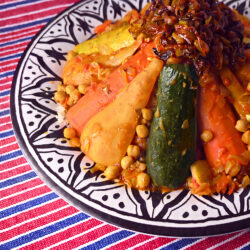
Couscous with Seven Vegetables and Tfaya
Ingredients
Tfaya
- 2 tablespoons neutral oil
- 3 to 4 cups thinly sliced yellow onions about 1 pound
- 1/3 cup golden raisins sultanas
- 1/2 teaspoon ground ginger
- 1/4 teaspoon cinnamon
- 1/4 teaspoon turmeric
- 1/4 teaspoon salt
- 1 tablespoon honey
Vegetables
- 1/2 small green cabbage trimmed
- 2 small zucchini
- 1/2 small pumpkin seeded and peeled
- 1 large carrot peeled
- 1 large parsnip peeled
- 1 large turnip peeled
- 3 tablespoons olive oil
- 1 large yellow onion chopped
- 2 large tomatoes peeled and diced
- 1 tablespoon turmeric
- 1 tablespoon ground ginger
- 1 tablespoon sweet paprika
- 2 teaspoons black pepper
- 1 teaspoon salt
- 1 bunch of parsley tied (see note)
- 4 cups vegetable broth divided
- 1 tablespoon tomato paste
- 1 can chickpeas (garbanzos) rinsed and drained
Couscous
- 2 cups instant couscous
- 2 cups water
- 1 teaspoon salt
- 1 tablespoon olive oil
- cilantro if not serving Tfaya
Instructions
Make the Tfaya
- I make this first because it can take nearly an hour and would be difficult to do simultaneously while preparing the vegetables. Place the oil in a large nonstick skillet over medium heat. Add the sliced onions and stir to coat.
- Meanwhile, put the raisins in a bowl and add warm water to cover.
- After 5-8 minutes, when the onions have started to soften, reduce the heat and stir in the ginger, cinnamon, turmeric, and salt. Cook on medium-low heat, stirring occasionally, until onions get very soft and begin to caramelize — about 15 minutes. Add the honey and stir to distribute. Drain raisins and squeeze out excess water, then add to the onions, and stir.
- Raise the heat to medium and continue to cook for 15-20 minutes, stirring occasionally, until the Tfaya is a golden brown. Set aside, to reheat at serving time.
Prepare the Vegetables
- Place the vegetables in a large bowl of cool water as you finish preparing each, in this order: Keeping the stem end intact, cut the cabbage into four wedges. Trim the zucchini ends, and cut in half lengthwise. Cut the half pumpkin into four wedges. Trim tops and bottoms of carrot and parsnip, then cut in half crosswise, then in half lengthwise. Cut the turnip into 4 wedges. Set aside the vegetables in their bowl of cool water.
- Heat the olive oil in a large pot over medium heat. Add the chopped onions and cook until soft — 5 minutes. Add the chopped tomatoes and continue cooking for 5 minutes until they have broken down. Add the spices (turmeric, ginger, paprika, pepper) and salt; cook 1 minute. Add the tightly tied bouquet of parsley and 1/4 cup of the vegetable broth; cook for 10-15 minutes over medium-low heat, stirring frequently to keep it from sticking. You want to have the flavors blend well.
- Add the tomato paste to the onion/tomato mixture and stir well. Add the remaining broth and bring to a gentle boil.
- Add the hardest vegetables first: carrots and turnips. Stir to cover the vegetables, bring to a brisk simmer, and cover the pot. After 5 minutes, add the parsnips, and cover.
- After 5 minutes more, add the pumpkin; stir gently, cover.
- After 10 minutes, add the zucchini and cabbage, and cover.
- After another 10 minutes, add the chickpeas, cover and cook until heated through — about 1 minute
- Check that all vegetables are tender and broth has thickened a bit. Remove and discard the parsley. Keep the vegetables warm while you make the couscous.
Make the Couscous
- Bring two cups water to a boil. Add couscous, salt, and olive oil; stir to combine.
- Cover tightly, remove from heat and let sit 5 minutes. (While the couscous is steaming, reheat the Tfaya.) Remove cover and fluff couscous.
Assemble the Couscous
- Mound the couscous on a large serving platter. Moisten the couscous with a ladleful or two of the broth, then start arranging the vegetables.
- Begin by putting the cabbage on the top in the center to create a full cone shape, then make alternating radial “stripes” of the other vegetables around the mound of couscous, as seen in the photos. Strain out the chickpeas and scatter over the other vegetables. Top with Tfaya. If not serving it with Tfaya, garnish with chopped cilantro. Serve a bowl of broth on the side.
Notes
Serves 6 to 8. (It will serve up to 10 if preceded by traditional Moroccan Salads.)
Homemade vegetable broth is quite easy. When you trim vegetables, keep all the trimmings in a jar or bag in the freezer. Good scraps to save are: onion/shallot/leek, tomato, carrot, celery, fennel. Make sure you have a good balance of scraps and that it isn’t all onion! When the time comes to make broth, put all the scraps in a saucepan and add water — about half as much more than the amount of broth you need. (If you need 4 cups broth, add 6 cups water). Add some salt, pepper, and herbs (thyme, bay leaf) and additional veggies you might have on hand: carrots, celery, onion, tomato. Bring everything to a boil, then reduce heat and simmer until you reach the amount of broth you need — about 20-30 minutes. Strain and use.
Using a 3-foot (1-meter) piece of kitchen string, tie the parsley stems together then wrap the bunch of parsley in a spiral — it will be easier to remove later.
Here are some other options for vegetables to use in this couscous:
- Double-peeled fava beans can be used in place of the chickpeas.
- Sweet potato or butternut squash is sometimes used instead of pumpkin
- Eggplant appears in some recipes.