
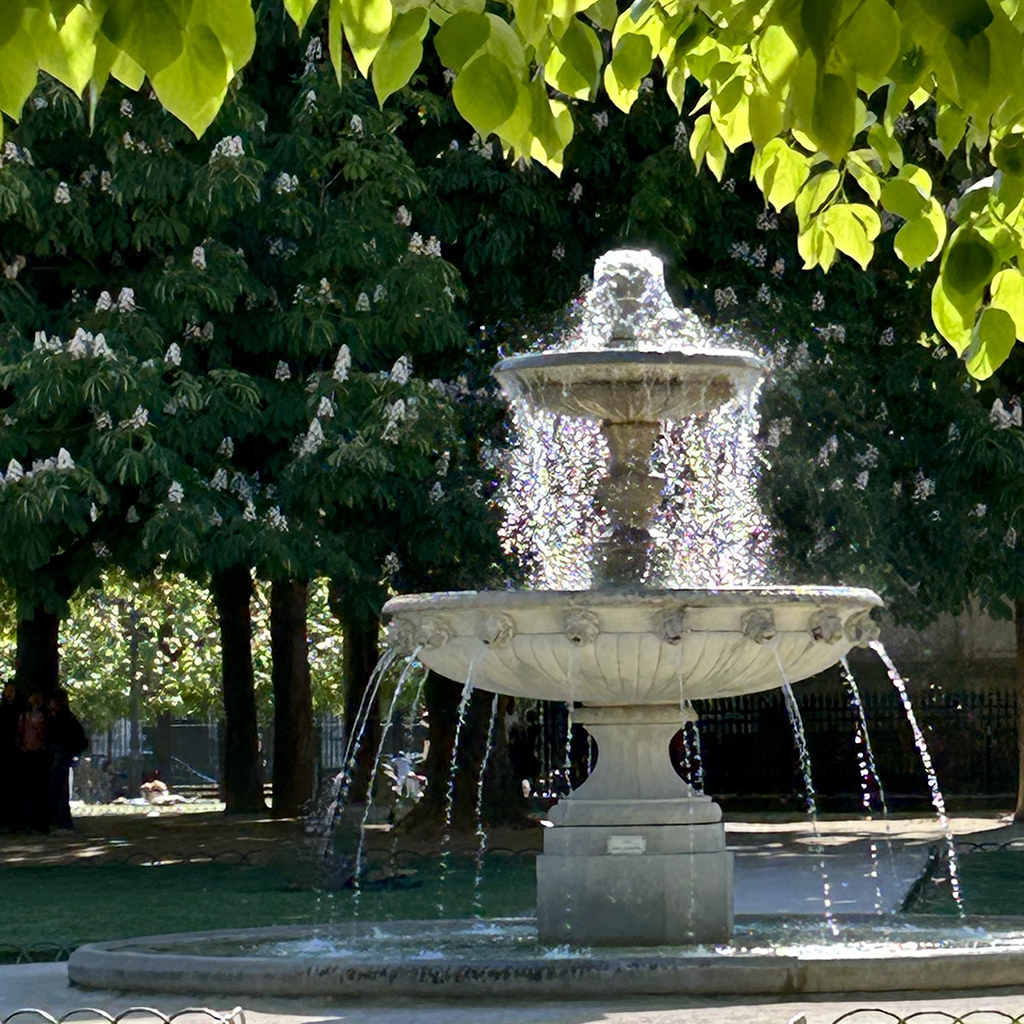
Paris continues to tug at my heartstrings; it always will. Each time I arrive in Paris, I think that I will see many old favorites and be very happy doing so. Naturally, this time we did just that, and some new things too — and we had friends Jennifer and Patrick with us to share the beauty.
Something Old.
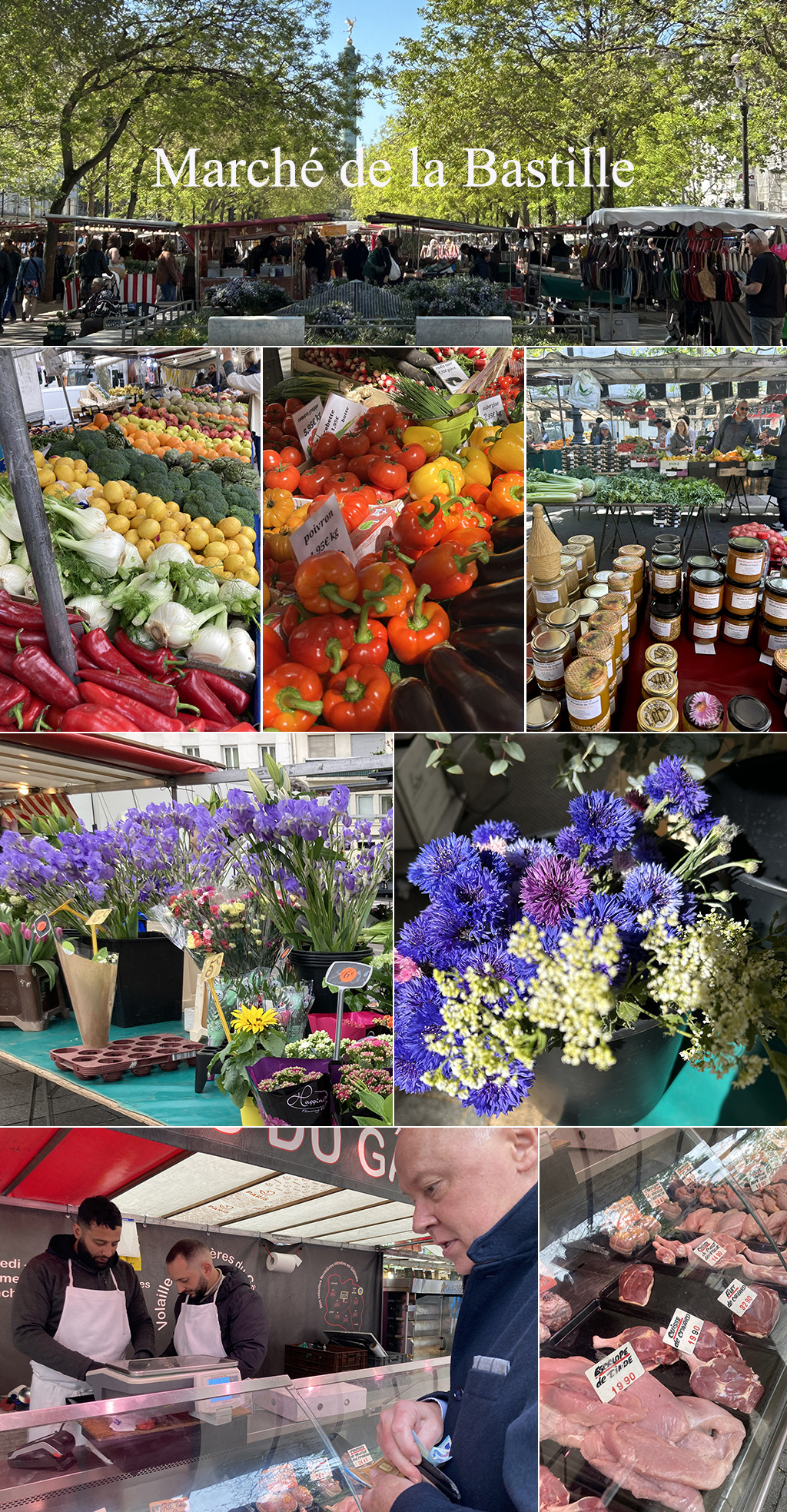
We went to our favorite markets (Marché de la Bastille and Rue de Nil); in the pictures, you can see me focused on shopping and menu planning based on what was available, seasonal, and fresh. The Bastille market is in the central promenade of Boulevard Richard-Lenoir and is several Parisian blocks long. It Is a traditional street market (Thursdays and Sundays) and has everything you need — food, clothing, kitchen gadgets, flowers, and gifts.
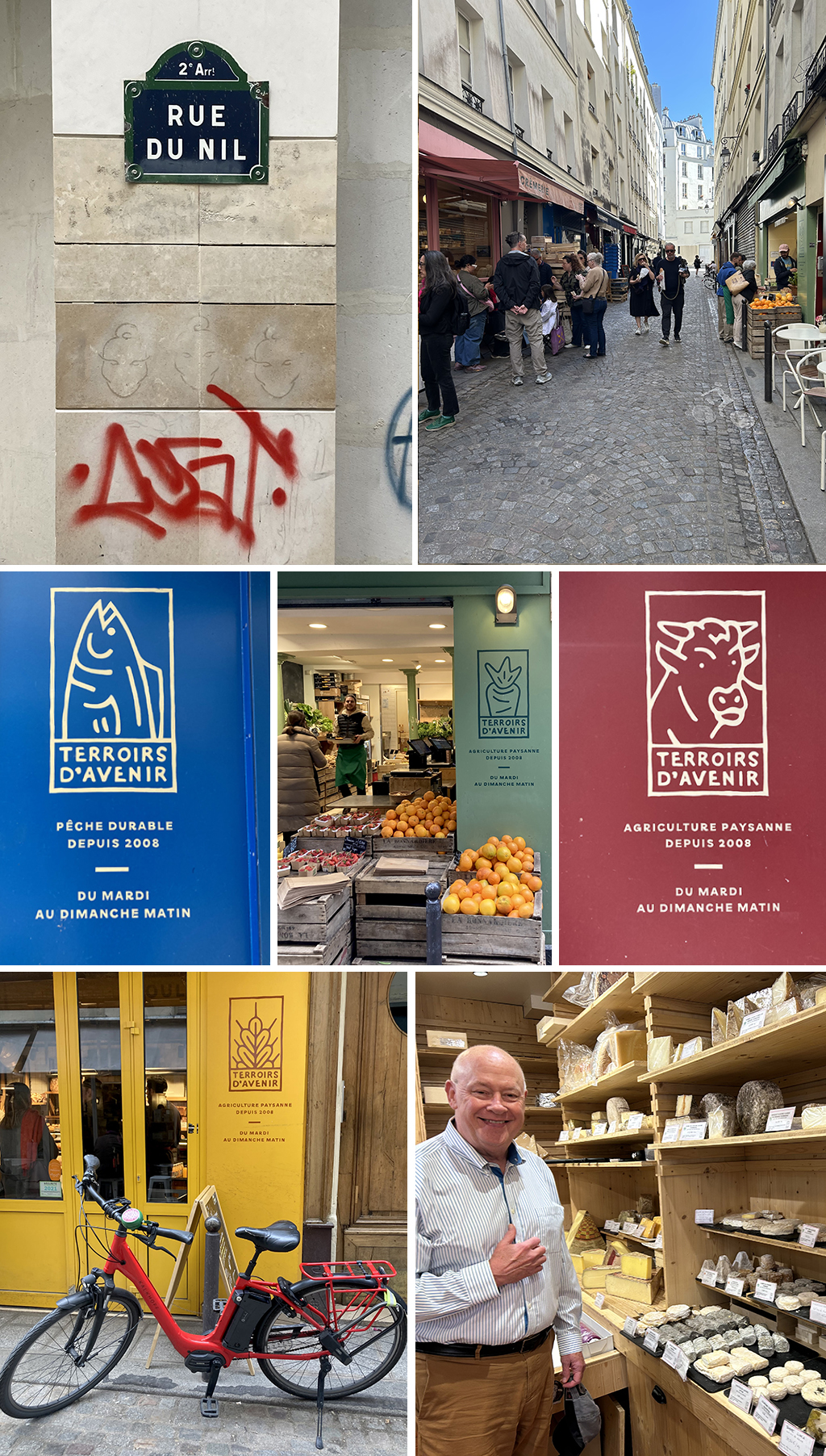
At the other extreme is Rue de Nil — once an entrance to the Cour des Miracles — a tiny street with a Michelin-starred restaurant and a group of shops under the name Terroirs d’Avenir (land of the future). These include a crèmerie, poissonnerie, boucherie, chocolaterie, boulangerie/charcuterie, and premier-epicure (grocer). There is only one of each, but the selection is superior and everything is from organic farms dedicated to sustainable agriculture. We especially enjoyed the crèmerie, where we bought cheeses several times.
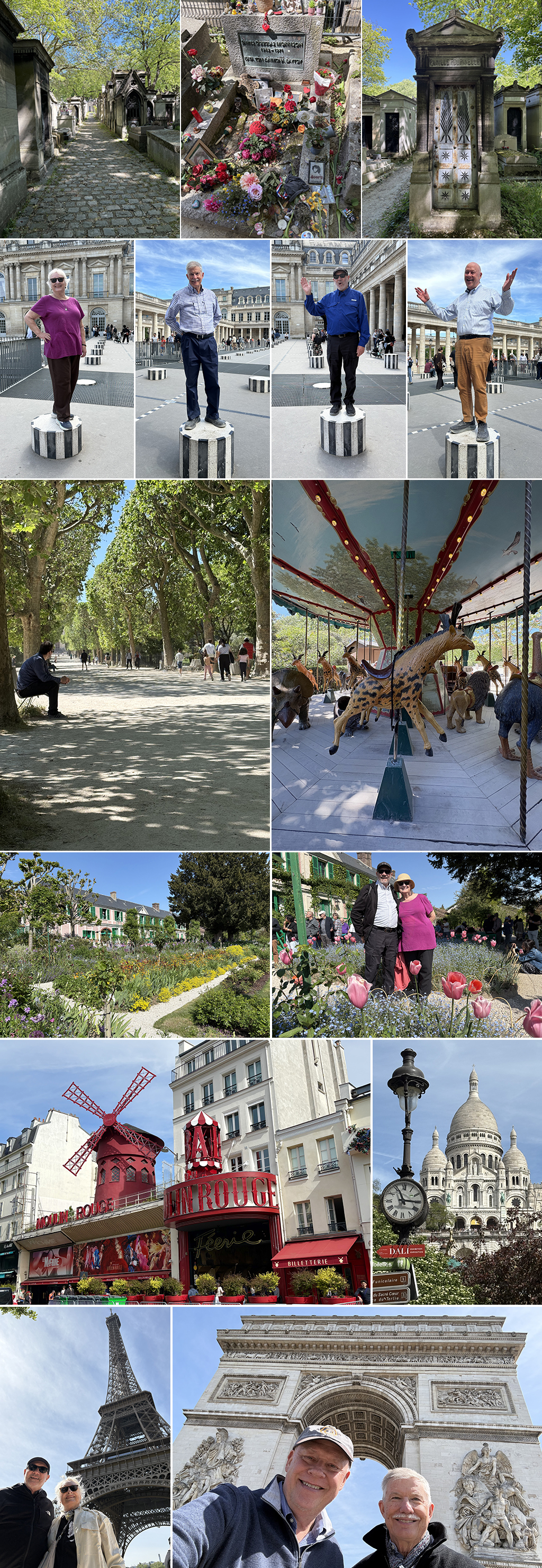
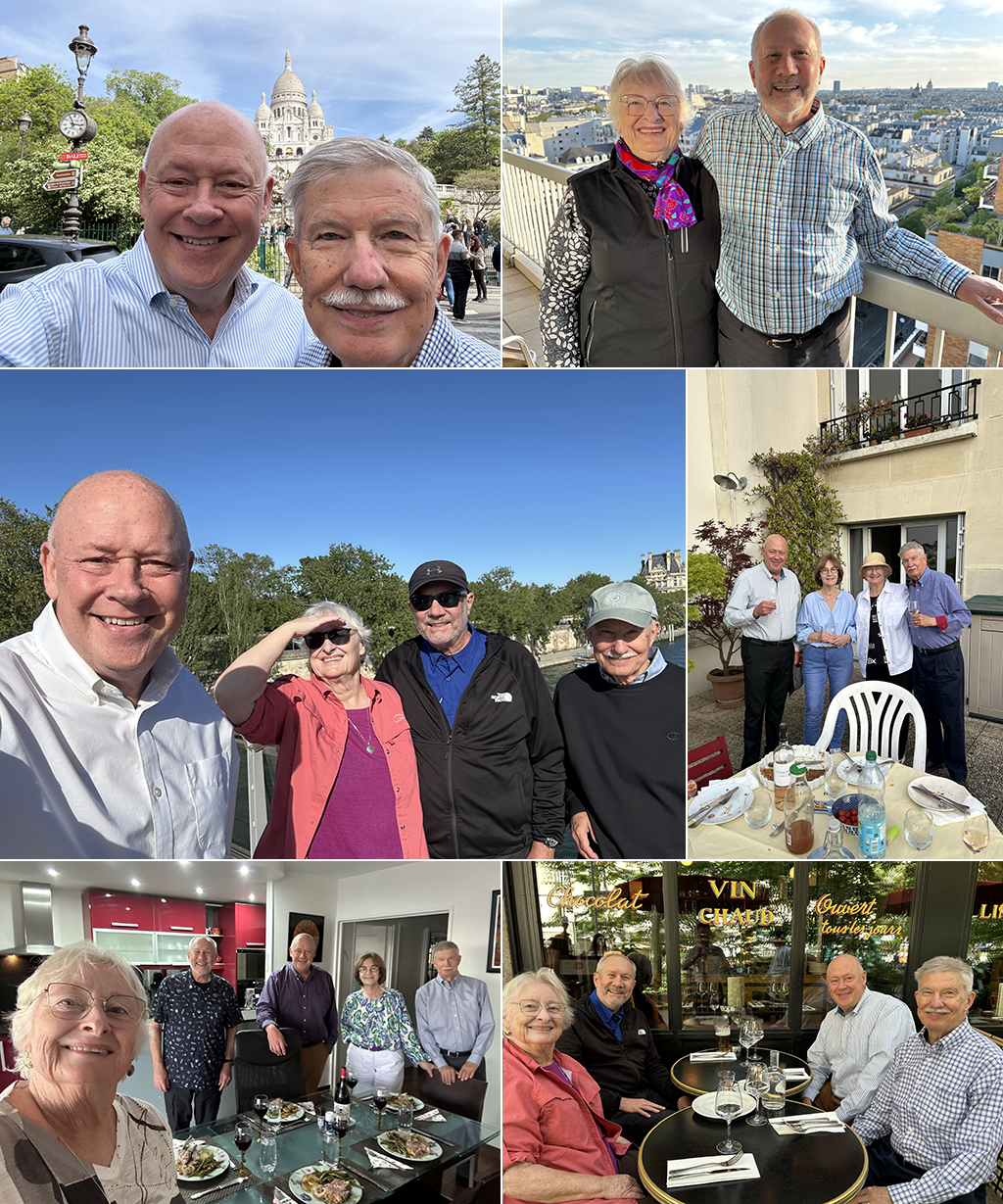
We revisited Père Lachaise Cemetery and, this time, found Jim Morrison. We posed on the Colonnes de Buren at the Palais Royal, strolled through the Jardin des Plantes, braved the crowds at Giverny, rode the funicular up to Montmartre, took selfies below the Tour Eiffel and Arc de Triomphe.
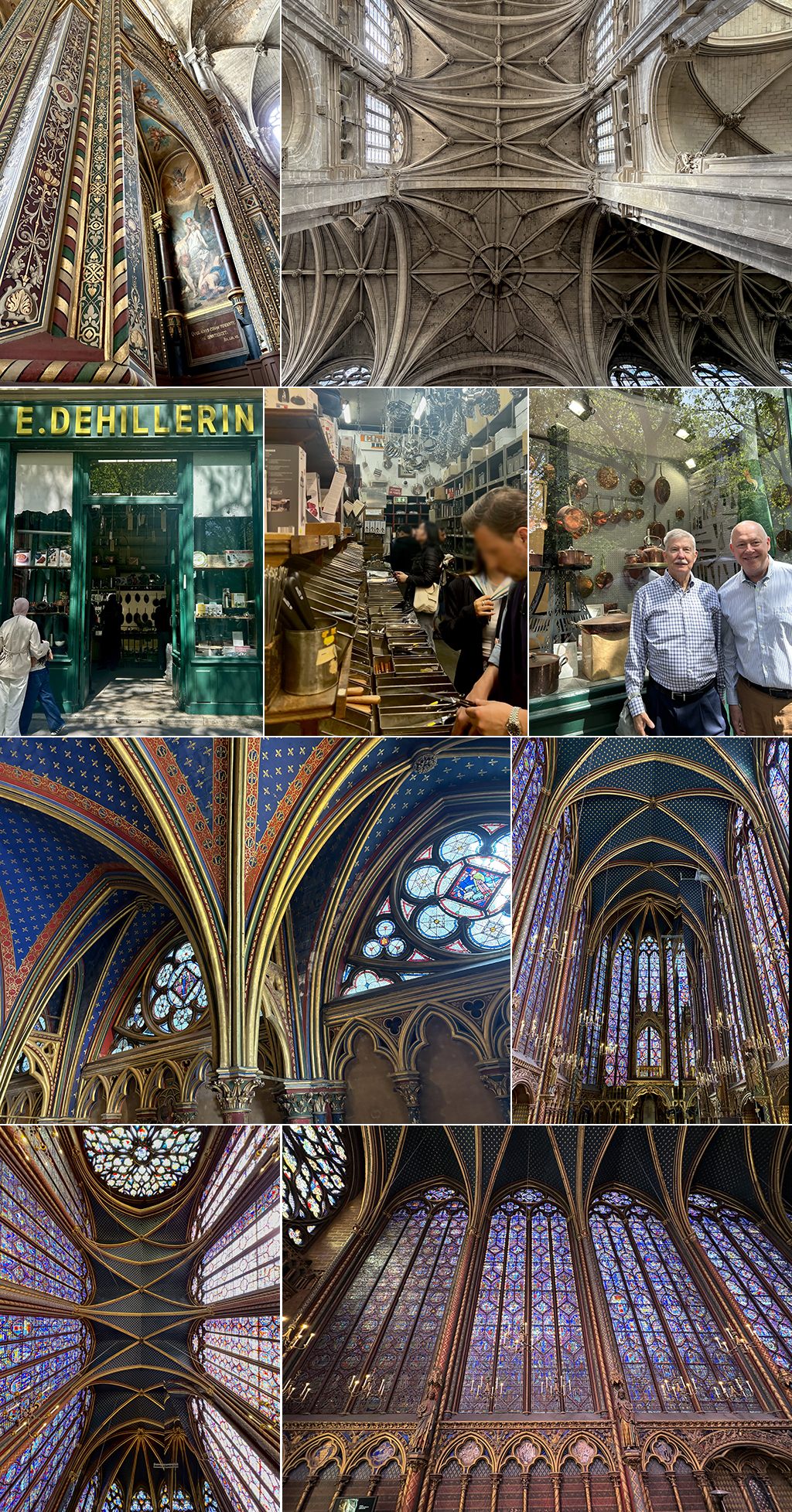
Twice we visited Saint-Eustache and the nearby kitchen supply store, E. Dehillerin (I bought a whisk for my cocoa). We bought timed tickets to visit Sainte-Chapelle and were thrilled that they use the ticketing to limit the number of people inside. We were amazed how they disguised the interior restoration scaffolding in front of one of the great windows using smoke and mirrors, minus the smoke.
And, of course, we gathered with friends — our friend Marie-Lise had us to her home for apéro, and we had her to dinner at our apartment.
Something New.
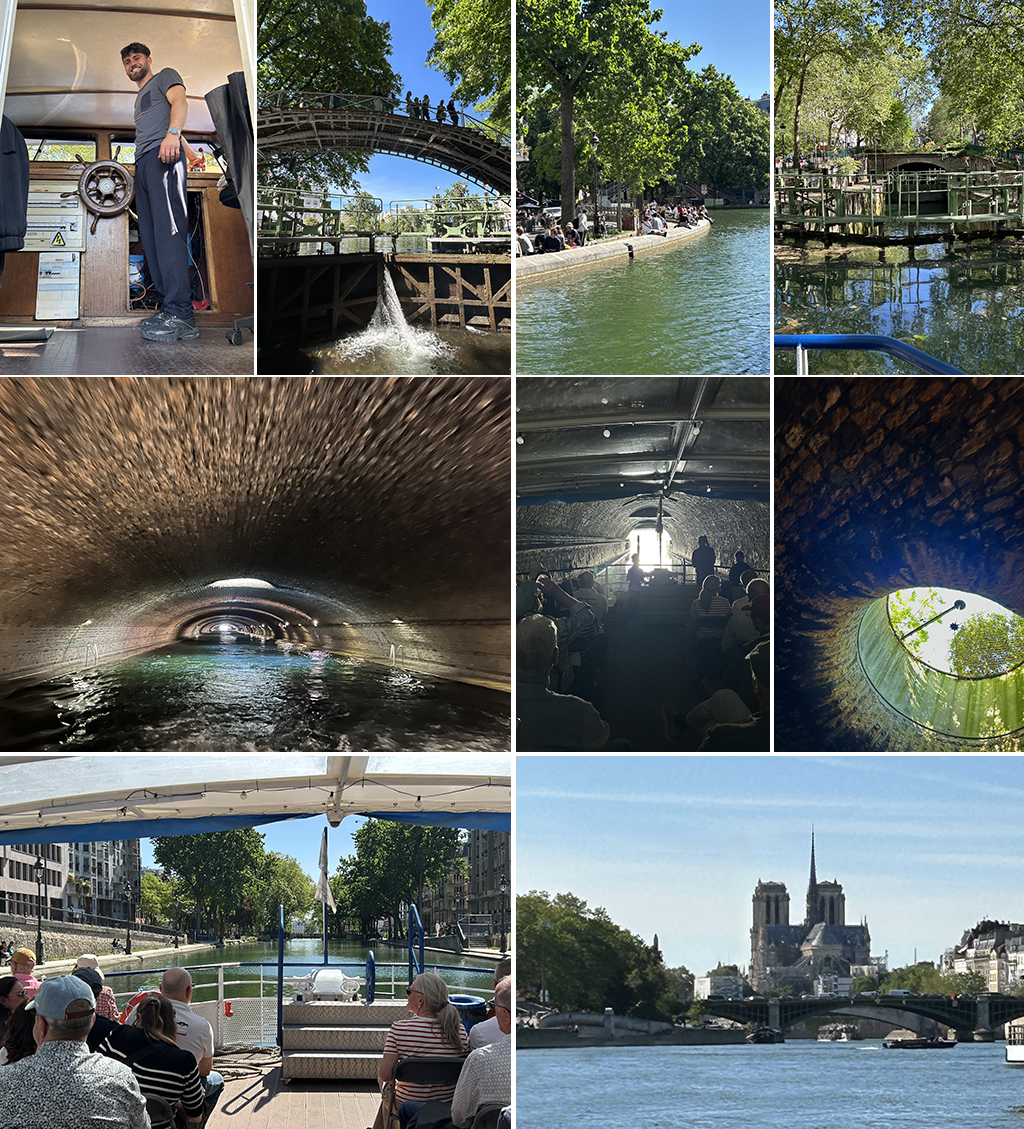
Our friends Jennifer and Pat suggested doing several things new to us. The first was a boat tour. Rather than take the super-crowded Bateau Mouche, we sought out a tour on the Canal Saint-Martin. We picked up the boat at La Villette, on the north side of Paris, where the canal meets the Canal Saint-Denis. The boat puttered south and the narration alternated between French and English, with occasional lapses because the narrator was also our bartender. The weather was glorious and the banks were draped with people sunning themselves, picnicking, reading, and strolling. The tender spring foliage of the chestnut, linden, and sycamore trees cast a dappled shade over all.
We passed through nine locks before entering the long tunnel underneath Boulevard Richard-Lenoir. It was fascinating and fun to see how it was constructed and operated, and illumined through oculi overhead, through which we could glimpse tree and gardens in the promenade above. Mark enjoyed it for the engineering and history, and we both enjoyed this stretch especially because it figures in the movie Under Paris. (Note: this film is not one of the great works of western civilization.) Once the boat entered the Seine, it turned westward/downstream past the Île Saint-Louis, Notre-Dame, the Conciergerie, the Louvre, and finished up in front of the Musée d’Orsay. (You can also start the tour there and head back up to La Villette.) Check out Paris Canal for more information.
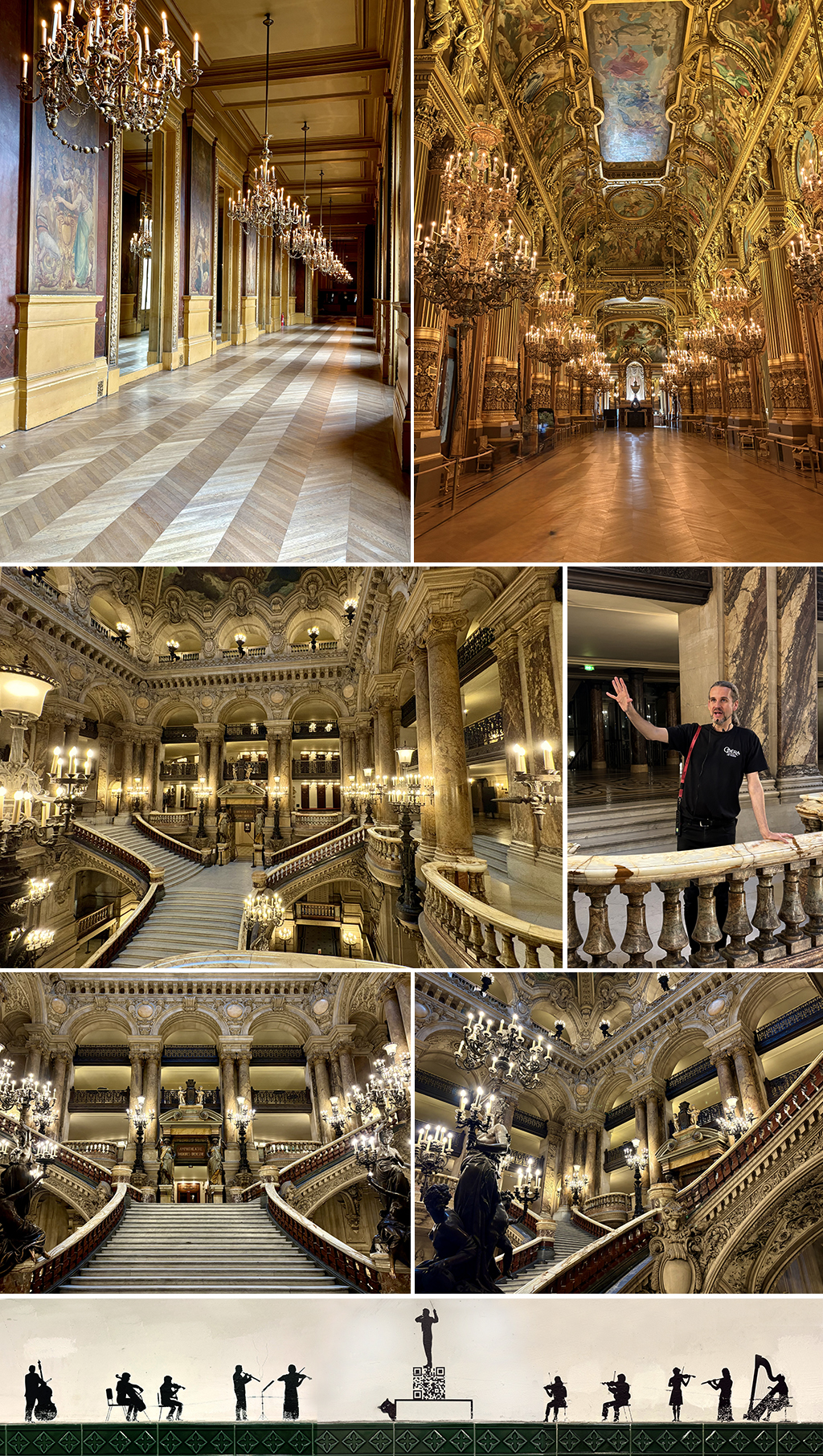
Another suggestion our friends made was to do an after hours tour of the Palais Garnier, the grand opera house known to theater-goers as the setting for the fictional Phantom of the Opera. Sadly, we couldn’t go into the auditorium because there was a rehearsal in progress. Our tour guide was William, who has a PhD from a university in the Netherlands. His dissertation was on the spread and acceptance of French opera in other countries. He was incredibly animated and watching him was a theater performance in itself. The interior of the building is dazzling. I hadn’t been inside since 1980 when I attended a performance of Gounod’s Romeo et Juliette. Visit the Opéra National de Paris for more information. (Don’t you love he little silhouettes in the Opéra Métro station?)
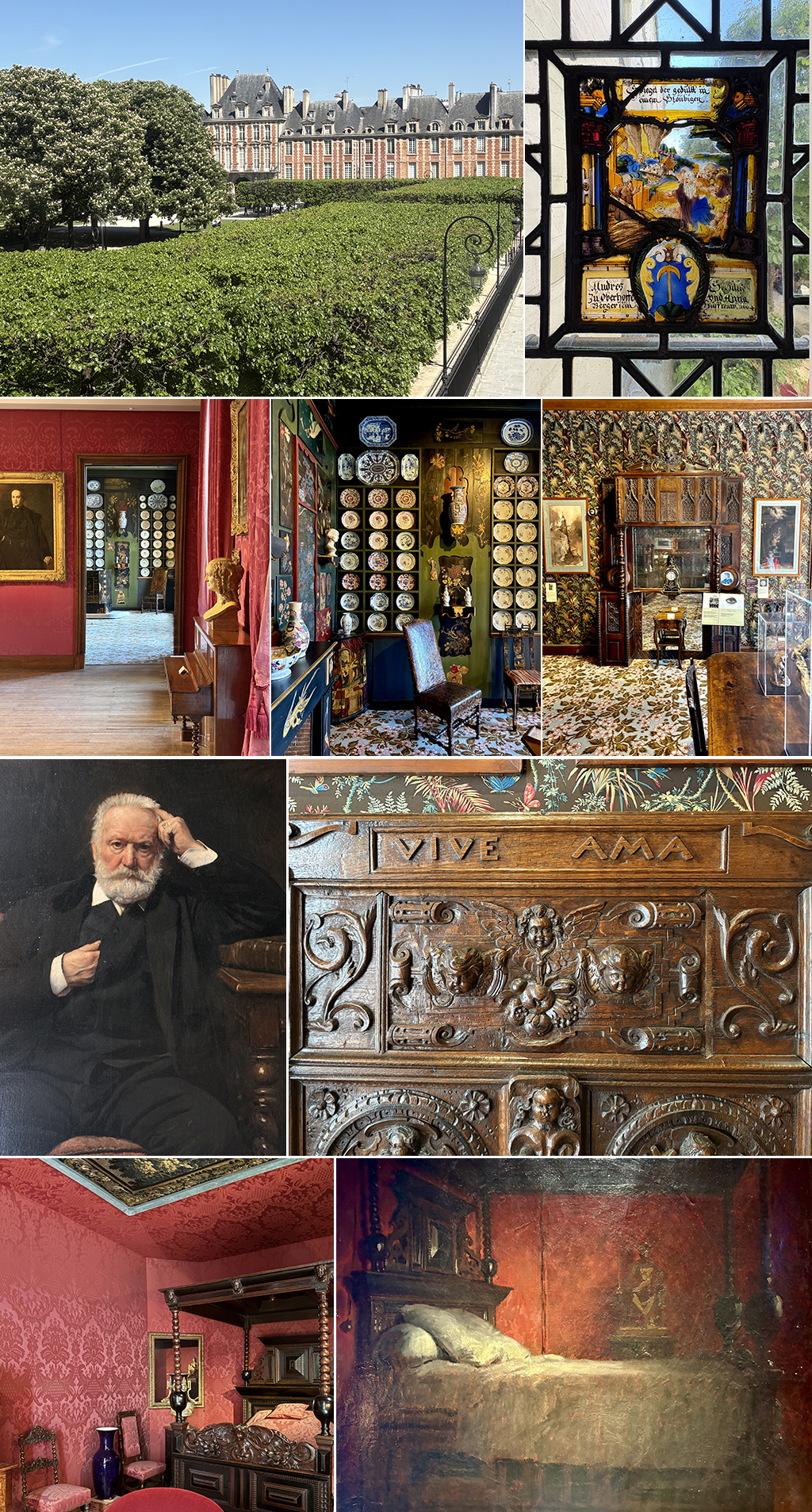
One morning, Mark and I were up early and ready to go, so we decided to walk to Place des Vosges to visit the Maison de Victor Hugo. I have been wanting to go to this museum as it is richly decorated, and was fascinated to learn that much of the decoration was done by Hugo himself. The museum had a special exhibition on the first floor about Victor Hugo as a decorator and visual artist — it included paintings, drawings, and sketches for his homes. The second floor was his living spaces with rich, fanciful wall coverings (wood, silks, and wallpaper), a considerable porcelain collection in a chinoiserie room, and a lot of paintings and sculptures… many of him. It was truly beautiful.
The house was especially interesting to Mark, who has read Notre Dame de Paris (the Hunchback of Notre-Dame) in its entirety (spoiler alert: by the end, almost everyone is dead; it ain’t Disney), Mark has also encountered a good deal about Hugo’s very active political life during the rocky decades of revolts, revolutions and coups d’états. We hadn’t known that he was exiled for several years for political speech. (Hugo called Napoleon III a traitor against his country when the latter overthrew the government, abolished universal [male] suffrage, and declared himself emperor). For more information on touring the house, click the link above.
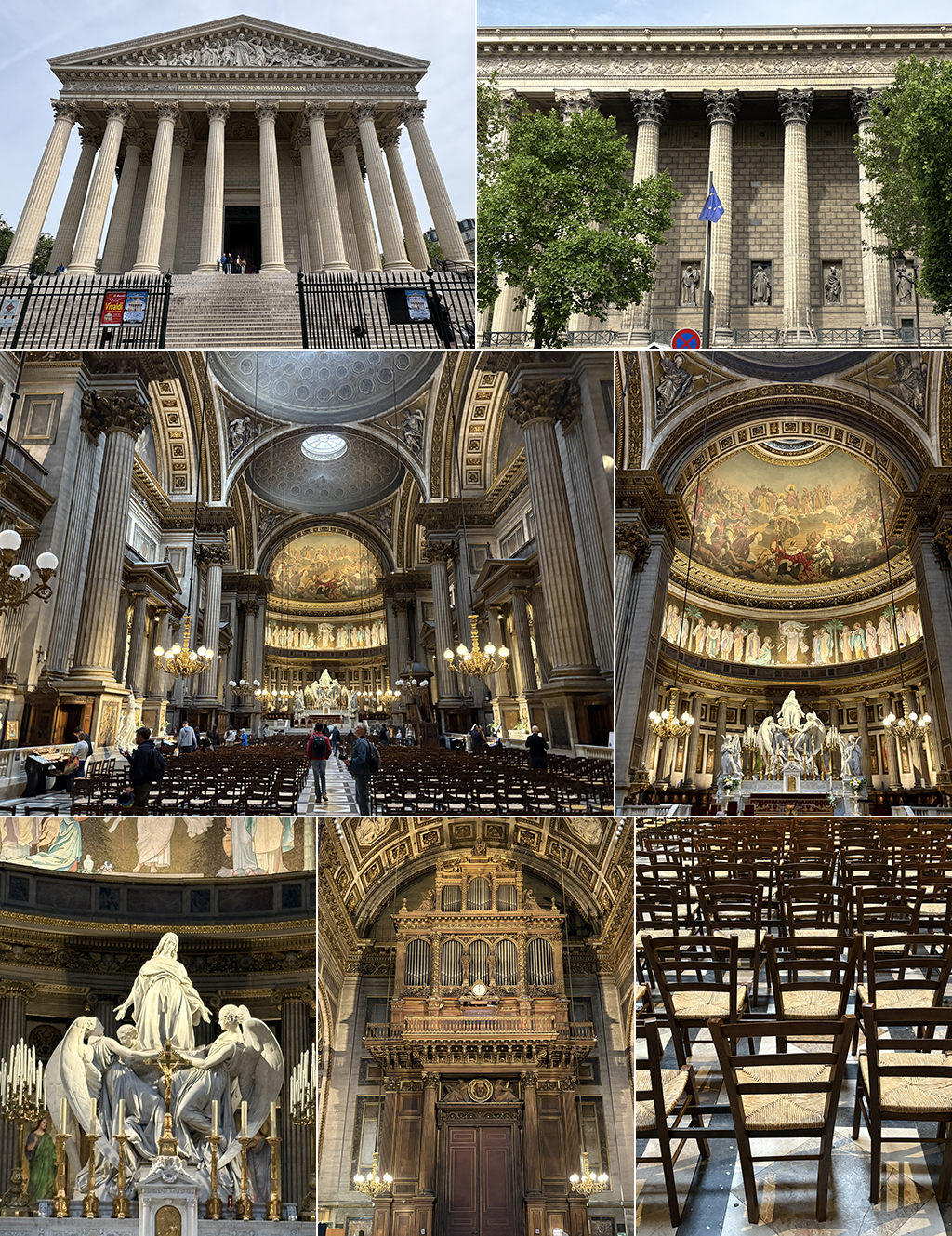
One day, while Jennifer and Pat were off strolling along the quaies of the Rive Gauche, we headed off to La Madeleine, The Church of Saint Mary Magdalene, originally planned and started by Louis XV in 1763, it is a Roman, temple-style church that avoided the problem of modern windows by using ceiling oculi. Due to redesign, then the revolution, work stopped with only the huge foundations and classical portico finished. Markipedia says it is odd for a portico to be built first rather than last, and he surmises this was because Louis wanted the church to be a grand terminus to the view up his new grand Rue Royale. In 1806, Napoleon I approved a new design with classical columns all the way around, which required removing all the previous work (foundations included) except the front portico; they began anew. After the fall of Napoleon I in 1815, Louis XVIII had work resume and it was mostly finished by 1848. This is the kind of detail that makes Markipedia geek out. Check out La Madeleine for information, should you wish to visit or hear a concert.
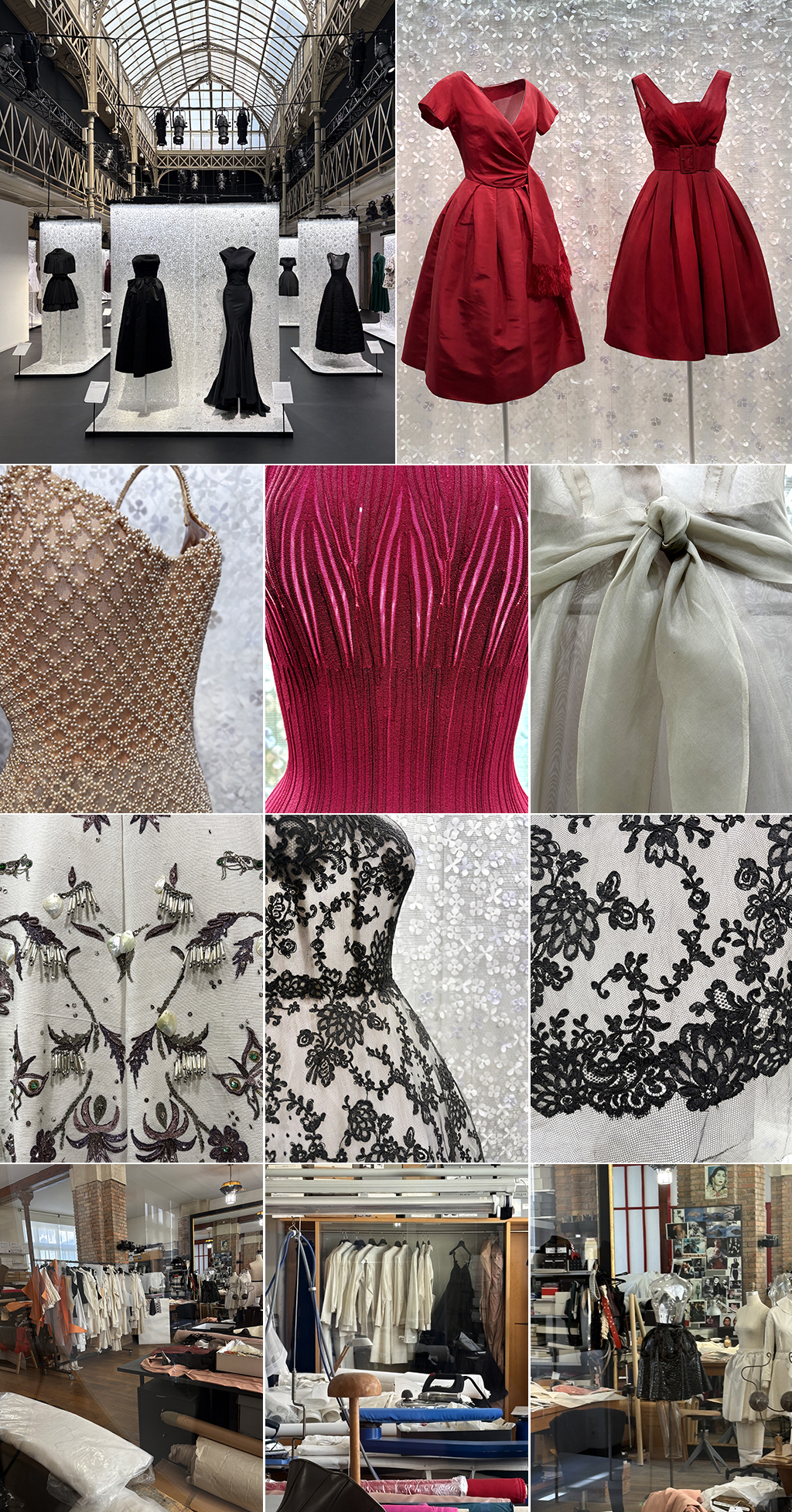
Fashion! Fashion! Paris has long been known as a hub for elegant vestments, raiment, and finery from head to toe. Worth, Chanel, Dior, Cardin, Sant Laurent, Givenchy, Gaultier, Louboutin. These are household names that carry weight. But there is one name mostly known only to the cognoscenti — Azzadine Alaïa, a Tunisian man born to farmers in 1935. Friends and neighbors saw his raw talent and encouraged him. At age 21, he went to Paris and worked in several ateliers before securing an internship with Christian Dior. After four months, he was fired. But his career continued and he worked in many studios along the way. He dressed many of the greats: Greta Garbo, Marie-Hélène de Rothschild, Tina Turner, Madonna, Lady Gaga, Michelle Obama, Carla Bruni. He was considered the “supermodel whisperer,” dressing Naomi Campbell, Stephanie Seymour, and Linda Evangelista. His work is stunning and can be seen — as well as his actual studio — at the Fondation Azzedine Alaïa in the Marais. We were lucky to see a side-by-side exhibition of his works alongside those of Dior, whose work he continued to admire and collect.
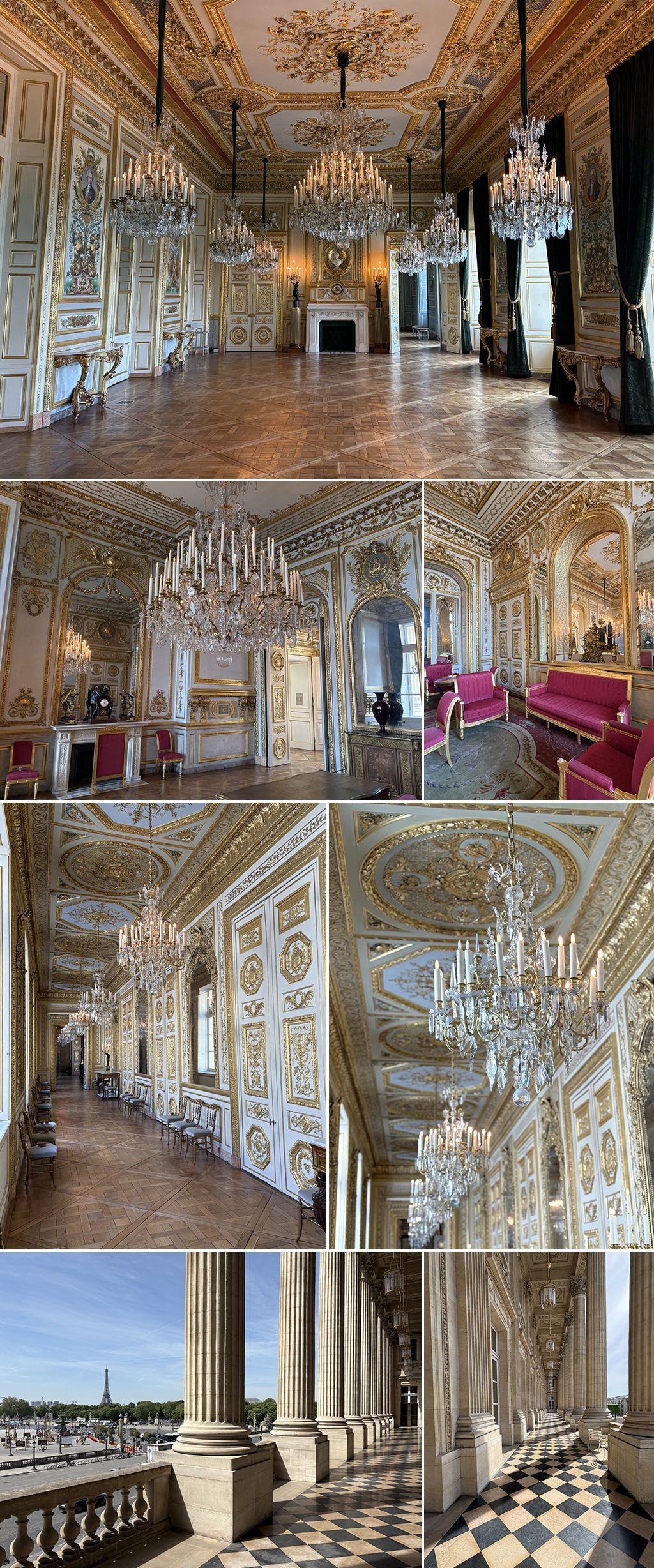
If, after days of touring, you just don’t have it in you to battle the hoards at Versailles, yet still want some sparkling glamour, I have the perfect recommendation for you: the recently-opened museum of L’Hôtel de la Marine, the 18th-century manager of the king’s furniture and treasures (ceremonial arms, etc.). Somehow that office was assigned to the Navy, whence “Marine.” We went through the dazzling early 19th-century neoclassical-era suite of rooms that was used for occasional public display of some of these treasures, and also for balls that marked important occasions like coronations. Our visit included the loggia overlooking the Place de la Concorde, a long handsome mirrored corridor, and the grand marble stairs. On another visit we will tour the 18th-century rooms that were residence of the official in charge. For us, this was a really worthwhile, last-minute, let’s-do-it decision.
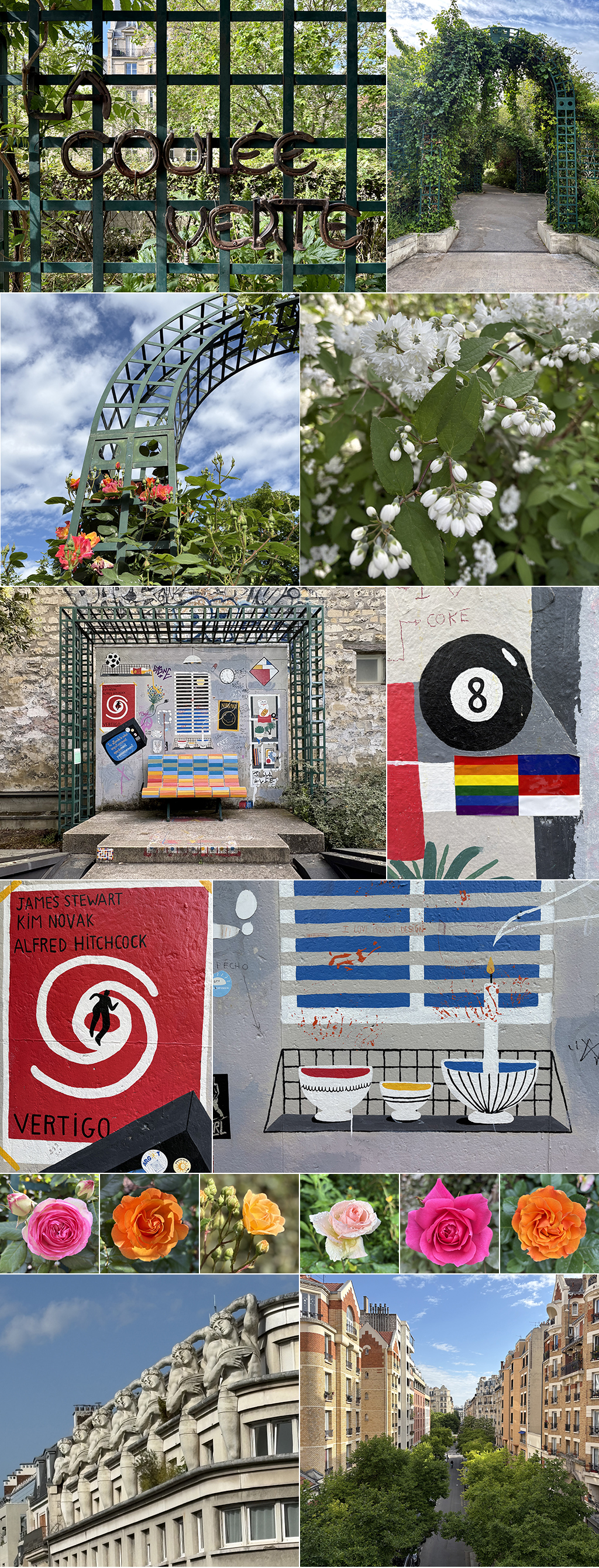
And, if all the hustle and bustle is just way too much after a week or so in Paris, try spending an hour or two on the Promenade Plantée, formally known as the Coulée Verte René-Dumont. Opened in 1993, this obsolete elevated railway line-turned spectacular green space is just east of the Place de la Bastille. It is almost three miles long and is beautifully planted with trees, shrubs, and flowers, and is dotted with many alcoves with seating for enjoying the beauty.
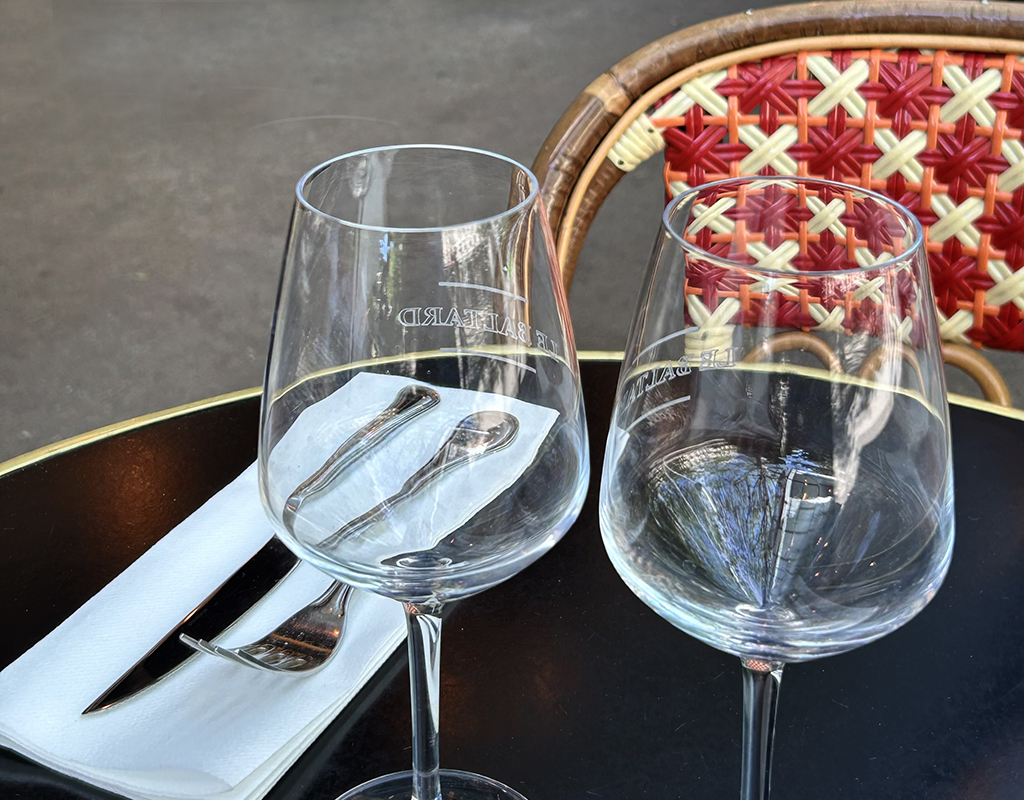
Getting hungry just thinking about two weeks in Paris? Here are a few places we enjoyed while there. Note: get reservations either online, by phone, or in person. Small bistros fill up quickly.
Thanks to Markipedia and Jennifer for contributing some photos.
Developed and maintained by Inspiratech LLC.
Design by Themeshift.
Eha Carr
June 3, 2026 at 4:54 amHave just scrolled up-and-down far more than once . . . one does that when travel photos arrive from you . . . and you have managed as yet again to remind one of the past, look at the present thru’ your and Mark’s eyes and go to bed dreaming . . . I have a special one remembering the many times at the Paris Opera . . . the productions could sometimes fail . . . the surrounds never . . . Oh, you two look well . . .
David Scott Allen
June 3, 2026 at 11:29 amThank you, Eha. It is fun bringing you along with us — such a joy to share this!
Marie-Claire
June 3, 2026 at 7:03 amLovely post and so pleased to read it as heading back soon. Merci, mon ami!
David Scott Allen
June 3, 2026 at 11:28 amI hope it’s a good trip, MC. We will be going again in December. Any chance you’ll be there then?
Barb
June 3, 2026 at 7:15 amStunning photos and a fabulous narration!! You and Mark definitely know how to have incredible vacations! Reading this post is almost like being there. Thanks for generously sharing all this magnificent beauty and history!
David Scott Allen
June 3, 2026 at 11:27 amThat is the perfect comment, Barb, as we want people to feel they are either us! Glad you enjoyed it.
Johanna Lockhart
June 3, 2026 at 7:28 amMille merci!
“So many places, so little time”…adaptation of F Zappa quote.
Wonderful! Travel logs don’t get better than those of Chef David and Markipedia..in pics n prose.
Have added so many adventures ‘a Paris’ to itinerary for my stay this Fall.
Bienvenue. JL
David Scott Allen
June 3, 2026 at 11:26 amSo glad you enjoyed this, Johanna — promise me that you will get to Moon Croissant! You will love it!
Mimi Rippee
June 3, 2026 at 7:48 amOh what a beautiful (and funny!) post. As you know, we’re here now. My daughter and grand daughter haven’t quite adjusted to the time change yet so they’ve both been a little grumpy. But we’ve done so much and my g d has had wonderful experiences. (Daughter has been to France a few times.) We even did a cooking class today with a delightful chef that took place in the Passy area that I’d never been to. Such great markets. I guess my family might go on strike and I’ll shoot over to E. Dellerin and meet them for dinner!
David Scott Allen
June 3, 2026 at 11:25 amI love the idea that you will escape to Dehillerin. It’s such a wonderful place in which to get lost (and spend some significance money). Have the best time!
Fran @ G'day Souffle'
June 3, 2026 at 7:55 amWow! You certainly did pack in a lot of things in your stay. We stayed in Paris last year for 4 weeks and will spend another 5 weeks there starting in late August. So, you’ve given me a lot of ideas for my next visit. Last year, most of the markets had dwindled down to nothing since it was during the summer, but we’ll be there in September so they should be open again.
David Scott Allen
June 3, 2026 at 11:22 amI envy your five weeks there, Fran — it’s such a magical place. September is a nice time of year to be there, though a bit early for the truffles and mushrooms, but maybe there will be a rainy summer? Let me know if you have any questions about anything — but definitely make your way to Boulevard Beaumarchais for Ama’s croissants. They are seriously the best I have had.
Chris Allen
June 3, 2026 at 8:11 amDavid and Mark –
This has been a wonderful (imagined) trip! Your photography and writing invite us to share your adventures.
Lovely!
Thanks,
Chris
David Scott Allen
June 3, 2026 at 11:19 amI’m so glad you enjoyed it, Chris — and we enjoyed knowing you were having fun in Tucson!
Paul Norton
June 3, 2026 at 9:06 amSuch a wonderful post! Took me right back to the late 70s when I worked in Paris and discovered so much of that beautiful city. I still use the small whisk and wooden spoon I bought at Dehillerin. Such wonderful memories came flooding back!! Thanks for sharing!!!
David Scott Allen
June 3, 2026 at 11:18 amI love my little whisk, Paul — now I need a wooden spoon! Last visit, we bought a counter brush and it is the best thing we have ever acquired! I’m so glad this brought back such good memories for you. Paris in the late 70s was glorious.
Rebecca Schroeder
June 3, 2026 at 9:48 amSpectacular photos! It was such a joy to read about your trip. I look forward to seeing how your time in France inspires your artistry in the kitchen! Miss you!
David Scott Allen
June 3, 2026 at 11:17 amThere’s going to be some fun recipes coning, for sure! Thanks for reading the post!
Gerlinde
June 3, 2026 at 10:49 amYou covered a lot, David. I am impressed. Paris has always had a special place in my heart, and after reading this wonderful blog post, I would love to go back and visit. Thank you, David.
David Scott Allen
June 3, 2026 at 11:16 amIt’s funny, Gerlinde — we feel we could have used another two weeks and that we barely scratched the surface. You really should go back.
Frank | Memorie di Angelina
June 3, 2026 at 12:38 pmLooks like a wonderful trip, David!
As much as I love Rome, I love Paris, too. As I think you know, I had a ball living there for two years many moons ago… right around the corner from the Moulin Rouge as a matter of fact.
I’m happy to know there’s someone else who enjoys visiting cemeteries. The Pere Lachaise is particularly fascinating, although my interest goes more to Napoleon’s marshals.
Sadly, I never actually been inside the Opera House. Shocking, I know..
David Scott Allen
June 4, 2026 at 2:56 pmWow, you really have to go inside the Opera House, Frank. It is spectacular, and it’s all the better if you can hear a performance there. They still do the occasional opera.
We went in search of Jim Morrison’s grave for our friends. I was much more engaged finding Oscar Wilde or Parmentier! But no matter who we found, it’s such a beautiful place. Have you ever been to the Montparnasse cemetery? It’s there that you will find, buried together, Jean-Paul Sartre and Simone de Beauvoir.
Carolyne
June 3, 2026 at 2:12 pmWonderful tips for my favourite city. I have added several of your suggestions to my “Paris Ideas” list for our next visit.
David Scott Allen
June 4, 2026 at 2:57 pmIt was nice to find some off the beaten track places to share. I hope you enjoy them!
FEL!X
June 3, 2026 at 6:29 pmThank you David for taking us through this wonderful Paris sightseeing tour!
David Scott Allen
June 4, 2026 at 2:51 pmIt was wonderful having you along, Felix!
Donn Poll
June 3, 2026 at 6:30 pmDeeeelightful!Thank you for sharing the photos and narration. Away from the “big” sites, did you find the crowds manageable in May?
David Scott Allen
June 4, 2026 at 2:50 pmI think if you went to the big sites, you would find huge crowds. But, at places like the Victor Hugo house, the Hôtel de la Marine, and Saint-Eustache, you would find very few people. Sometimes we marveled that we were the only people in some of these beautiful places. I’m so glad you enjoyed the post, Donn. Hope you and Eric are doing well!
angiesrecipes
June 4, 2026 at 2:39 amwow..I can tell that you guys had a BUSY and really great time in Paris. Thank you so much for taking us along with this wonderful post.
David Scott Allen
June 4, 2026 at 2:48 pmIt’s funny, it didn’t seem so busy when we were there… But when I looked back, we did do a lot! Glad you enjoyed the post, Angie.
Mad Dog
June 4, 2026 at 6:46 amFabulous pictures – I lived in Paris during the 90s. On summer evenings, we used to take a picnic of cheese and wine to the banks of the Seine, opposite Île Saint-Louis and watch the world go by. I particularly like the stretch of Canal Saint-Martin going down towards Bastille. I always wanted a flat along there.
David Scott Allen
June 4, 2026 at 2:48 pmIt’s funny, Mad Dog, I used to enjoy picnic on the banks of the Seine with bread and cheese and some wine. These days, though, I really enjoy going to the market and making meals in our apartment. As you know, there is so much good food to be had in France! How fortunate that you lived there in the 90s!
Priya
June 4, 2026 at 2:13 pmWhat a detailed post David. I am saving this post for my future trip.
David Scott Allen
June 4, 2026 at 2:46 pmThanks, Priya. I hope you get to go soon!
Raymund
June 4, 2026 at 4:06 pmWhat a gorgeous travelogue, I felt like I was tagging along with you through every market, museum, and sun‑dappled Parisian street. I love how you balance the classics with little discoveries, and your photos make the whole trip feel so alive and personal. The Canal Saint‑Martin tour and the Victor Hugo house are now firmly on my list, and I’m absolutely stealing your tip about Moon Croissant. Honestly, this post just reminded me why Paris never stops tugging at the heart.
David Scott Allen
June 5, 2026 at 9:17 amYou will love Moon Croissant, Raymund – the croissants and the people are the best! And don’t forget to add L’Hôtel de la Marine – such a find!
Evening With A Sandwich
June 5, 2026 at 9:16 amMy friend David, I would be packing it up for 6 months (tourist visa) and calling Paris home for half the year. This journey you shared with us you coal feel your enthusiasm and excitement. You were in your element. Surrounded by beautiful architecture, food, fashion and my list could go on…. and on….
Love that you shared this beautiful post with us. I had to go through it a couple of times to catch it all but loved every moment.
Cheers to Paris!
Velva
David Scott Allen
June 5, 2026 at 3:06 pmI know, Velva — I want to get a tourist visa for 6 months (or years), too. I really love Paris — and you will see that I love Rome equally, but for such different reasons. More than anything, just being in Europe there is such a different sense of life and living… and I really appreciate it so much.
Jill W Becker
June 5, 2026 at 2:18 pmRead this three times and still find it fascinating. Thank you and Mark for sharing what looks like a charming trip. Will look forward to more posts with recipes and other travels.
Jill
David Scott Allen
June 5, 2026 at 3:04 pmI am so pleased you enjoyed reading this (several times!), Jill. Fear not — there is much more coming!
Karen (Back Road Journal)
June 6, 2026 at 12:41 pmWhat a wonderful post. You trip sounds perfect with interesting places that the average tourist might not think about. You weather looks like it was spectacular for the most part as your photos make you feel as if you are there. Memories for a lifetime yet it won’t need to be since you are already planning another visit. I can’t wait to tag along again…you two are the best guides.
David Scott Allen
June 9, 2026 at 9:48 pmWe had the best weather I have ever had in all my times in Paris, Karen — I had to pinch myself. Glad you enjoyed our tour — more coning soon!
Sherry M
June 7, 2026 at 9:32 pmwhat a wonderful marvellous trip David. The buildings the food the history … Fabulous. My hubby has been to Paris and Provence to visit his sister; maybe one day I too will get there…
cheers
sherry
David Scott Allen
June 9, 2026 at 9:46 pmOh, I do hope you get there, Sherry!
Ben | Havocinthekitchen
June 8, 2026 at 1:44 pmWhat a wonderful read, David! I especially enjoyed your experience on balancing favourite places with new discoveries. The photos are beautiful, and they really capture the timeless charm and atmosphere of Paris.
David Scott Allen
June 9, 2026 at 9:44 pmThanks so much, Been. No matter how many times I go to Paris, I always find new things to intrigue me.
Inger
June 9, 2026 at 8:49 pmSuch beautiful photos. And so many things to add to my list for our next visit! Looks like you had a marvelous time–not that there was ever any doubt. You know we try to get an airbnb at least part of a longer trip since we don’t check a bag (except sometimes home with wine or ??? ) so need to do laundry. But now I need to think about doing this to cook from the local delights. Interestingly I just ran into an old note I’d made about the fall mushrooms in the NYC Union Square and how someday I should get an apartment to cook with them.
David Scott Allen
June 9, 2026 at 9:40 pmAs much as I enjoy eating out when we travel, I really enjoy the marketing and cooking when I am away. It’s realy so much fun.