
Rome wasn’t built in a day. Nor can our three wonderful weeks in Rome be described in one article/photo essay. Today, in my first of three posts, I begin with the Churches of Rome. Not only are they architectural marvels, they also hold some of the world’s greatest paintings and sculptures. Friends have expressed astonishment at the number of churches we visit in Rome. This is best understood in the context of Rome being the center of the papal states for 1,114 years, which generated a lot of religious institutions (for us to visit in 2026).
______________________________
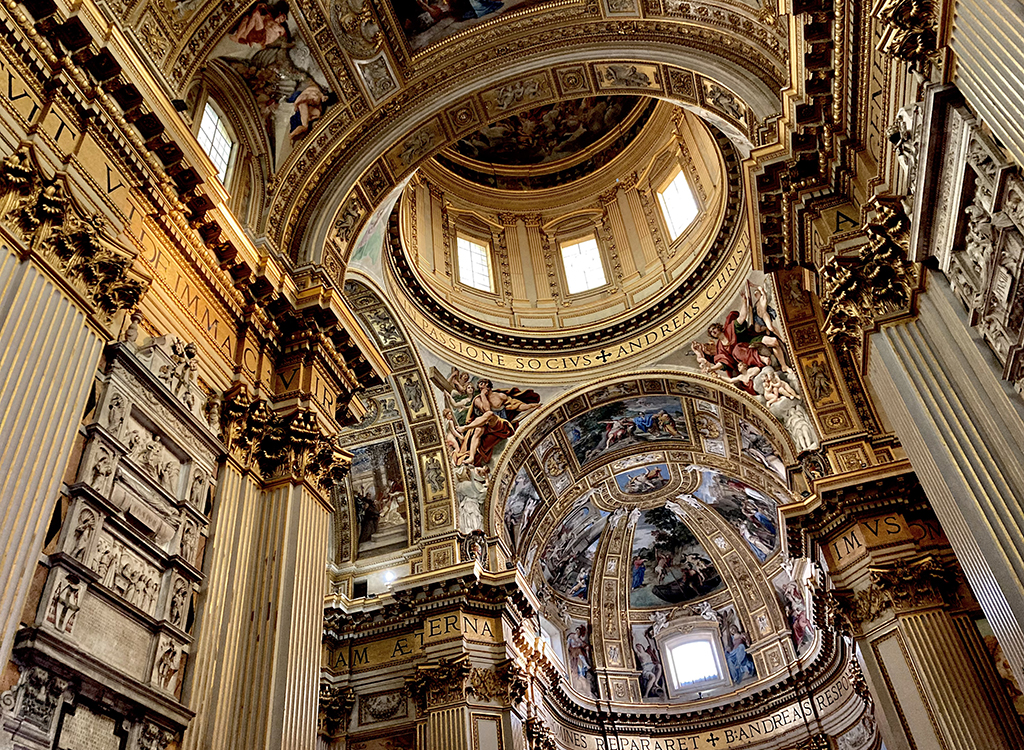
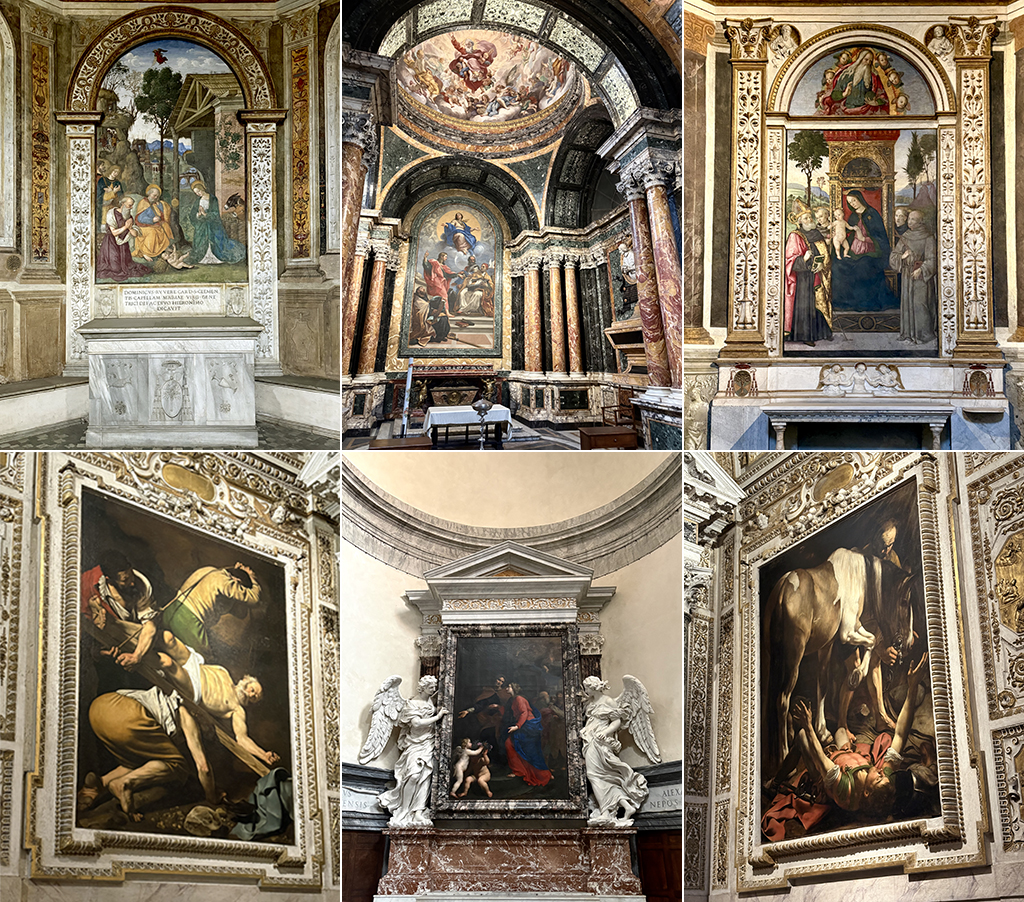
Santa Maria del Popolo — as we arrived, to our dismay, we saw a large group filing in the narrow door, but inside we saw that group tromping down the left side aisle to see two famous paintings down front, so we took our time going down the right side aisle to admire the beautiful side chapels designed and decorated by various artists over the centuries, Pinturicchio among them. The organ was playing, which gave the entire space a wonderful ambiance. The organ cases, designed by Bernini, feature oak boughs wrapped around the pipes. There are gorgeous Bernini angels at each end of the transept, posed so as to support large paintings. These wonderful works are generally ignored in the overly-focused goal of seeing the two wonderful paintings by Caravaggio in a chapel at the front left. By the time we got there, the group was gone, but the chapel was still moderately busy. The upside of so many admirers of these works was that people kept feeding coins into the light meters, so we could observe the chapels throughout with the flood lights on.
______________________________
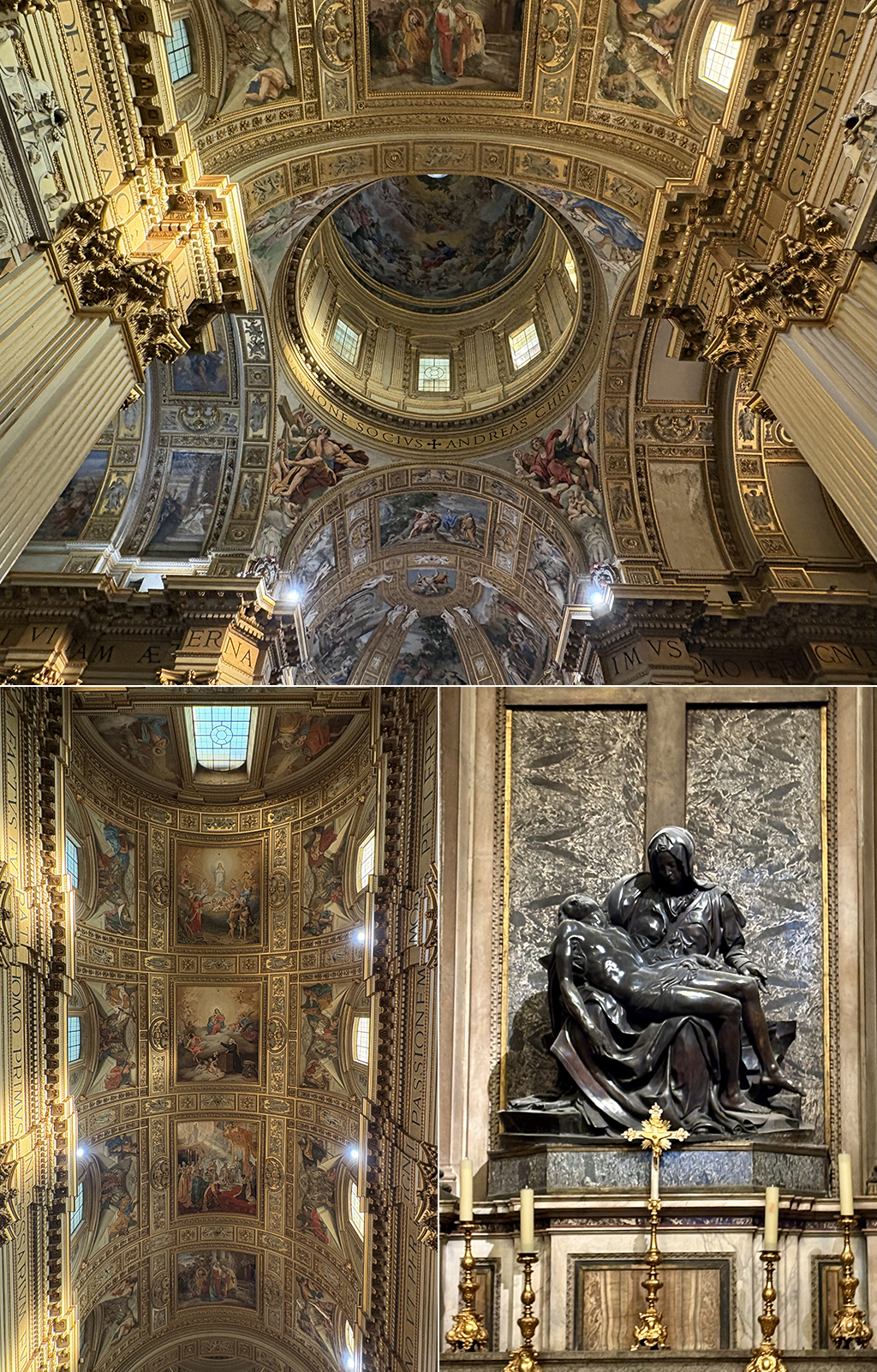
Sant’Andrea della Valle — our visit this time was brief, simply to be in the space and feel its grandeur. Sant’Andrea, located along the Corso Vittorio Emanuele II, is renowned for having the city’s highest dome after St. Peter’s (Vatican), a significant contributor to the city’s agitated skyline. This mid-17th-century basilica has stunning Baroque frescoes. Opera fans will know it as the setting for Act I of Puccini’s famous opera, Tosca. (I’ll discuss another great Tosca setting in my next post on I Palazzi di Roma.) It is also home to a preciese bronze replica of Michelangelo’s Pietà by Gregorio de Rossi.
______________________________
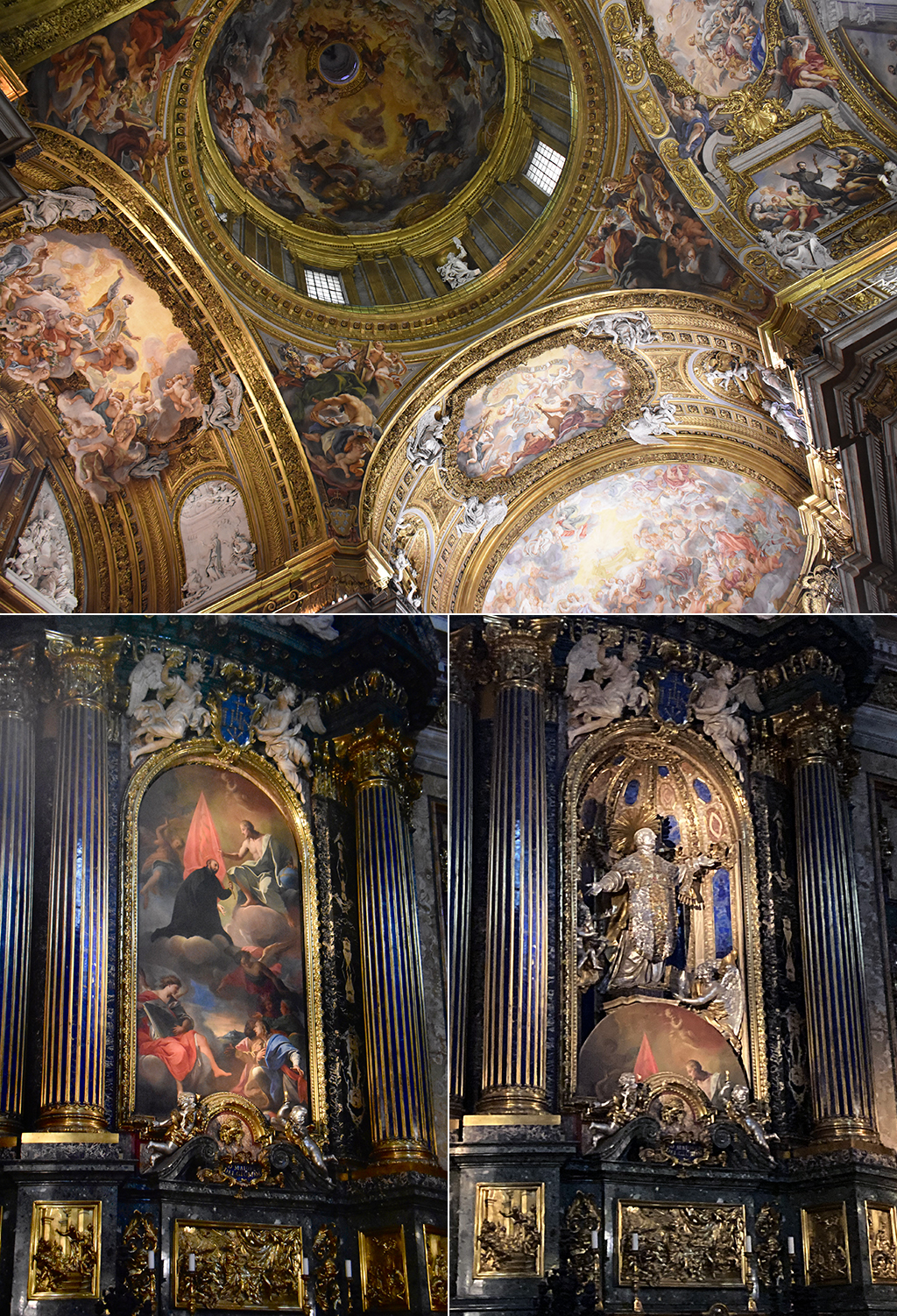
Chiesa del Gesù — our intention was to visit so that we could see the Corridor of Sant’Ignazio painted by Andrea del Pozzo. It was closed with a reopening schedule for the day after we left Rome. (Sigh.) We stopped into the church, sat for a while, and enjoyed its beauty. The church itself, the mother church of the Jesuits, was built in the late 16th century. It has a baroque facade (not unusual in Rome, though sometimes considered the first in this emerging style, and a model for Jesuit churches in many countries), and interior by Vignola and della Porta. The interior is an opulent mix of baroque and 19th century decoration. The stunning ceiling frescoes dissolve the separation of physical walls and a vista into the heavens. Daily at 5:30pm, there is a sound and light show (free to all), formally called La Macchina Barocca. As music plays, a narration of St. Ignatius’s life begins, the lighting shifts to emphasize different parts of the interior, while a large 17th-century canvas above the left side altar slowly slides down via a pulley system. It reveals a glowing, bejeweled statue of St. Ignatius. At the conclusion, the nave vault and dome light up to show the beautiful ceiling frescoes to great advantage.
______________________________
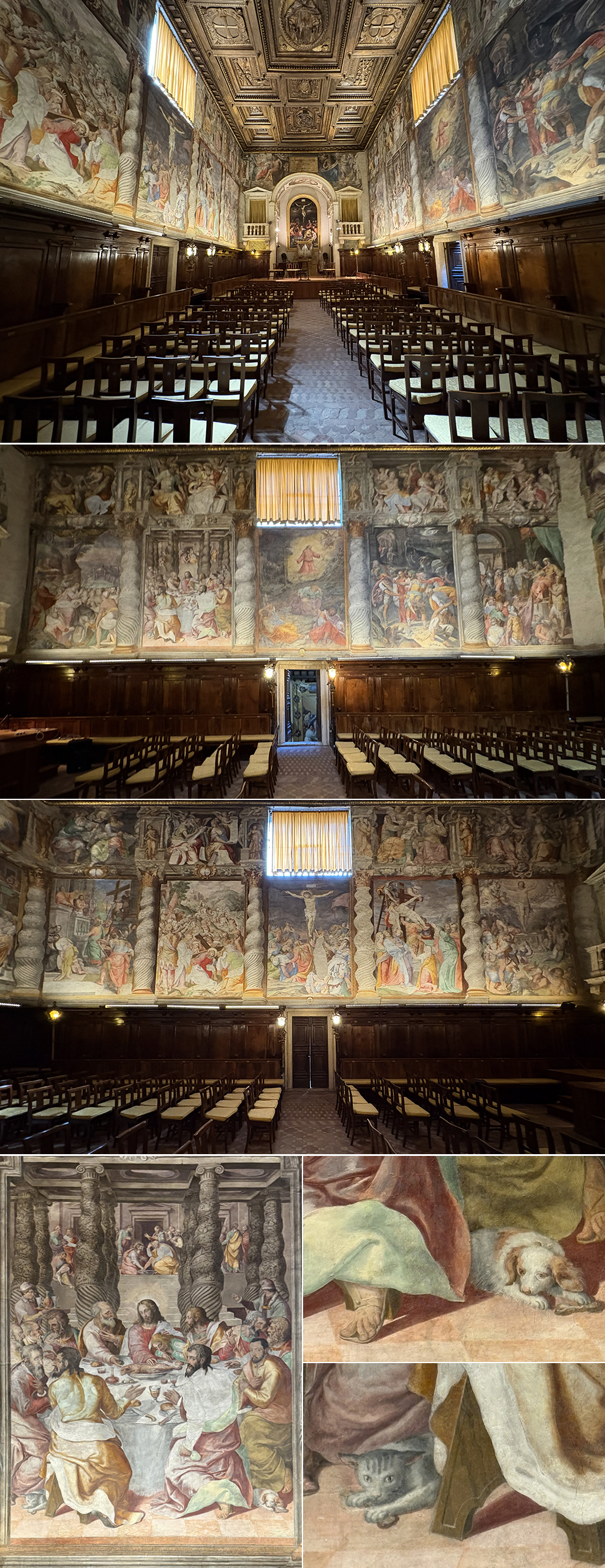
Oratorio del Gonfalone — this was a real surprise for us, with a nod to an Instagramer who listed off-the-beaten-track places to see in Rome. It is a true gem and is called, by some, “a miniature Sistine Chapel.” The entire chapel is frescoed from one end to the other in a sequence of the stations of the cross. The frescoes were painted by several well-known mannerist painters of the time; we noted interesting differences in the artists’ techniques. Both of us were charmed by some details in the Last Supper fresco; a cat and a dog, as well as a young server carrying a flask of wine, who looked like he was right out of the Happy Days diner. The Confraternity of the Gonfalone (banner), was founded several centuries earlier, and they were dubbed “Gonfalone” because of the banner they carried in their processions. If you find the front gate closed and chained, go round to the next street and ring the doorbell and ask to see it. It is now the home of the Roman Polyphonic Choir.
______________________________
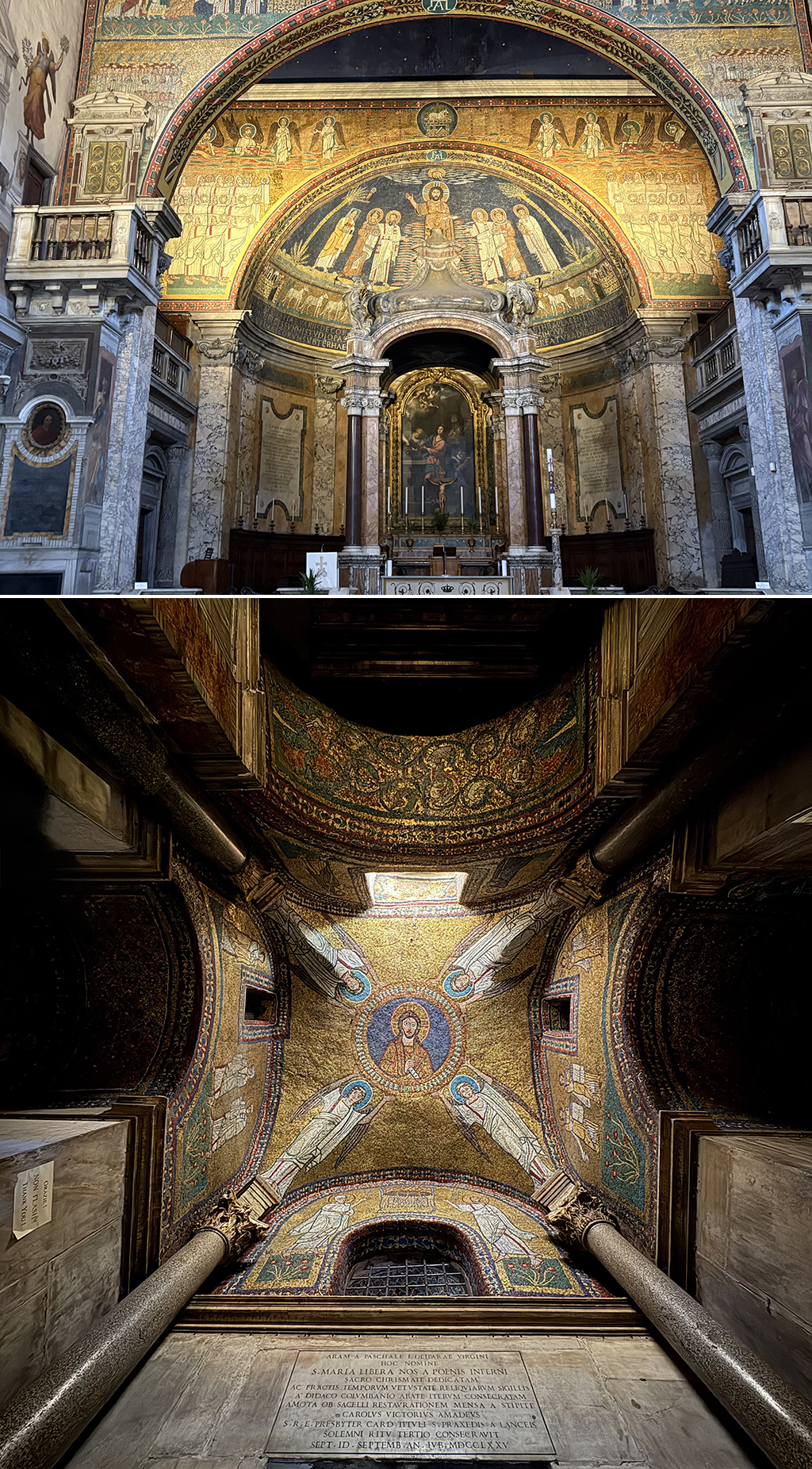
Santa Prassede — this might actually be my favorite church in Rome. The sanctuary is filled with incredible, glittering, brightly-colored, 9th-century Byzantine mosaics, with more in a side chapel on the right. Mosaics in another side chapel seem to be late 19th century. There is a crypt underneath the altar for Santa Prassede. We learned that the site of the well where she saved all the blood of martyrs was actually at the entry of the church in the nave. It is marked by a large, circular piece of porphyry marble, part of a gorgeous 20th-century Cosmatesque revival floor.
______________________________
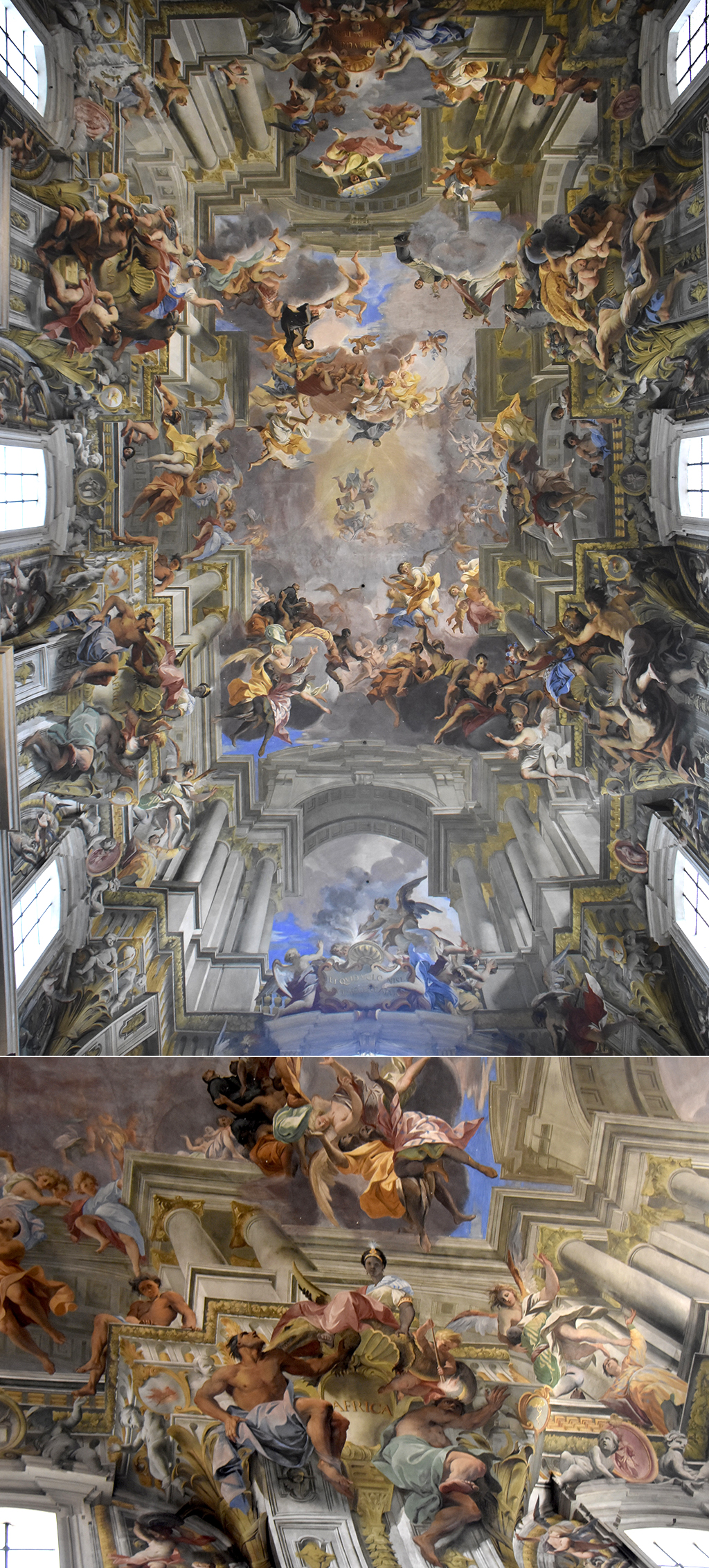
Sant’Ignazio — before visiting Santa Prassede, Sant’Ignazio was hands down my favorite church in Rome, and Mark’s too for decades before that. When I first visited Rome in 2011, there were almost no visitors to the church and you could walk right to the center of the nave, find the brass marker, take a seat (so you didn’t all over backward), then look up to see the most glorious ceiling in all of Rome painted by Andrea Pozzo (with apologies to Michelangelo). The corners are personifications of the four continents, and the most amazing thing is that this is painted on a ceiling that is basically flat. When we visited twenty years later, the brass marker had a mirror standing over it, to allow visitor to admire the ceiling without craning their necks. This year, we were disturbed to find a seemingly-endless line of Instagram influencers waiting to take a selfie at the now angled mirror. They pay €1 for a minute at the mirror, so at least their donation contributes to the maintenance of the church. Of course, you can skip the line and simply take a seat adjacent to the mirror and look up to enjoy the beauty. This year, we were treated to a dress rehearsal of a wind orchestra and choir, Handel’s Hallelujah Chorus among the pieces. The music seemed to bring the entire swirling ceiling painting to life. Once the chorus and wind ensemble had departed, the organist kept playing, apparently just for fun. Serious fun. In the echoing interior, and with the somewhat gushy voicing of Italian pipe organs, it took me a minute to recognize the theme to Dragnet, followed by one of the 007 themes. The organist finished his fun with several excerpts from Star Wars. Seeing that incredible ceiling to the tune of Darth Vader’s Imperial March made us both erupt in church-stifled laughter. Talk about incongruity!
______________________________
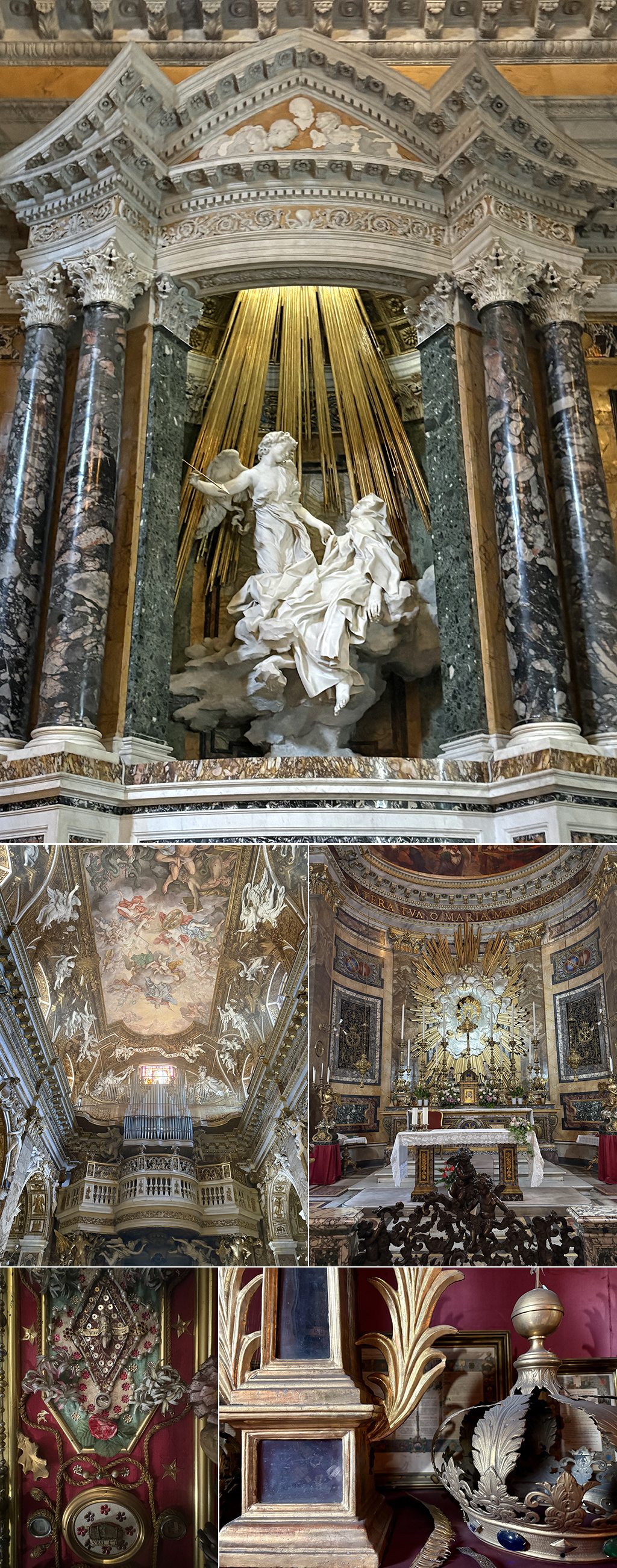
Santa Maria della Vittoria — this church was on Markipedia’s Bernini Crawl to see every possible Bernini sculpture that exists in Rome (not to be confused with his Caravaggio Crawl). I doubt we did, but I bet we got close. Santa Maria della Vittoria houses a beautiful Bernini marble sculpture of the Ecstasy of Saint Teresa, which is naturally illumined from a window above. Of course there are lights, too, turned on for a couple minutes by dropping a €1 coin in a meter. Additional to this stunner, the church has a less-admired wax recreation of Saint Victoria’s body, in which are set her teeth and hand bones; reportedly, her other parts are distributed in reliquaries throughout Christendom. We went around back and visited the sacristy, as well, which had some very nice cases with religious vestments, documents, and crowns. It is confusing that the church is named for Saint Mary of Victories not for Santa Vittoria.
______________________________
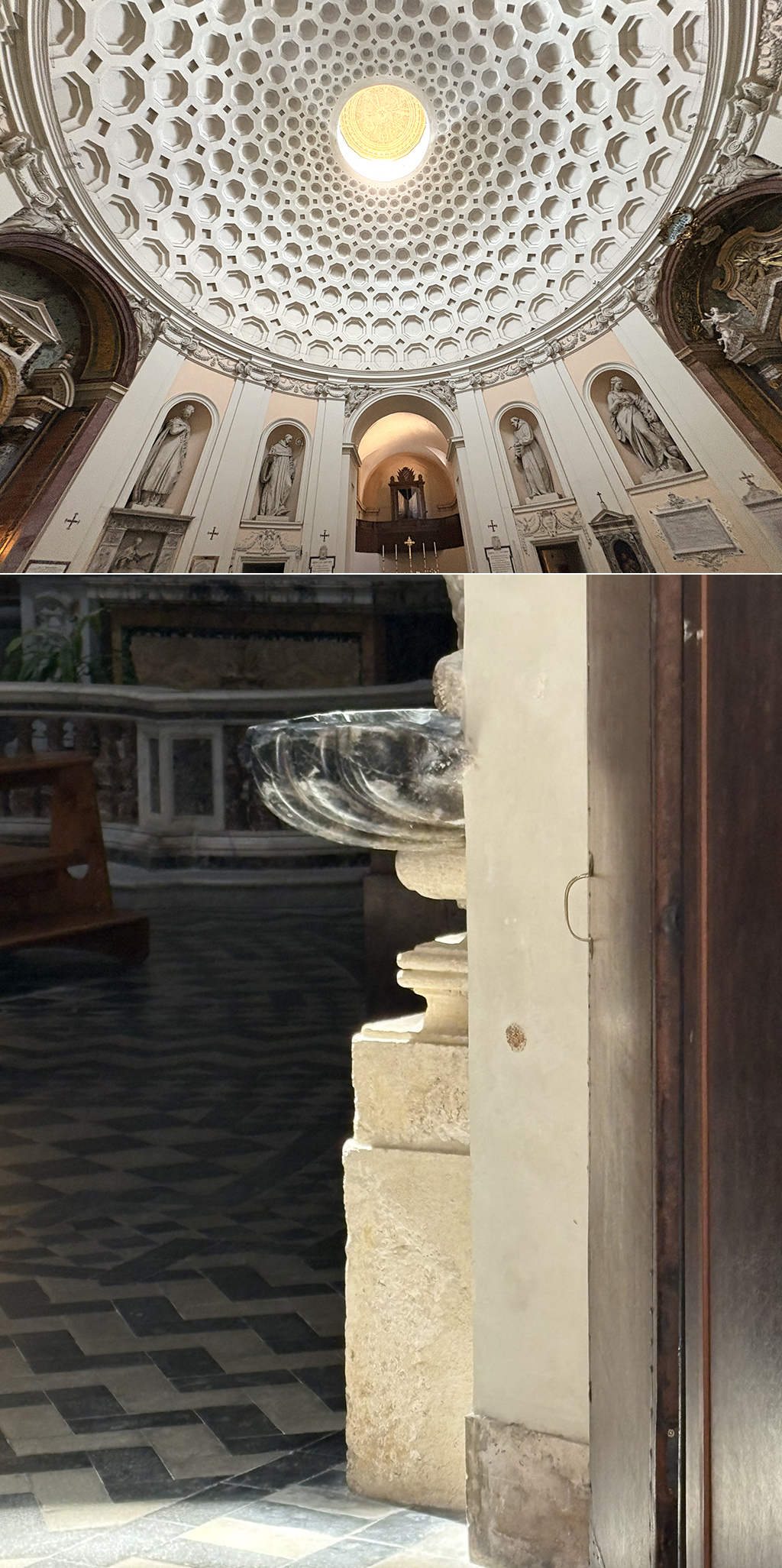
San Bernardo alle Terme — Life is full of unexpected opportunities and, in Rome, most of those opportunities come in the form of popping into random churches. San Bernardo alle Terme, as an example, is a 16th-century church renowned for being converted from an ancient Roman circular tower that was part of the Baths of Diocletian. It’s right around the corner from Santa Maria della Vittoria; it was uncrowded and looked like a miniature version of the Pantheon.
______________________________
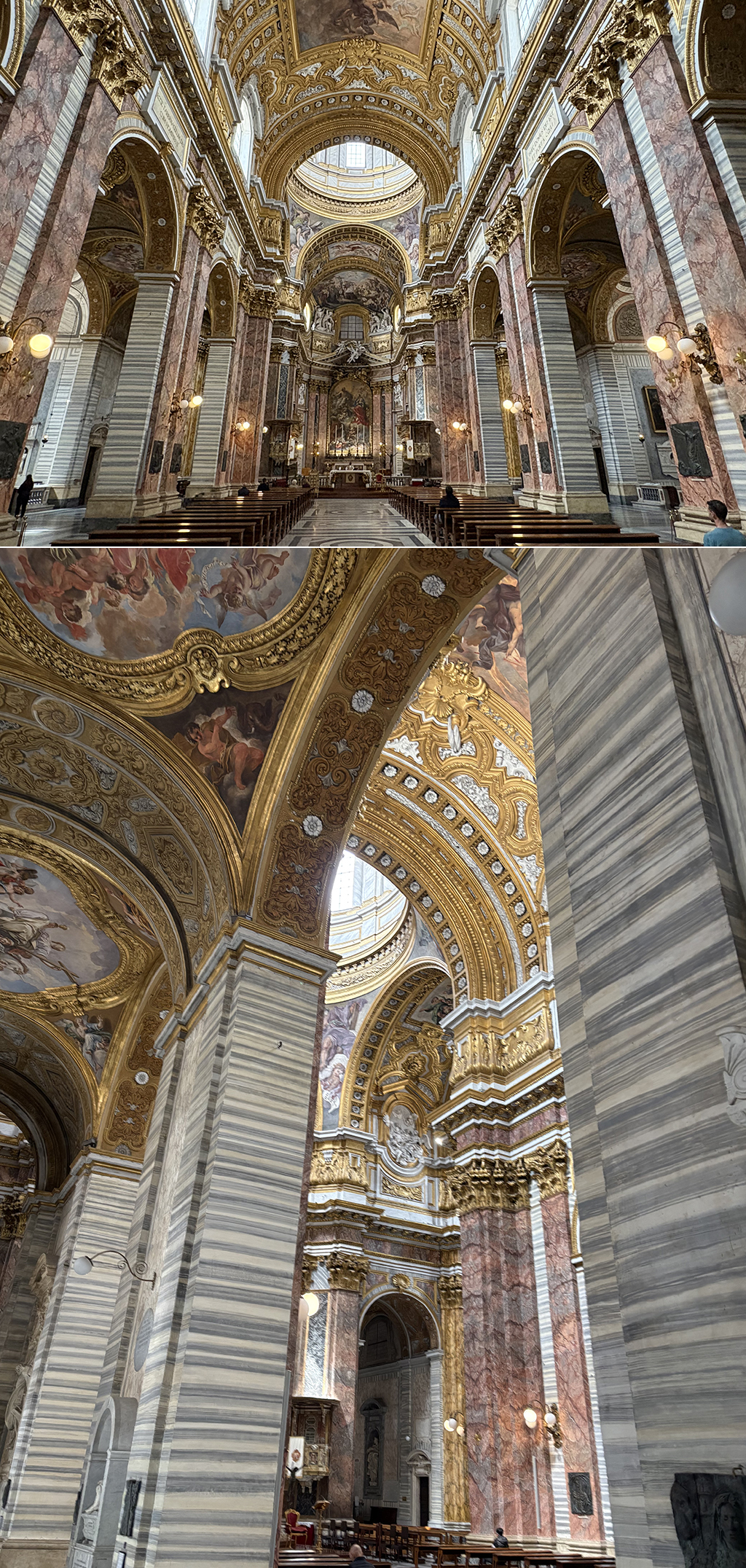
Sant’Ambrogio e Carlo al Corso — mostly known simply as San Carlo, if known at all. This was a quick visit for us, as there was a mass in progress (which is, after all, the building’s purpose). The 17th-century church, dedicated to the two patron saints of Milan (one a founding 4th-century theologian, the other a powerful figure in the Counter-Reformation) is also the Norwegian national church in Rome. A side chapel has a painting of a rather unexpected Viking-esque depiction of the 11th-century Norwegian Saint Olaf (I hadn’t noticed if the mass was in Norwegian, Italian, or Latin.) A reliquary in the ambulatory (which I was spared) contains the heart of San Carlo Boromeo. For a huge baroque church, centrally located on Via del Corso, it is pleasantly untouristed.
______________________________
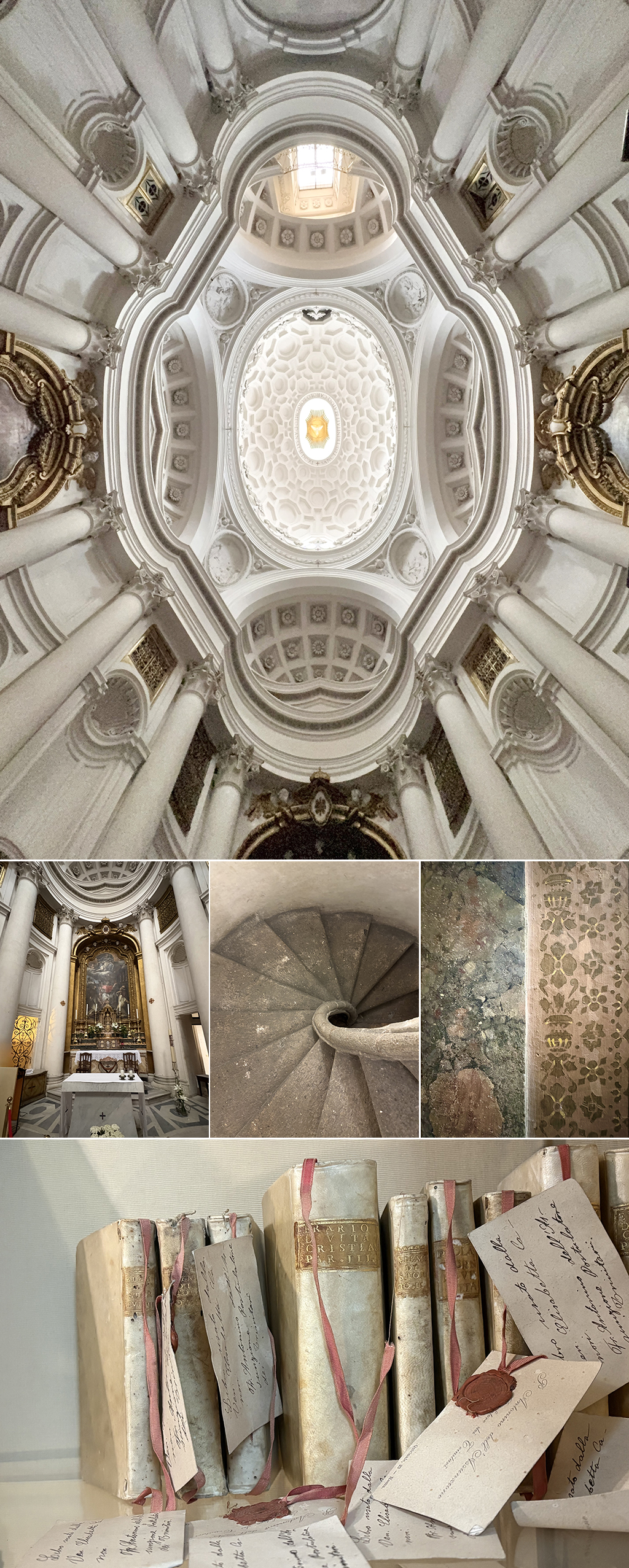
San Carlo delle Quattro Fontane (also called San Carlino, or Little Saint Charles) — this wasn’t a Bernini bucket list visit, but it has been on Mark’s “to see” list since 1974, the year he studied in Rome. This is a good moment to mention that some churches and businesses still follow the old schedule and close for lunch from 1:00 to 3:00pm. It took us two tries, but Mark was determined. Again, uncrowded, a place for a very few connoisseurs plus us. This gem was designed by Boromini on an oddly-shaped corner. Seeing the undulating lozenge-shaped floor plan elucidates how he solved the problem with stunning results. It is not unusual these days to see culturally tone-deaf sexy selfies at sacred sights, so we were a bit started to see a young woman suddenly open her modest knee-length coat to reveal a mini-“something” that resembled a Dallas Cowboys cheerleader outfit. She then proceeded to mug for photo portraits in front of the altar. Please explain this to us old geezers.
______________________________
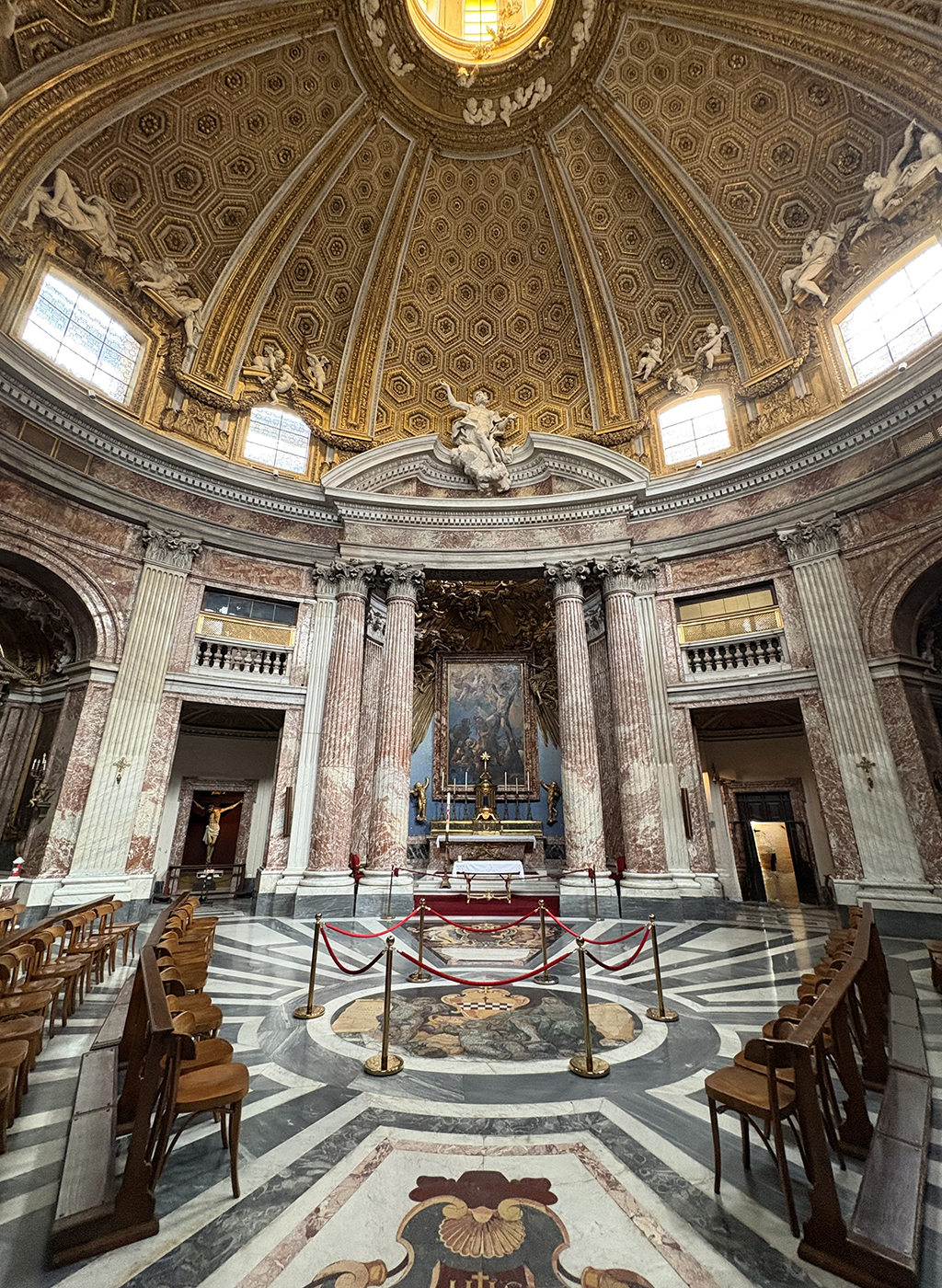
Sant’Andrea al Quirinale — while waiting to enter San Carlo, we walked through a nearby garden and, after, had another serendipitous discovery. Next to the garden was Sant’Andrea, which turned out to be designed by Bernini. According to his son, it was his favorite — a work he considered his most perfect. It is a beautiful oval church with the entry on the flat side of the oval, an accommodation to an unusually shallow site that would not accommodate a long linear nave. A very nice find.
______________________________
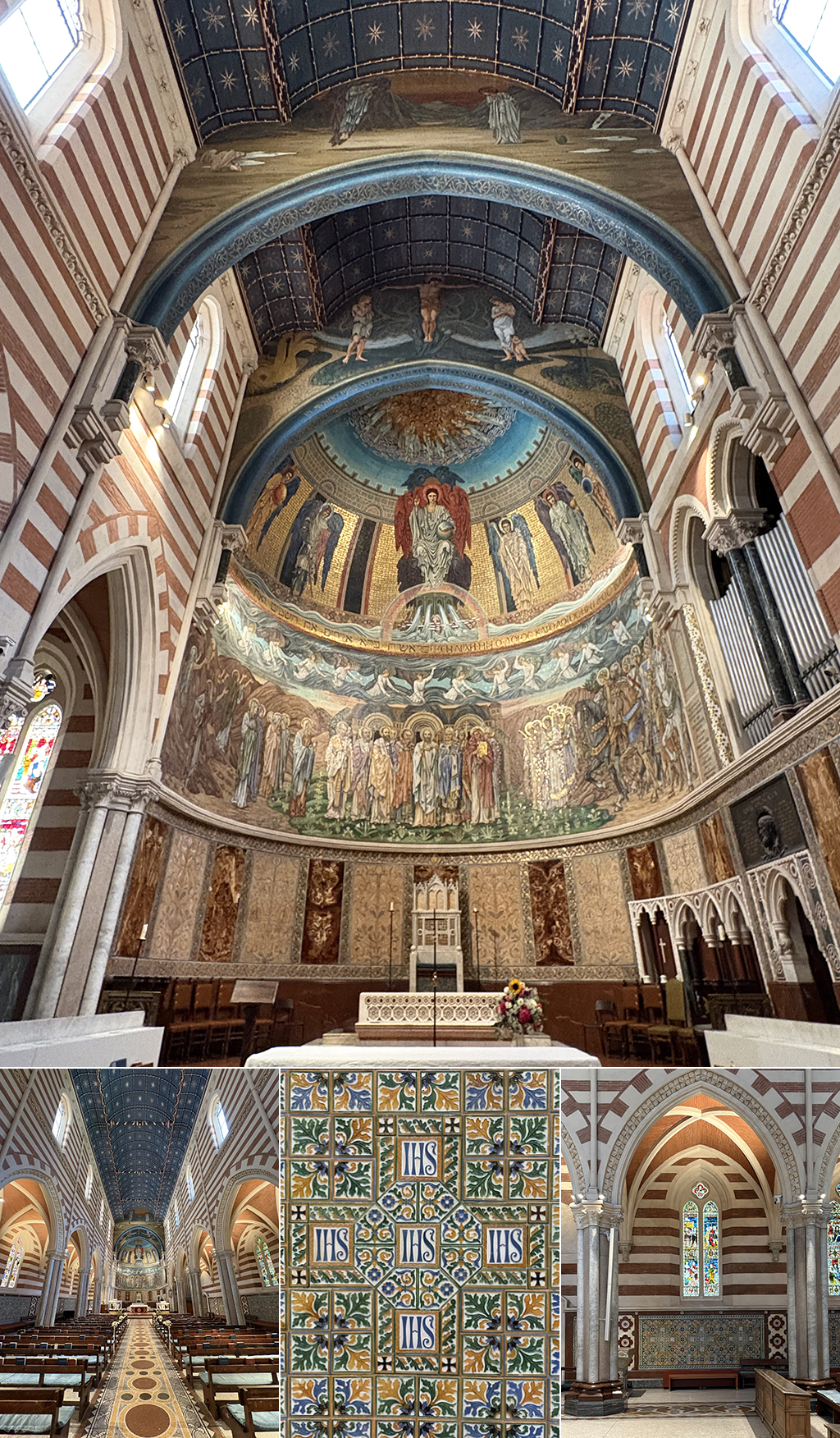
Saint Paul’s Within the Walls — third time’s a charm, right? After several attempts to visit over the years, we finally got in after outwaiting yet another wedding in progress during their regularly-scheduled open hours. Saint Paul’s Within the Walls, also know as the American Church of Rome, is a late 19th-century British Pre-Raphaelite treasure trove. The building was designed by George Edmund Street, and much of the interior decoration is by Edward Burne-Jones. The mosaics are incredibly beautiful, as is the tile work that lines the walls of the side chapels. The gorgeous stained glass windows were created by Clayton and Bell. In spite of the sound of traffic outside on Via Nazionale, it feels like it has been transplanted from London.
______________________________
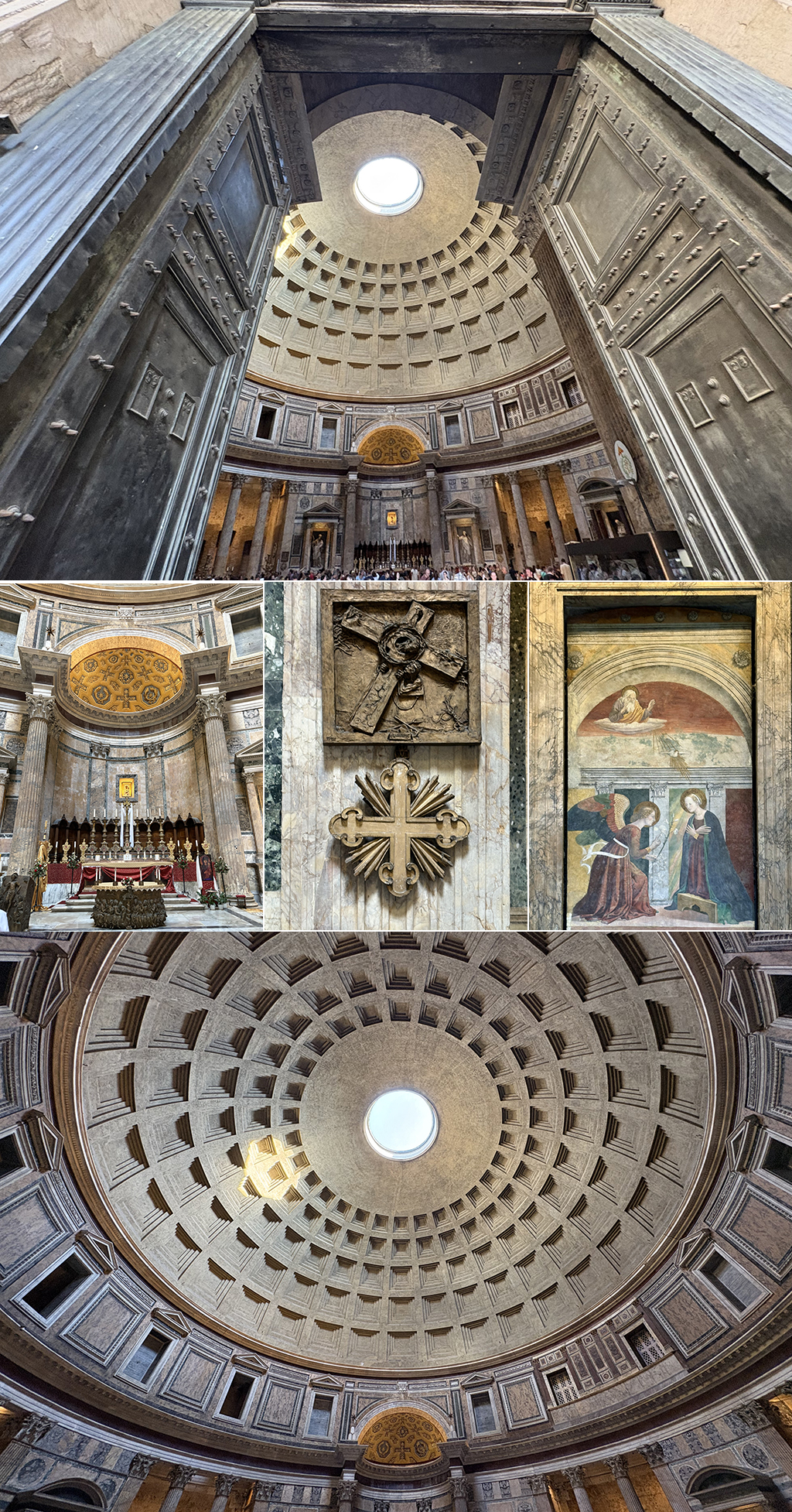
Pantheon — one of the most iconic buildings in all of Rome, the Pantheon was built in the 2nd century as a Roman temple and was converted to a Catholic Church — Basilica Santa Maria ad Martyres — in the early 600s. That suffix, “ad Martyres” is because the pope who converted this to a church brought the bones of (presumed) early Christian martyrs transferred here from the catacombs. Almost two thousand years after it was built, the Pantheon’s dome is still the world’s largest unreinforced concrete dome. The height to the oculus and the diameter of the interior circle are the same: 142 feet. The scale is hard to grasp, but as a reference point, the oculus, or skylight, is about 30 feet, as big as a house. In the renaissance, the hugely-admired artist Raphael was buried there, the first burial there since the martyrs’ bones were moved here nine centuries earlier. Three centuries after Raphael’s burial, and after Italy’s unification into a single country, the kings Vittorio Emanuele II and Umberto I were buried in the Pantheon, as well as Queen Margherita (in whose honor the Neapolitan pizza was re-named). Buy timed tickets in advance and select the last entrance time of the day when there are generally no group tours and fewer tourists, as it is getting on to their dinner time; advance tickets at that hour also mean no wait in line. Toward the end of our visit, there were very few people inside which gave us a completely different feel for the tremendous space.
______________________________
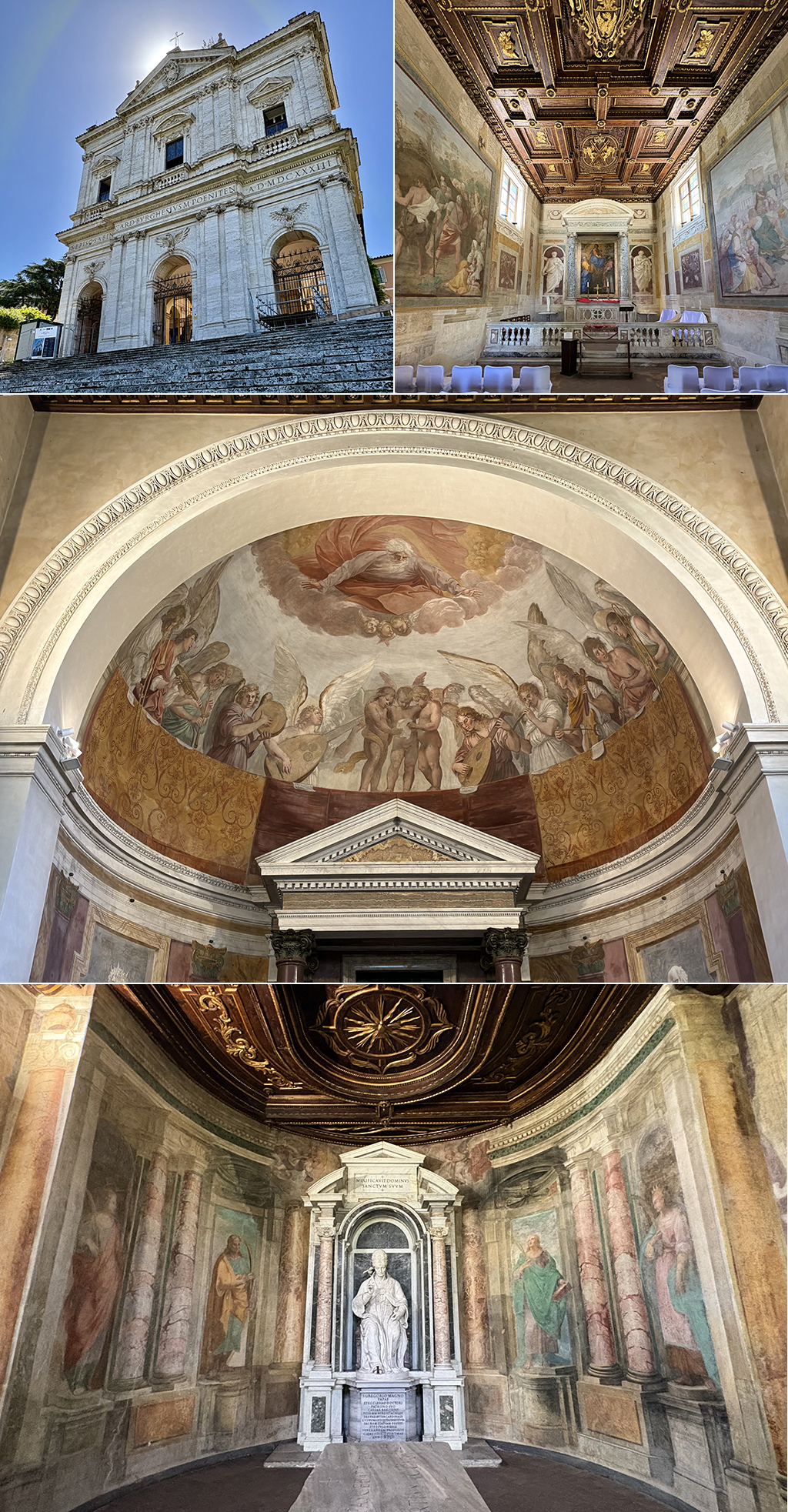
San Gregorio Magno al Celio and the Oratorios of Sant’Andrea, Santa Silvia, and Santa Barbara — On the Caelian Hill, near the south end of the Circus of Maxentius (Circo Massimo), you will find the church of Saint Gregory the Great (Pope Gregory I), and in the garden to its left three little oratorios. The site – the whole hill, for that matter – is quiet and untouristed. The church was one of many church interiors in scaffolding and closed, however the three 17th-century oratorios beside it were open for visiting — Santa Silvia, the one closest to the church, is dedicated to Gregorio’s mother. Next to that is Sant’Andrea featuring frescoes by Reni and Domenichino. The third oratorio is named for Santa Barbara. In the center of the latter is a marble table, from the triclinium (dining room), of Pope Gregory’s family home over which the church is built — a table at which Gregory is said to have fed 12 poor men each day.
______________________________
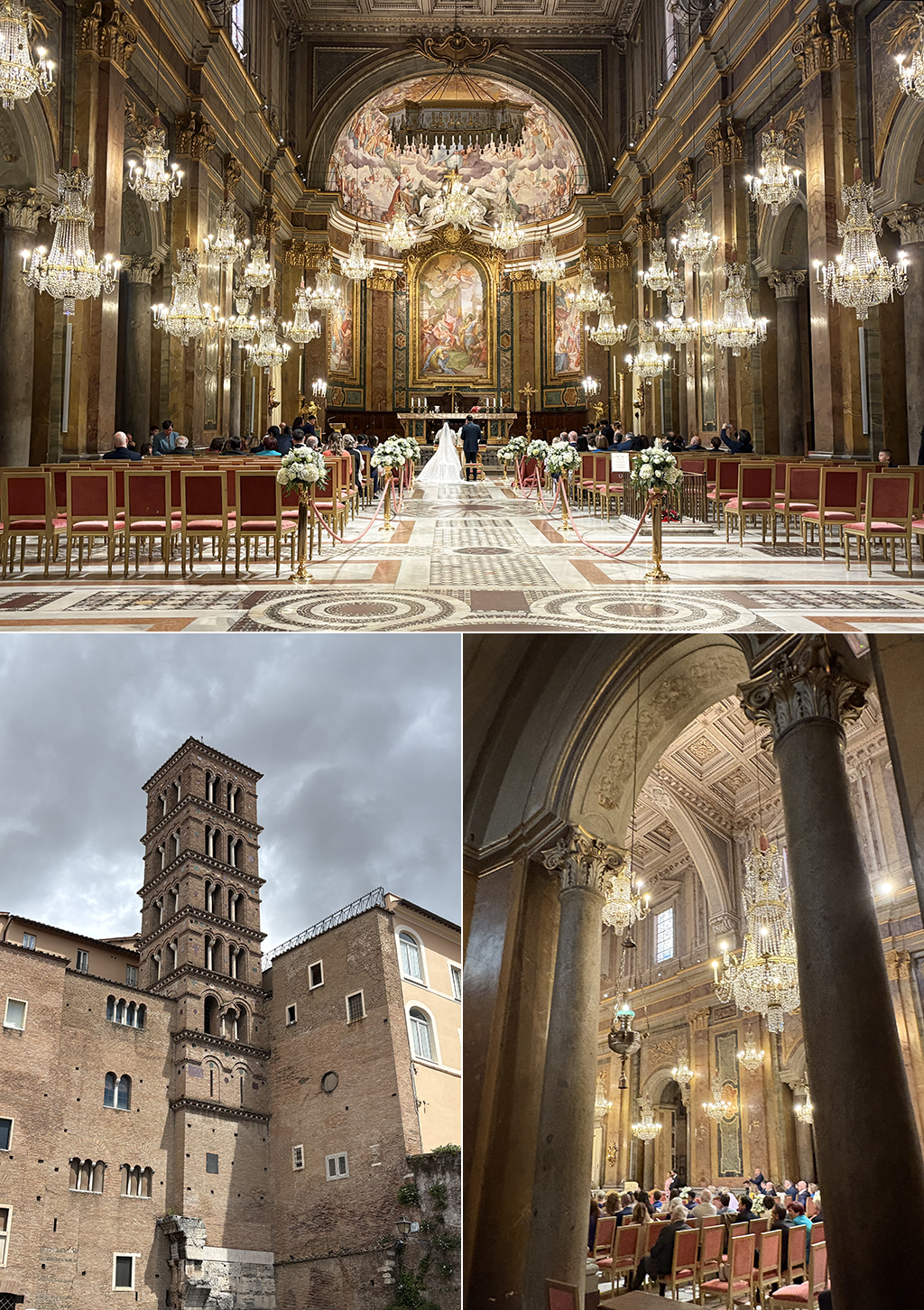
Santissimi Giovanni e Paolo — this, again was a quick visit as there was a wedding in progress. Saints Giovanni and Paolo Rome is an ancient basilica church built in AD 398 on top of the homes of two martyred Roman solders, John and Paul. The houses were excavated in the 19th century and are now open as the Case Romane del Celio — I’ll go into more detail in my third Rome installment. The church above is braced by buttresses that arch over the steep narrow street beside it. The interior glitters with twenty-some crystal chandeliers gifted by the mid-20th-century American Cardinal Spellman, purportedly procured from the old Waldorf-Astoria Hotel with some financial help from Joseph Kennedy.
______________________________
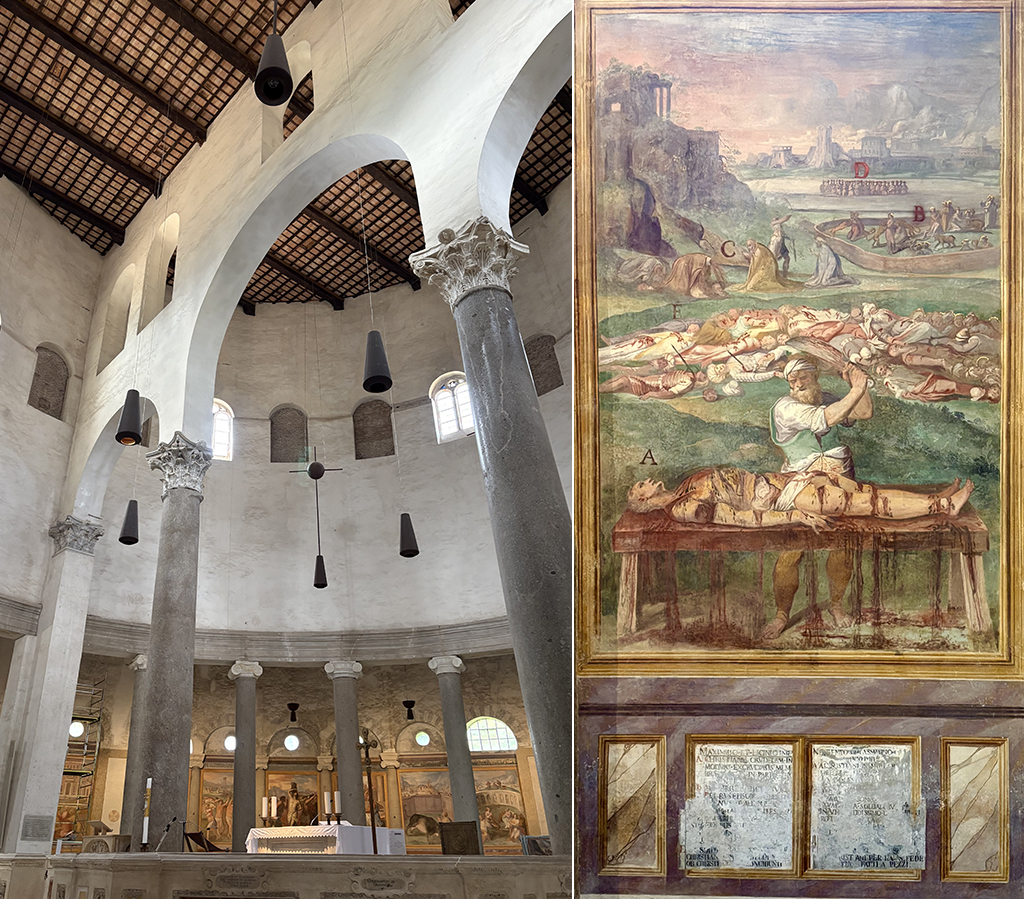
San Stefano in Rotondo — also known (to me) as Saint Steven’s House of Horrors. This is the oldest circular church in Rome built in the 5th century (note: the Pantheon is an older building but was not built as a church). Additional to its unusual and spacious architecture, it is known – if known at all – for its vivid, disturbing frescoes commissioned by Pope Gregory XIII in the 16th century. They depict 34 scenes of early Christian martyrdom, complete with name-shaming of the emperors responsible. At six by nine feet, these are not small, demure paintings. I’m sure teens would find this as fascinating as they find zombie movies.
______________________________
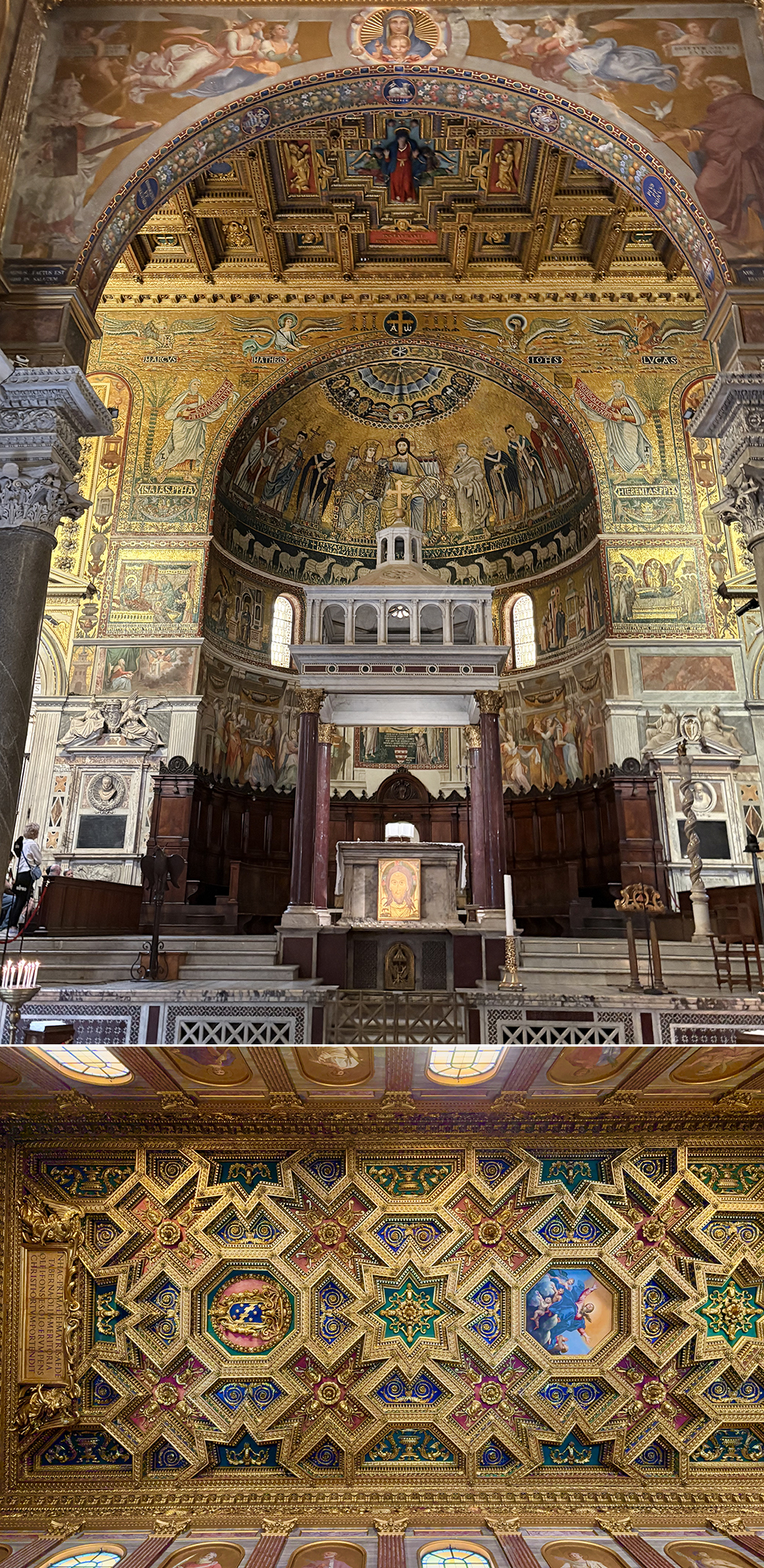
Santa Maria in Trastevere — every time we head across the river to Trastevere, we include a visit to the Basilica di Santa Maria in Trastevere. It sits in a beautiful piazza with a central fountain, and is considered to be the oldest church in Rome dedicated to the Virgin Mary (3rd century AD). It was mostly rebuilt in the 12th century, and it is known for its shimmering medieval mosaics at the end of an otherwise straightforward baroque nave.
______________________________
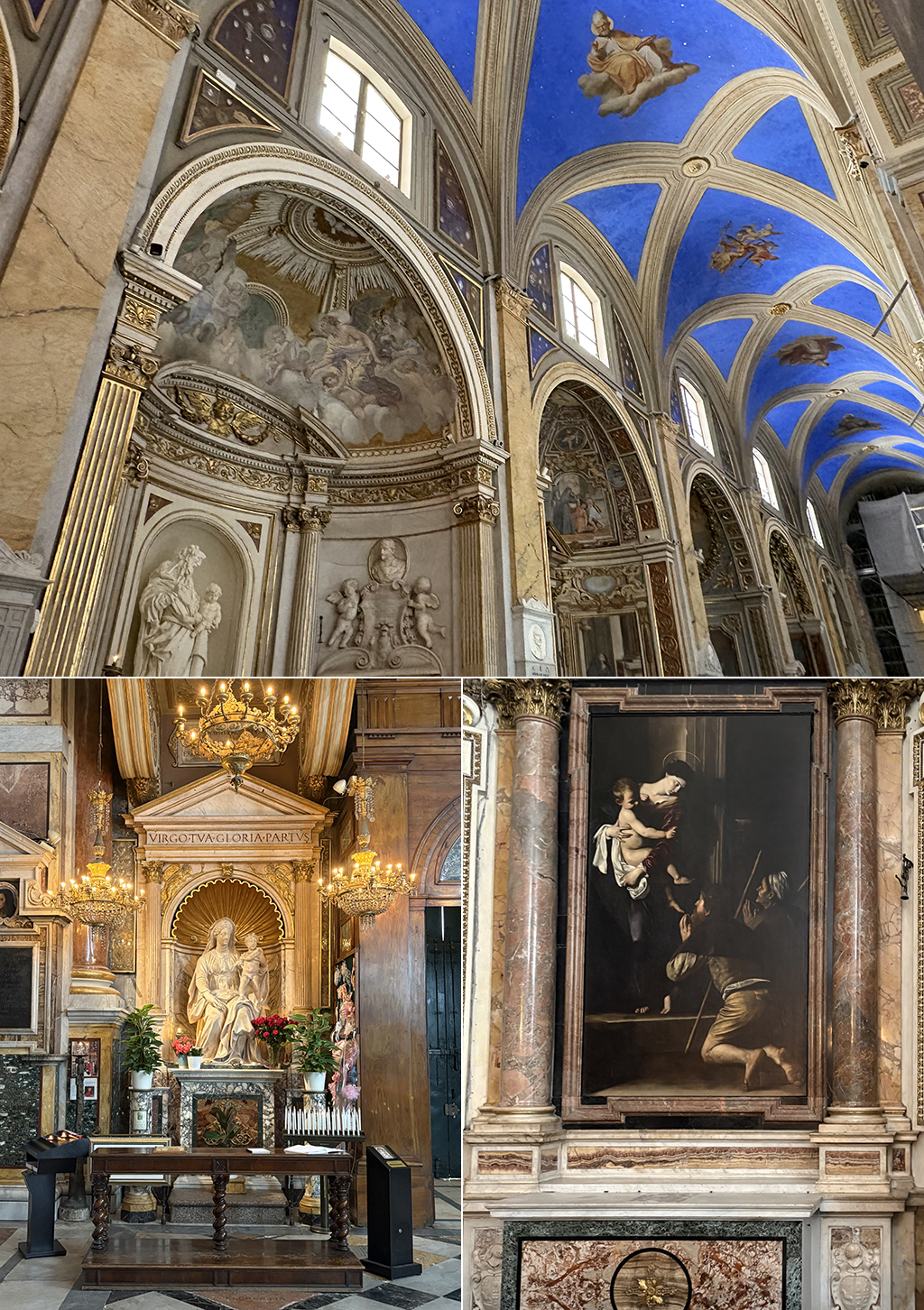
Sant’Agostino — this is a wonderful church to combine with a visit to the Palazzo Altemps or the Biblioteca Angelica next to it (more on those in another post). The church interior is beautiful but is currently covered in scaffolding. It has a very nice Caravaggio painting in the first chapel on the left, but the Raphael painting for which the church is also known was behind the scaffolding. In addition to Mark’s Bernini Crawl, he also had a belt with notches for every Caravaggio we saw, and it was nice — and unexpected — to add another notch. And how clever was I to take photos that dodge the scaffolding?
______________________________
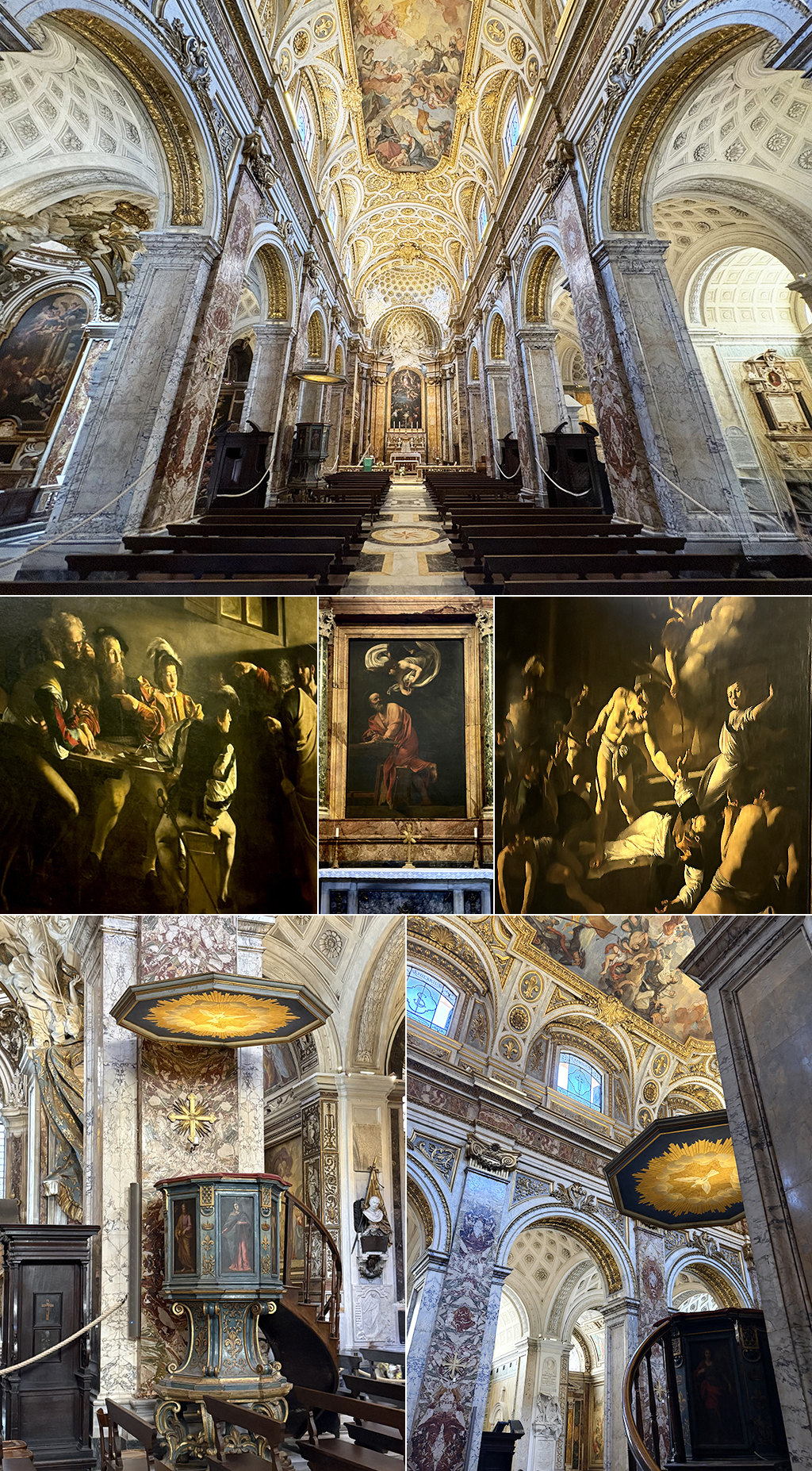
San Luigi dei Francesi — our final stop on Mark’s Caravaggio Crawl was a visit to San Luigi de Francesi, Saint Louis of the French, dedicated to the patron saints of France: the Virgin Mary, Saint Denis, and King Louis IX. It is the national church of France in Rome; the attendants even spoke French! It was built in the late 17th century and was designed by della Porta, who, you might remember from the church of Il Gesù, and had support from Catherine de’Medici, the Italian queen of French King Henri II. The Contarelli Chapel (far left) contains three stunning paintings by Caravaggio portraying the life of Saint Matthew; these paintings exemplify his strong and strange compositions, and theatrical lighting, that were soon hugely influential on other painters.
Next week, I will share some of the palazzi/villas we visited with one addition non-palazzo/villa site: a library.
~ David
Developed and maintained by Inspiratech LLC.
Design by Themeshift.
Jill W Becker
July 1, 2026 at 2:37 amWhat beauty…and to have the descriptions and history. I wonder how many people who attended church in these magnificent buildings were listening or just admiring the beauty surrounding them. Thanks for sharing. Looking forward to next weeks installment.
David Scott Allen
July 1, 2026 at 10:02 amJill — I know that, as a child in church, I was looking at all the architectural elements, the colors in the stained glass, etc. I think that answers your question!
Eha Carr
July 1, 2026 at 4:17 amThank you! I have been to Rome well over a dozen times . . . to my shame have been to the Pantheon and two, possibly three of the churches you have photographed so beautifully. Well, asking Mr Google’s help as usual, shall take your visits one by one and do some homework to ‘catch up’ and differentiate . . . the very romantic me wants to know more about the not-so-old chandeliers also . . .
David Scott Allen
July 1, 2026 at 10:00 amThe not-so-old chandeliers (in several churches) are proof that the buildings are living organisms — they change with the times.
Mad Dog
July 1, 2026 at 5:15 amStunning and you’ve done a great job photographing all those beautiful interiors!
I always go and look at churches. There are some in Spain still blackened by centuries of candle light and I’ve noticed recently that the red candles are dispensed by a vending machine!
David Scott Allen
July 1, 2026 at 9:59 amLove the candles from a vending machine! More anymore, they are using electric or battery operated candles. They lose on the romance scale.
Mimi Rippee
July 1, 2026 at 5:22 amIncredible! You really have taken some stunning photos of these churches. Three weeks!!!
David Scott Allen
July 1, 2026 at 9:57 amThanks, Mimi! I know — but we felt three weeks just wasn’t enough!
Barb
July 1, 2026 at 7:25 amDavid, this is the most incredible history lesson I’ve ever had!!! Did you take all of those exquisite photos with your cell phone camera? Regardless of the type of camera you used the photos are truly amazing! You captured the incredible architecture and art work beautifully! I truly appreciate the many hours of work you do to share the fabulous places you visit with us.
David Scott Allen
July 1, 2026 at 9:57 amThank you so much, Barb. I am always in awe when I enter these places — and there are quite a few more I didn’t mention. I had to stop somewhere, right? Yes, for the first time in my adult life, I didn’t travel with a camera — just my iPhone 16. It takes great photos and I was generally very happy.
angiesrecipes
July 1, 2026 at 8:00 amGosh, all the churches look quite impressive. I am in awe of all the details and the works they have put into them. Did you take those photos with iphone? They are so amazing!
David Scott Allen
July 1, 2026 at 9:52 amThey are so incredibly beautiful and the artistry that it took to complete them is outstanding. For the first time ever, I traveled without a camera. I used only my iPhone to take all these photos. I was very happy with the results! Thanks for saying you enjoyed them.
Terry Temple
July 1, 2026 at 12:26 pmYour photography takes us deep inside all of this Awesome beauty. Thanks David
Safe journeys and God Bless
David Scott Allen
July 1, 2026 at 12:38 pmThanks, Terry — it is a truly wonderful city. Have you been?
Frank | Memorie di Angelina
July 1, 2026 at 3:43 pmGorgeous! You’ve captured so wonderfully some of my favorite churches in Rome—and a couple, believe it or not, I never got around to visiting. Kudos for your photography, the ceiling of Sant’Ignazio in particular is a stunner!
By the way, your story about the crowds at Santa Maria del Popolo (sadly closed when we were last in Rome) reminded me of a similar experience I had at Santa Maria sopra Minerva, where the crowds walked right past a marvelous Christ by Michelangelo himself without a glance and ignored the amazing Carafa Chapel with its breathtaking frescos by Filippino Lippi. Not that I’m complaining. Nice to be able to have these marvels to yourself…
David Scott Allen
July 2, 2026 at 8:22 amThank you, Frank — I really enjoyed putting this together. I can’t believe we hit a few places you haven’t been! Thanks for your comment on Sant’Ignazio. On my first trip, I thought I got a perfect shot only to discover afterwards that the focus was way off. I could hit wait to get back to make sure that didn’t happen again. Isn’t it the most glorious ceiling? You would be mortified by the crowds nowadays.
The Christ in Santa Maria Sopra Minerva is stunning — we missed it this time but saw it (and the Lippi frescoes) two years ago. I’m glad you had them to yourself.
Jane Sanders
July 1, 2026 at 4:13 pmMy Mom, who lectured for many years about 17th ,18th & 19th Century furniture at the Frick Museum, always told me to: “Look up” when visiting museums, churches, palaces, etc. . Can you imagine what you (and therefore us) would have missed if that advice wasn’t followed! Thank you so much for sharing the incredible photos and wonderful history lessons with all of us.
David Scott Allen
July 2, 2026 at 8:10 amWow, Jane, did you grow up with your mom taking you to the Frick? What a treat that would’ve been. I’ve heard they’ve done a lot of work and I would love to see it again. I don’t know who taught me to look up, but I do remember someone telling me that that’s something I should do. A great piece of advice.
Raymund
July 1, 2026 at 6:03 pmThis was such a lovely read, short, warm, and full of that classic David charm. And honestly, seeing all those churches again made me a little wistful; I’ve been to many of them myself, and now I’m really missing those slow Roman wanderings, stepping into one cool, echoing space after another. It’s amazing how a city can stay with you long after you’ve left.
David Scott Allen
July 2, 2026 at 8:09 amDid you live in Rome, as well? I’m glad they brought back more wonderful memories. Yes, a place staying in your heart after you leave is a beautiful thing. Sometimes it’s hard to go back but, more often than not, it’s a visit filled with wonder.
Joseph McClain
July 2, 2026 at 7:45 amBrava, great photos, great comments and most of all I love your love of these places!
David Scott Allen
July 2, 2026 at 8:07 amThank you so much, Joseph — I am so glad you enjoyed it.
Marian Jensen
July 2, 2026 at 8:41 pmWhat a wonderful post, David. We share a love of Rome — you may remember it’s our favorite city–and visiting the churches there. Your notes and photos are outstanding. I always say the next magnificent thing is right around the corner (or just inside the churches) in Rome.
Looking forward to your next post. It’s like I’m on a Roman Holiday!
David Scott Allen
July 3, 2026 at 9:05 amYou are so right, Marian! No matter which way you turn in Rome, there is something magical just around the corner. Thanks for reading — I’m so glad you enjoyed it!
Christina
July 10, 2026 at 1:38 pmIt’s always mind boggling to me just how many churches and cathedrals there are in Rome. I still pop into every one that’s open when I’m wandering around. You hit some amazing ones, and I’m with you with the photo shoots inside religious places. What’s there NOT to understand about respecting others’ religious spots? Why there? Infuriating, but I’ve seen it so many times, as well. Ugh.
David Scott Allen
July 11, 2026 at 2:02 pmHonestly, it was appalling to us, then things we saw. We also saw it in Morocco. I just don’t understand how this younger generation can think like that. (Aren’t I sound like an old codger?)