
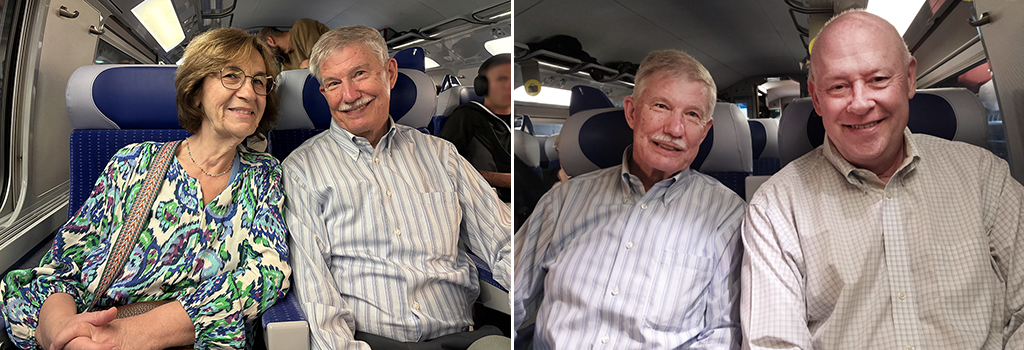
Our friend Marie-Lise, who lives in Paris, comes from the small village of Morette just northwest of Grenoble, in the Isère department. It is in the rolling hills above the Isère River to the west of the Massif du Vercors. She has a lovely home there with stunning mountain views. After Paris, we enjoyed a few days with her there to relax following our busy time in the big city. We travelled by train.
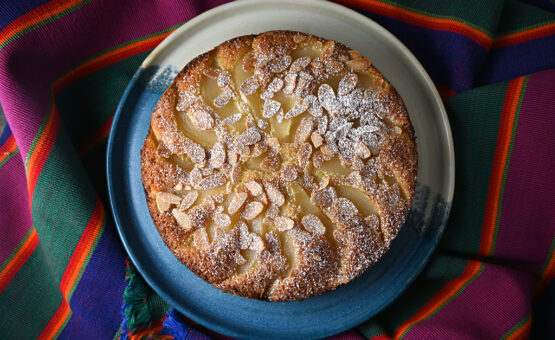
Morette and the region are know for growing walnuts, and Marie-Lise’s family are walnut farmers. The whole area is resplendent with beautiful walnut groves. On her kitchen hutch, there is a large wooden bowl filled with nuts from her family trees, harvested and dried last autumn. One evening,while sipping wine, nibbling bread and cheese, and exchanging stories and laughter, the three of us took turns cracking walnuts, so I could make a gâteau aux noix — a recipe you will soon see on Cocoa & Lavender.
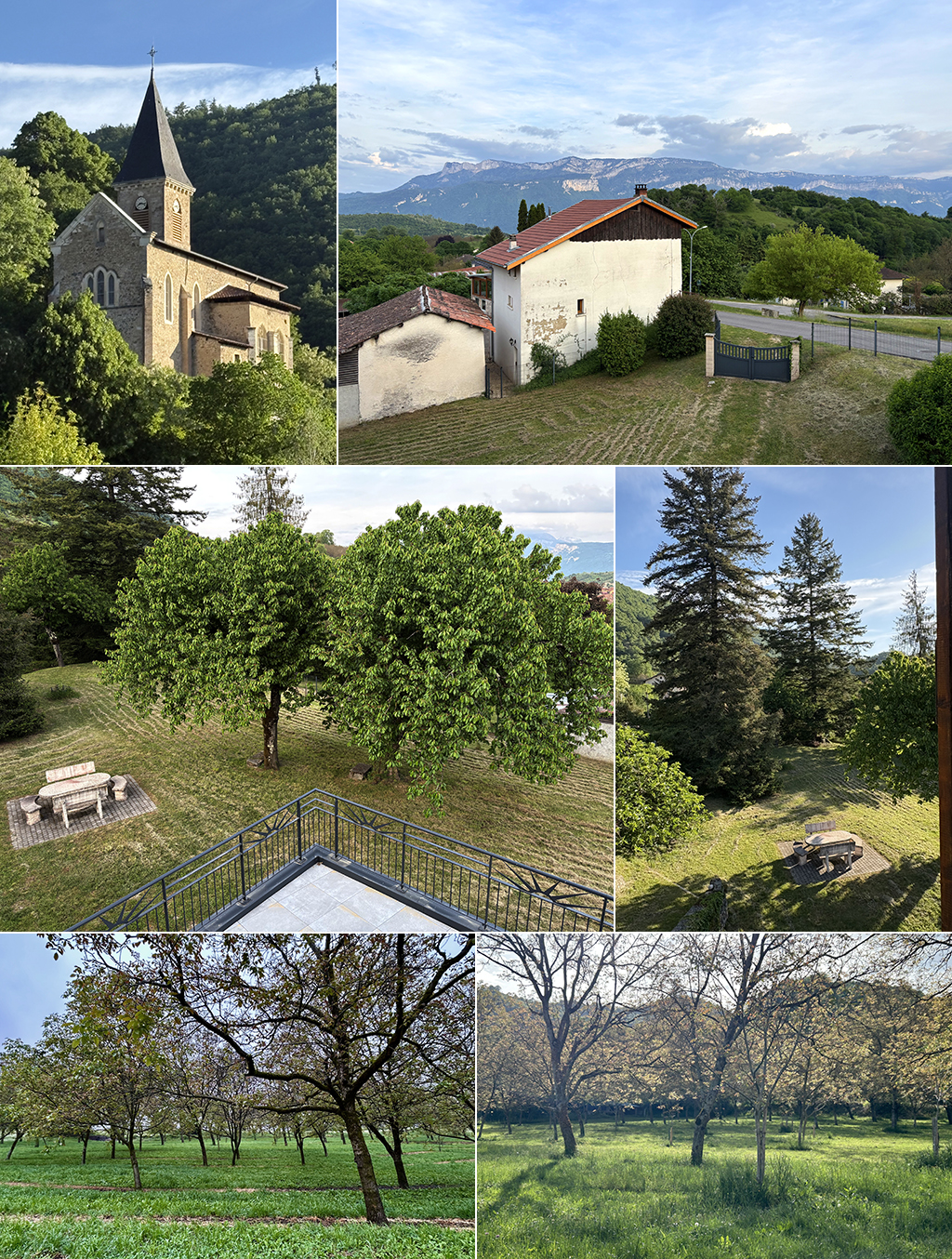
While you might not think there is a lot to do in a small village, a short drive got us to some fascinating places, far off the beaten path, which satisfies our preference for places with few (or no) tourists.
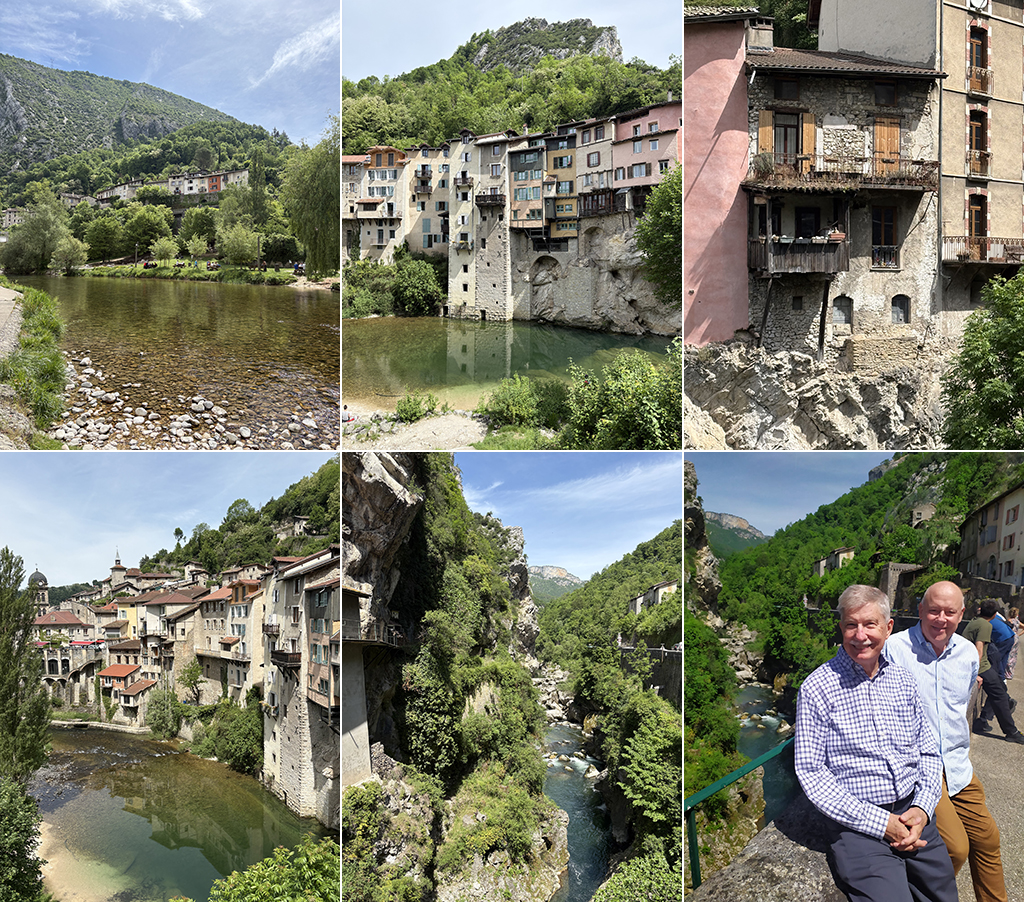
Our first stop was the commune of Pont-en-Royans in the Auvergne-Rhône-Alpes region on the Bourne River, a tributary of the Isère. This village consists of medieval homes that are precariously cantilevered over the river gorge. We strolled around for a while, enjoying the roses and wisteria hanging over garden walls, descended and crossed the river, walked along its babbling course, and then ascended several flights of stairs to get to a restaurant for lunch: M. Baret. Mark and I both had the local specialty of Ravioles Dauphiné — tiny, cheese-filled ravioli in a blue cheese and walnut cream. They were quite good and very filling. The restaurant is built into the side of the cliff with bedrock as its back wall, and has beautiful views of the village. The only downside to this town was that it has been found by bikers that often made a lot of unnecessary noise. Tant pis.
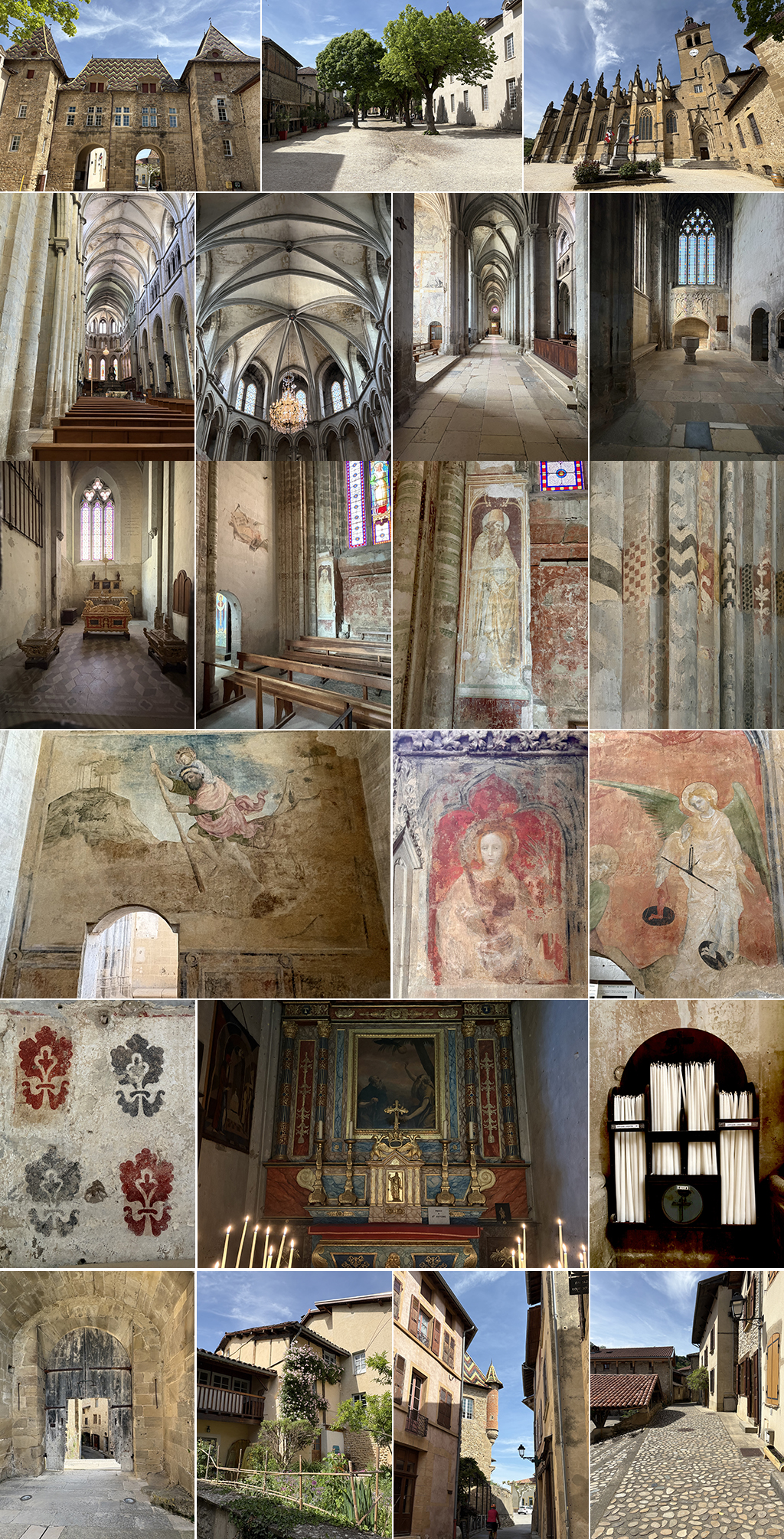
After lunch, we drove on to the Abbaye de Saint-Antoine. Built between the 12th and 15th centuries, the abbey houses the relics of Saint Anthony the Great (of Egypt) which were moved to France sometime in the 1000s. It was the main church for the Hospital Brothers of Saint Anthony. The monks who inhabited the abbey were known for treating ergot poisoning, historically known as “St. Anthony’s Fire,” using herbs and tinctures they made from plants in their garden. This was before the modern knowledge that ergot comes from a mold that is mostly associated with rye grown in damp climates. The abbey is situated in the eponymous commune of Saint-Antoine-l’Abbaye, which has been designated one of The Most Beautiful Villages of France. And it is.
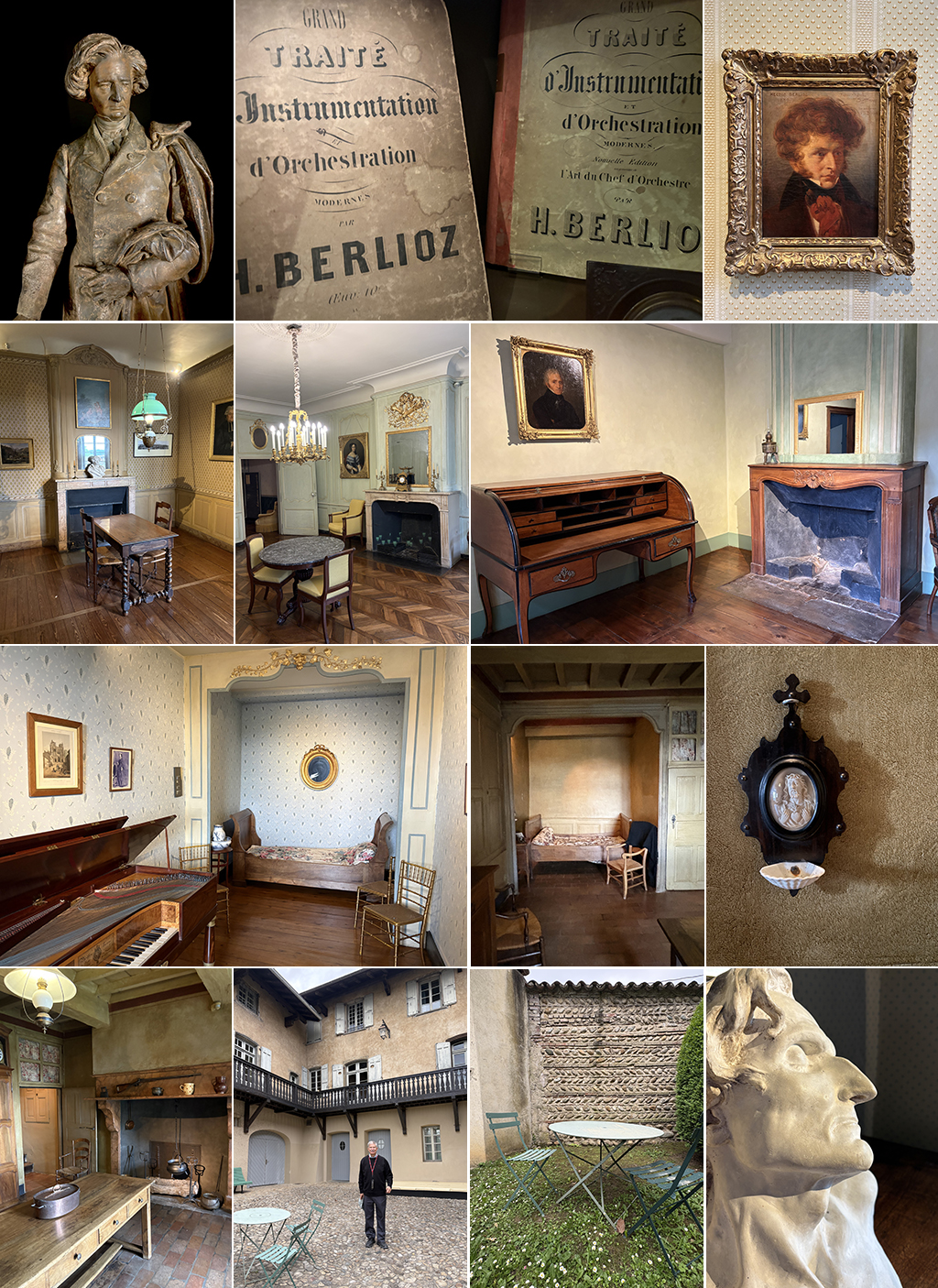
Early one morning, before daylight, Marie-Lise was searching online for activities for the day, and discovered that the French Romantic composer Hector Berlioz was born just over the hill (forested mountains, really). The town of Côte Saint-André has a long, ordinary, old-fashioned French business street on which we found the stolid home of Berlioz’ parents. The ground floor of the house museum was devoted to formal exhibits about the romantic era, giving context for Berlioz’ music. Upstairs, the first floor was series of rooms with beautifully-reproduced historic wallpapers, some furnishings, and cases with objects of historical significance. On the second floor were formal exhibits, including letters Berlioz had written, and musical instruments of the type he learned to play as a boy. One fascinating room was devoted to later technology for recording music (cylinder recordings, gramophones, record players, even radios), a reminder that in his day, one heard music live or not at all. Behind the house was a very nice garden where, in spite of the gray chilly day, we found several people painting watercolors while another reclined in a chair, reading — a charming scene.
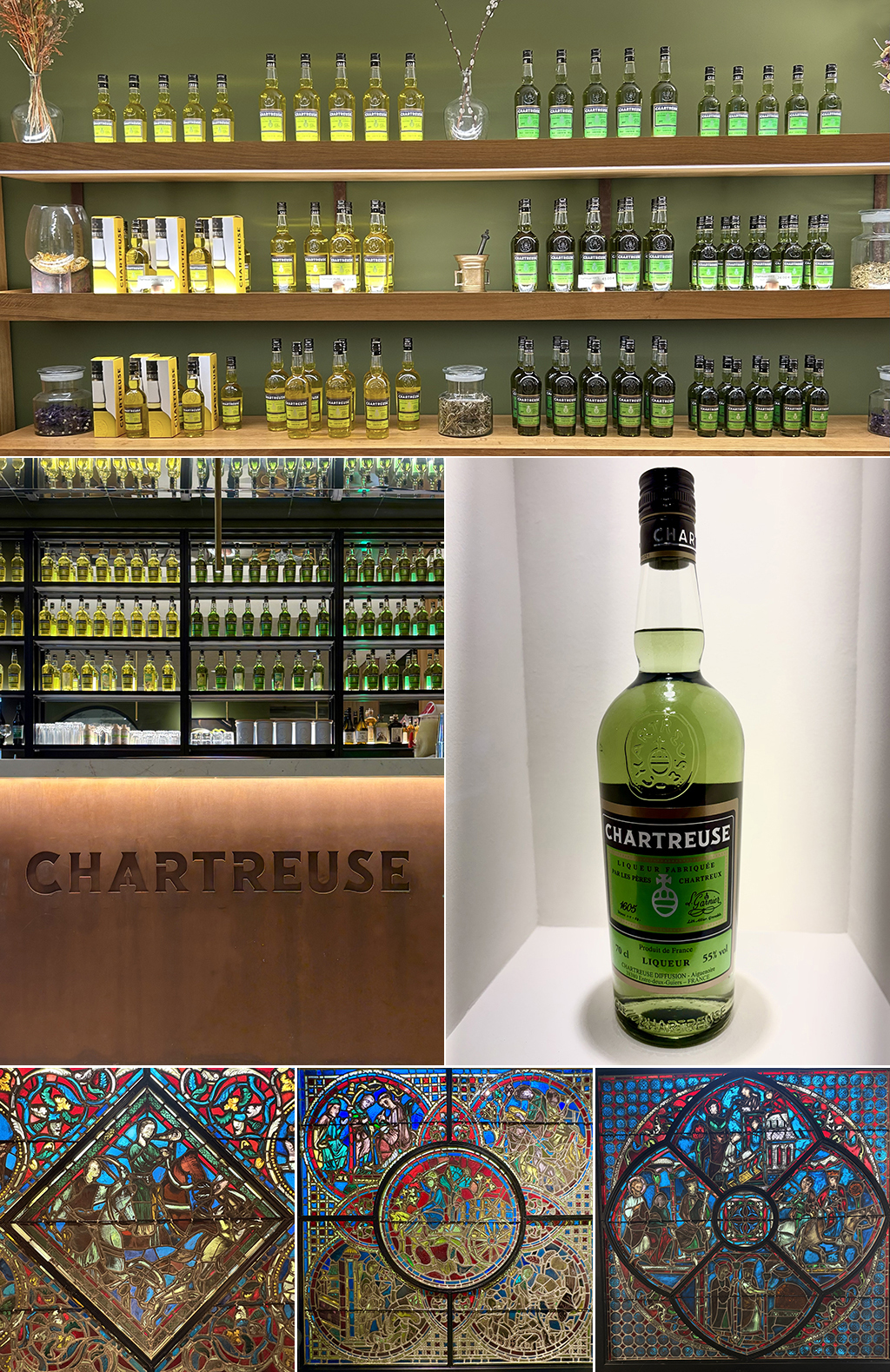
Our final outing took us (in the rain) further east to Voiron to visit the Caves de Chartreuse nestled between the Chartreuse Mountains and the Massif du Vercors. To most people, this region is best known for the herbal liqueur, Chartreuse. Being a fan of digestifs like Chartreuse, we felt a tour and tasting were de rigueur. Our tour included a variety of galleries with old engravings, photographs, documents, advertisements, utensils, and scale models related to the monastery of Chartreuse. We learned that 133 herbs and spices are used to make Chartreuse, and the difference between yellow and green is the amount of sugar and alcohol. The green (55% alcohol) is very strong and was considered medicinal. The yellow (at 43%) is sweeter and was considered more of a digestif. The green has roots in the early 1600s as a recipe for a medicinal liquor, and its recipe was given to the order of monks by the family who had created it and didn’t know what to do with it. Today, at any given time, there are only two monks who know the recipe, and they can never travel together. Production moved several times for different reasons (including revolution), even as far as Tarragona, Spain. The facility we visited in Voiron was a production facility but it closed in 2017 when production was moved yet again. The tour finished with us tasting the elixir (just a couple of drops on a meringue) and then, in another tasting room, sips of the yellow and green varieties. Photos weren’t permitted on the tour, so all I have is the stylish bar (what museum doesn’t have a cocktail bar?) and its stained glass windows. Funny note: the windows are replicas of those in Chartres Cathedral, yet there is zero connection between Chartres and Chartreuse.
I hope you enjoyed a taste of the Isère region as much as we did. Many thanks to Marie-Lise for being a wonderful hostess.
Developed and maintained by Inspiratech LLC.
Design by Themeshift.
Eha Carr
June 17, 2026 at 4:12 amWhen you commented we might perchance wonder what there was to do in a small Village I remember my older Polish cousin’s words ‘Eha, why do you always have to do, why can’t you sometimes just be ?’. How true, as I have found out in life. BUT – besides contentedly ‘being’ there was quite a bit ‘to do’ in that scenically very lovely area, wasn’t there 🙂 . Love your photos – be they of the walnut trees or the Abbey or finding out Chartreuse came in two colours . . . thank you for the meander . . .
David Scott Allen
June 20, 2026 at 6:49 amOften, when we travel, we spend some time just “being“ because that’s part of being in a place. Mark‘s mother used to admonish us for sitting in a café, drinking hot chocolate when we could be in a museum! We finally convinced her that art and culture don’t always mean taking ourselves to a building filled with paintings.
Mimi Rippee
June 17, 2026 at 5:37 amOh my goodness. Drop me in a French village and I’m at my happiest. What gorgeous scenery. I’m afraid I would think chartreuse tastes like cough syrup…
Debbie Thomas
June 18, 2026 at 4:02 amI so enjoy your writings of the wonderful trips that you and Mark take and the beautiful photos.
You both look amazing.
Thank-you for sharing your adventures.
Love, Debbie
David Scott Allen
June 20, 2026 at 6:42 amThank you, Debbie. It’s a really way to share our travels with people who couldn’t be there!
David Scott Allen
June 20, 2026 at 6:48 amThat made me laugh, Mimi. Perhaps that’s why they call it medicinal?
Carolyne
June 17, 2026 at 6:18 amWhat a wonderful side trip. Your photos are beautiful, as always.
David Scott Allen
June 20, 2026 at 6:47 amThanks, Carolyne!
Barb
June 17, 2026 at 8:13 amWhat a charming place to visit! It must have seemed like stepping back in time. Fabulous photos! I looked up the gâteau aux noix — it looks and sounds delicious. Looking forward to seeing your version on C&L.
David Scott Allen
June 20, 2026 at 6:47 amThanks, Barb. I’m pretty sure my version of the cake will be quite different as it has changed changed over the years.
Mad Dog
June 17, 2026 at 9:13 amHa ha tant pis indeed!
That looks like a fabulous trip to la campagne. I love that kitchen in the Berlioz home!
I’m quite fond of Chartreuse and have read up about it’s history previously. Those monks were kicked out of France twice, which is why they moved the distillery to Catalunya. The chupitos of Hierbas, handed out at the end of a Catalan lunch taste quite similar to the more refined and expensive Chartreuse. Similar but different, when Absinthe was banned in France, Absenta continued to be made south of the border by Pernod Fils, also in Tarragona. There are several very old Absinthe bars in Barcelona.
I’m looking forward to your gâteau aux noix recipe.
David Scott Allen
June 20, 2026 at 6:47 amWe stopped counting the number of times that the monks were kicked out of their lodgings. But, yes, twice out of France. They had a rough go of it! I, too, like chartreuse, especially as a digestive after dinner. Yes, the kitchen and Berlioz’ home was really nice — as you can imagine, kitchens are my favorite parts of any house.
angiesrecipes
June 17, 2026 at 11:10 amWhat a great place to live! Look at that mountain view…I am swoon! I look forward to your gâteau aux noix.
David Scott Allen
June 20, 2026 at 6:45 amI’m working on the cake this week, Angie! You should see it fairly soon.
Jill W Becker
June 17, 2026 at 4:13 pmOne word describes this part of your trip – charming, so so charming. Now perhaps the story of how you met your hostess – Marie-Lise.
David Scott Allen
June 20, 2026 at 6:44 amOh, Marie-Lise and I met Back in the mid 1980s when she came to the university at Albany to study marketing and was a teaching assistant in the French department, where I had several friends. We’ve been friends ever since.
Sherry M
June 18, 2026 at 1:23 amwow that is a lot of herbs and spices 🙂 what a fab trip you had David. So only 2 people only ever know the formula? Sounds like an accident waiting to happen…
sherry
David Scott Allen
June 20, 2026 at 6:44 amThat is exactly what we were thinking, Sherry — only two people with the recipe doesn’t seem like a good idea.
Raymund
June 18, 2026 at 4:39 pmThis was such a lovely read, it really felt like I was tagging along with you through those quiet mountain villages and walnut‑lined roads. I love how you capture the charm of these out‑of‑the‑way places without ever overselling them; the mix of history, food, and those little human moments (like cracking walnuts over wine) makes it all feel so warm and real. Honestly, you’ve made me want to hop on a train and disappear into rural France for a while.
David Scott Allen
June 20, 2026 at 6:41 amI don’t think you would regret disappearing into rural France (or Switzerland, or Germany) for a while. They are beautiful countries.
Pauline McNee
June 22, 2026 at 6:37 pmI never tire of what medieval villages have to offer, and how on earth did they build in such precarious locations. I’ve just looked up the map to see where you were in relation to us, when we were very recently at Montpellier, Avignon, the Carcassone, etc and you were more inland, but only about 3 hours North by car all within driving distance of Geneva, how exciting. Loved reading your travel diary, and such beautiful photos.
David Scott Allen
June 25, 2026 at 4:49 pmI know exactly what you mean — building those must have been so dangerous! I knew we would be close by one another when traveling — how nice it would have been to meet up. 🙂
Valentina
June 25, 2026 at 8:29 pmWow, David, what a truly special village with so many treasures. Your photos are absolutely beautiful – I wish I could just jump into them! So fantastic to have a local friend in a new place. The best! What a lovely tour you took us on – it doesn’t get much better than gorgeous old buildings built into the cliffs. 🙂 ~Valentina
David Scott Allen
June 26, 2026 at 9:08 amIt was such a fun visit to the region. I hope your travels will soon appear on COTW!
Inger
June 29, 2026 at 10:16 amSuch a lovely and unique experience! I always remember the stories from my dad on business trips in smaller towns in France and Italy. I am really going to need to get past my fear of renting a car in Europe.
David Scott Allen
June 30, 2026 at 2:33 pmI’m really with you on the fear/anxiety about car rentals in Europe. It’s not fun, though it does enable you to do a lot. We take trains a lot — and it is amazing how many small towns are connected.
CC
July 10, 2026 at 1:53 pmWhat a wonderful trip you had! Just my cup of tea, and the perfect combination of food and culture! I can’t wait for the end of September when it will be my turn (haven’t been anywhere since October!) Thanks for sharing your travels with us, David!
David Scott Allen
July 11, 2026 at 1:59 pmI’m so excited you are getting to go back soon! Where will you be when you go back, Christina? Glad you enjoyed a visit with us.