
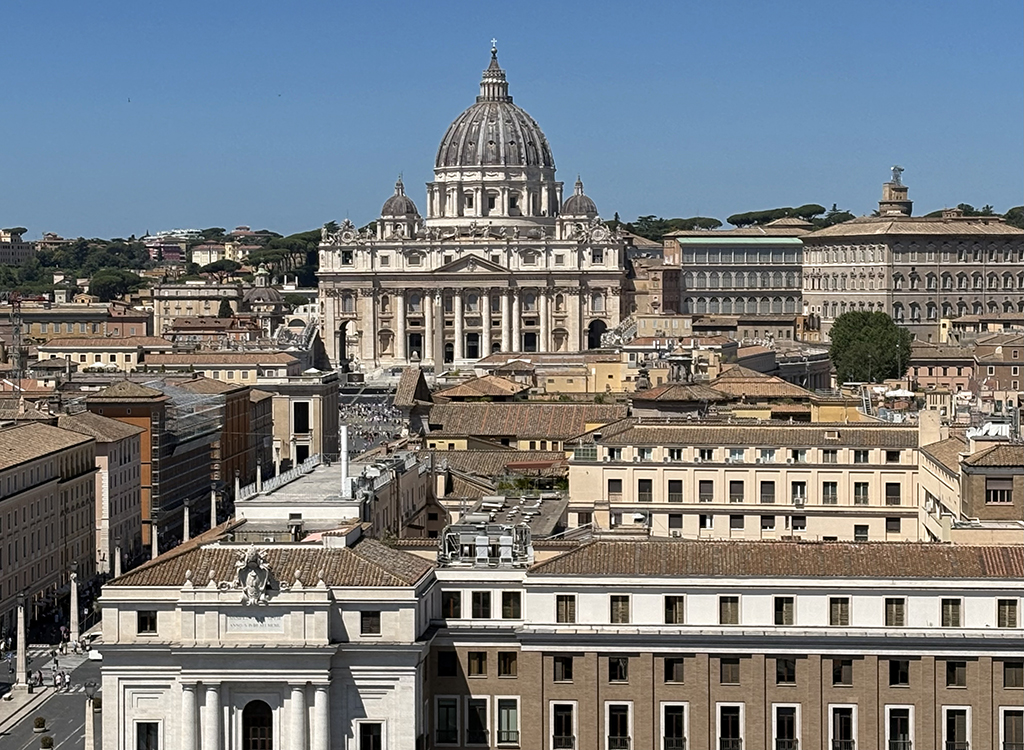
All good things don’t really need to come to an end. We will definitely be going back and, no matter how many times we go back to Rome, there’s more to see. Today, I share a couple of historical sites, a few of my favorite street photos, some fun street art, visits with friends, and — of course — a few restaurant recommendations. Links are included whenever available. A friend suggested that I let you know that, for the first time, I did not bring a camera with me on a trip. I used my iPhone 16 to take all these pictures. It is an amazing little device, and I think it did a great job.
______________________________
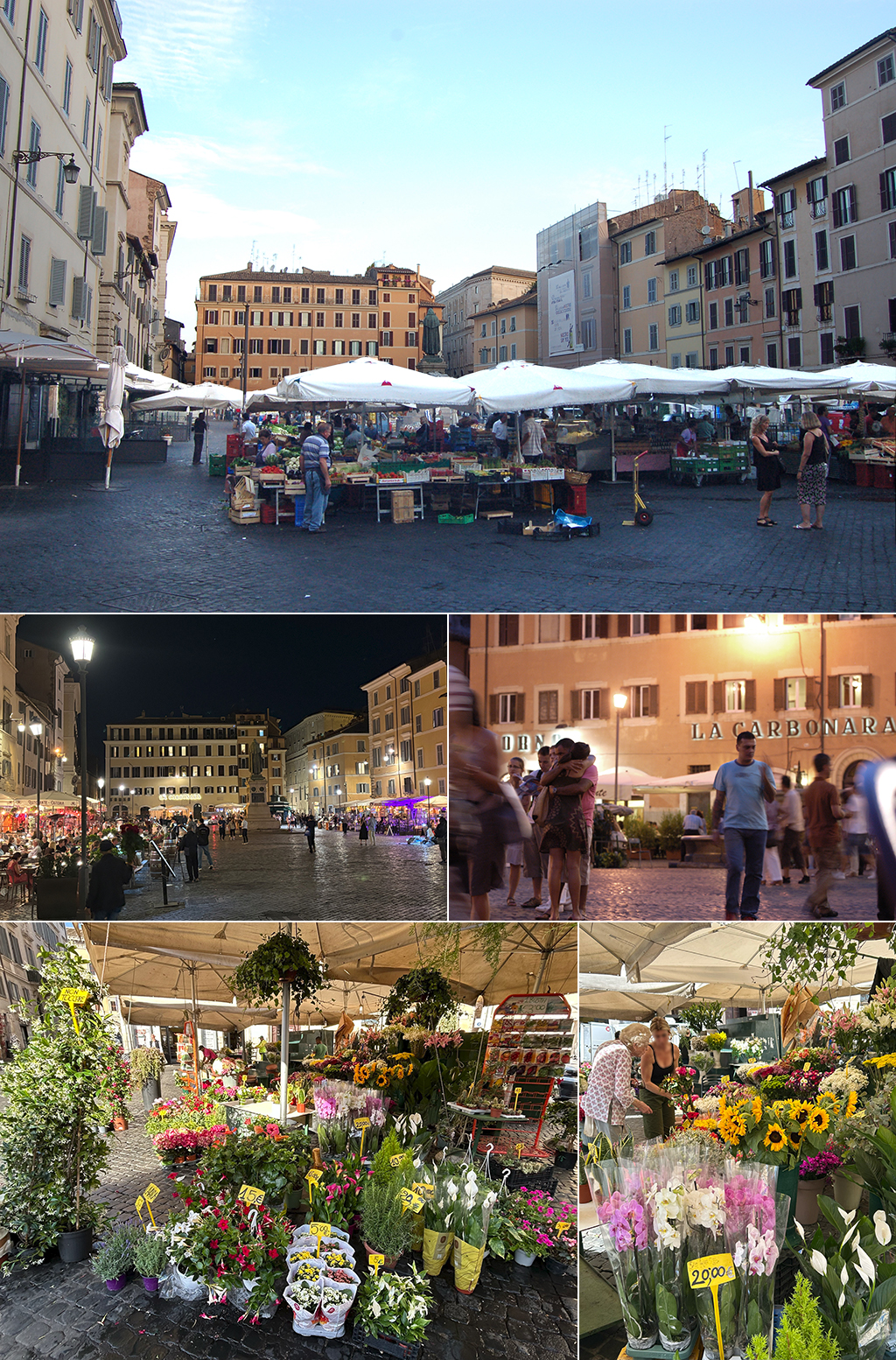
Our apartment was in the neighborhood of the Campo de’Fiori, (“Field of Flowers” perhaps very long ago). While the neighborhood is very touristed, it is our favorite because it is so close to everything we enjoy. (We have become quite good at avoiding crowds.) Six mornings a week, the Campo is filled with many vendors who sell fresh vegetables, cheeses, and flowers, while others sell packaged pastas, herb mixtures, and limoncello. At the end of the day, the vendors decamp, the piazza is cleaned, and by evening is a stage for aperitivi, outdoor dining, and strolling with a gelato.
______________________________
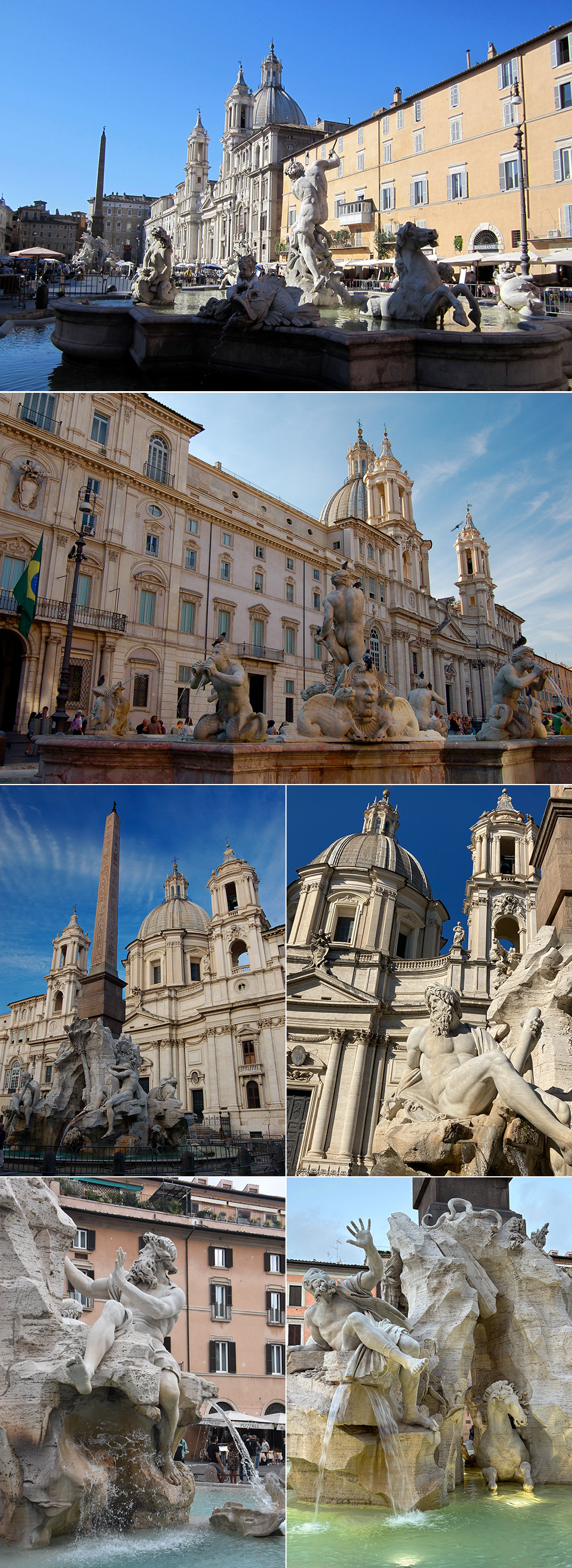
Not too far from the Campo’de Fiori is another piazza that always makes us sigh with its beauty: Piazza Navona. This very long and oval shaped piazza follows the footprint of a 1st-century race course, which determined its shape. In the center is the Fountain of the Four Rivers by Gian Lorenzo Bernini; the symbolically-represented rivers indicate the four then-known continents: the Nile (for Africa), Rio della Plata (for the Americas), the Danube (for Europe), and the Ganges (for Asia). Each is accompanied by a plant and an animal suggestive of the continent. At the ends of the piazza are smaller and equally beautiful fountains: the Neptune Fountain and the Fountain of the Moor. You’ll find many tourists in Piazza Navona during the day and evening, strolling, dining, and watching street performers. There are a couple of churches on the Piazza, but only one is open to the public: the Sanctuary of Our Lady of the Sacred Heart. The stunningly beautiful Sant’Agnese in Agone is also there, directly across from the Bernini fountain; it is not often open to the public. If you are ever there and find it open, definitely go in.
______________________________
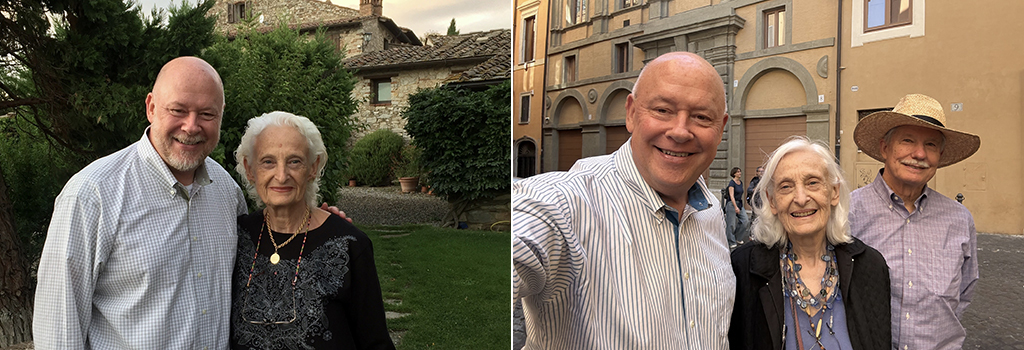
One of the great delights about visiting Rome is getting together with our friend Simonetta. I met her many years ago here in Tucson when she gave an Italian cooking class to a group of friends. She and I bonded over our love of the mezzaluna used for chopping herbs. We then visited her in her beautiful medieval stone house in Tuscany in 2017, and have kept in touch regularly, and she has generously shared many of her recipes with me. A few years ago she moved to the Trastevere district of Rome to be closer to her daughters. She invited us to her home a couple of times this visit, and we went out to lunch another day. She is an excellent cook and we were honored to be invited to dine at her table. As she is originally from Genoa, our primo piatto was trofie with pesto alla Genovese; but, living in Rome, our secondo piatto was a traditional a Roman spring-vegetable stew called vignarola. For dessert, we had some beautiful woodland strawberries from the market with some sorbet. It was a wonderful meal. In the pictures, here I am with Simonetta in Tuscany in 2017, and in Rome this year.
______________________________
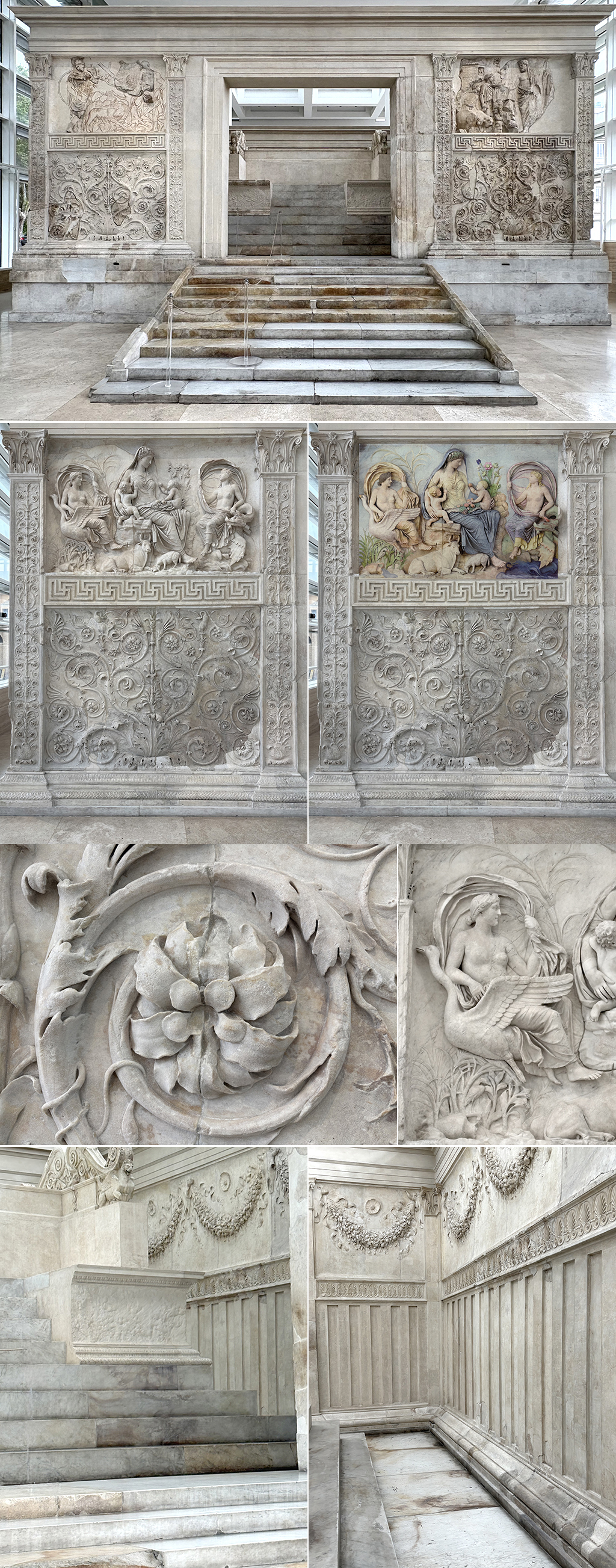
During our last visit, we walked past the Ara Pacis and told ourselves we’d go back. Well, it took us five years, but we did it. The Ara Pacis is an alter to Roman peace in honor of Emperor Augustus to greet him as he returned from battle; it was consecrated in the year 9 BC. It stands where it was relocated by Mussolini, now sheltered from the weather by a gorgeous new pavilion designed by the architect Richard Meier. The ancient carving is very elegant, though there is a lot of infill where parts were lost. Now, at night, there is a light show that illuminates what it might have looked like with its original polychromy. I have superimposed a segment of that coloring on one corner of the altar, so you can get an idea of what it might have looked like when new. We both found it so exquisite in its simplicity that it’s hard to imagine that a riot of color would make it any more beautiful.
______________________________
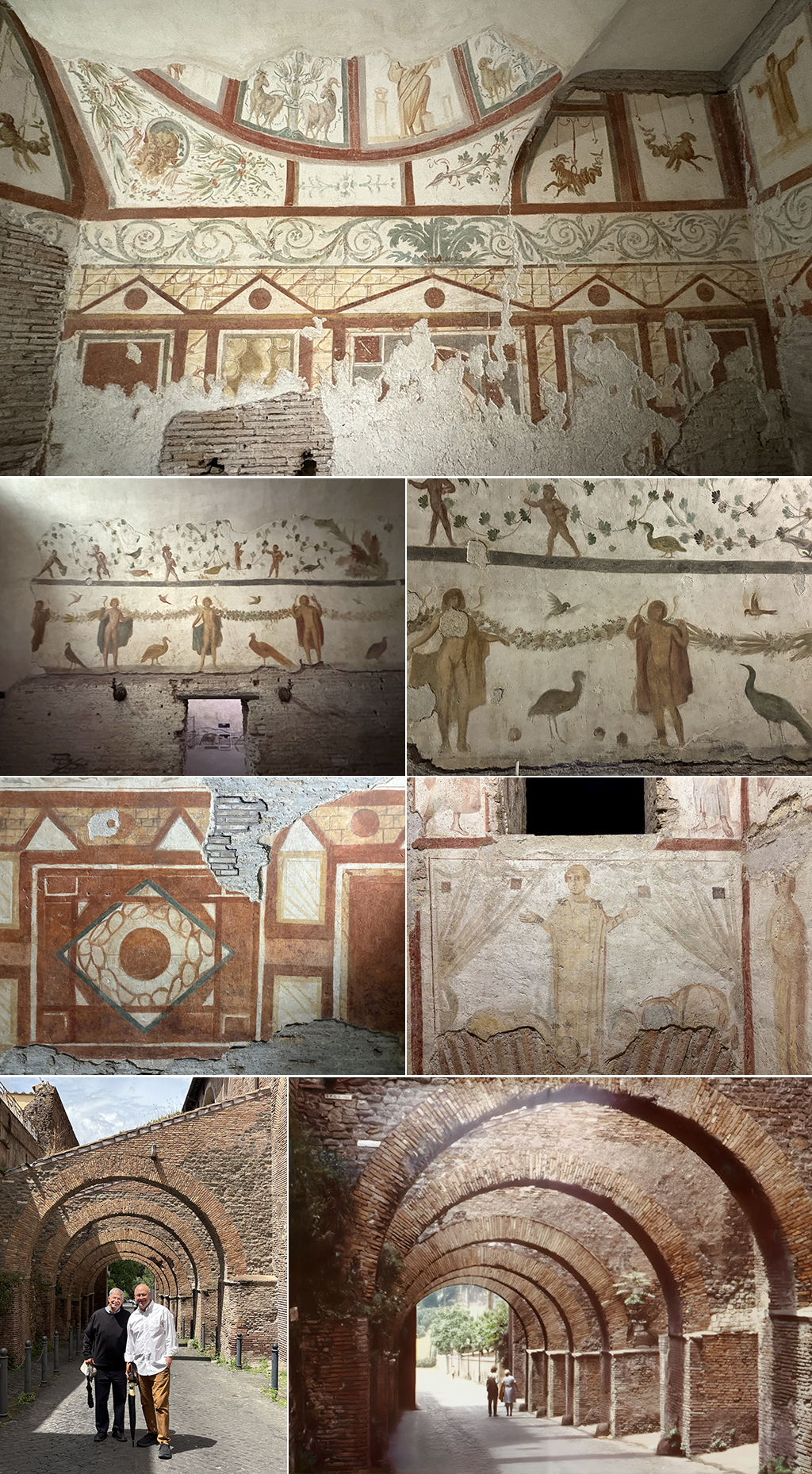
After our visit to the church of Saint Gregory and its three adjacent oratorios, we walked out the back garden to find ourselves just down the hill from the Church of Saints Paul and John. Under the church buttresses that arch over the street, there was an entrance to Le Case Romane del Celio, which consisted of several ancient houses discovered in 1887 beneath the church. As I mentioned in my notes about the church, they are thought to be the homes of the martyred Paul and John, to whom the church is dedicated. The site consists of about 20 subterranean rooms, many with their wall painting partially intact. The first of the last two photos shows Mark and me at the entrance, and the last photo by Mark’s father shows Mark and his mother walking down the street in 1974.
______________________________
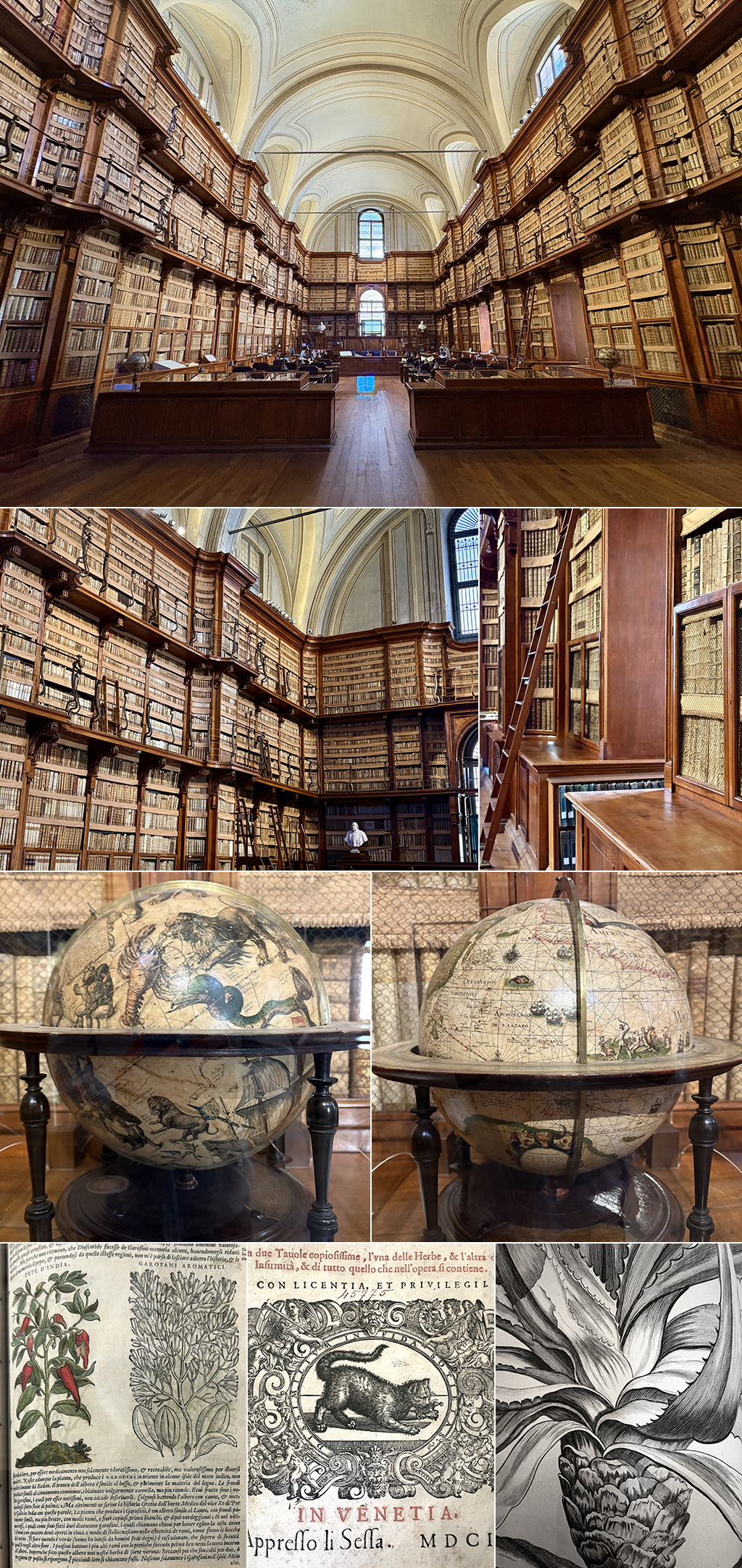
We discovered the somewhat obscure Bibliotheca Angelica, snugged up against the Chiesa di Sant’Agostino. Once you enter the building from the forecourt, you ascend stairs to the library. What we saw literally took our breaths away. It is still a place for research and, with the appropriate paperwork, anybody can work there. When we arrived, there was one other person looking around, and three or four people at their desks studying. A small exhibit around the public area displays four or five globes dating from the 1590s and early 1600s, and quite a few books open as a sample of the historic resources available. The library was founded in 1604 by an Augustinian bishop; it has more than 200,000 volumes, half of which are from the 15th to 18th centuries. It opened in 1609 and, along with the Bodleian in Oxford, and the Biblioteca Ambrosiana in Milan, it is considered the oldest public library in the world,
______________________________
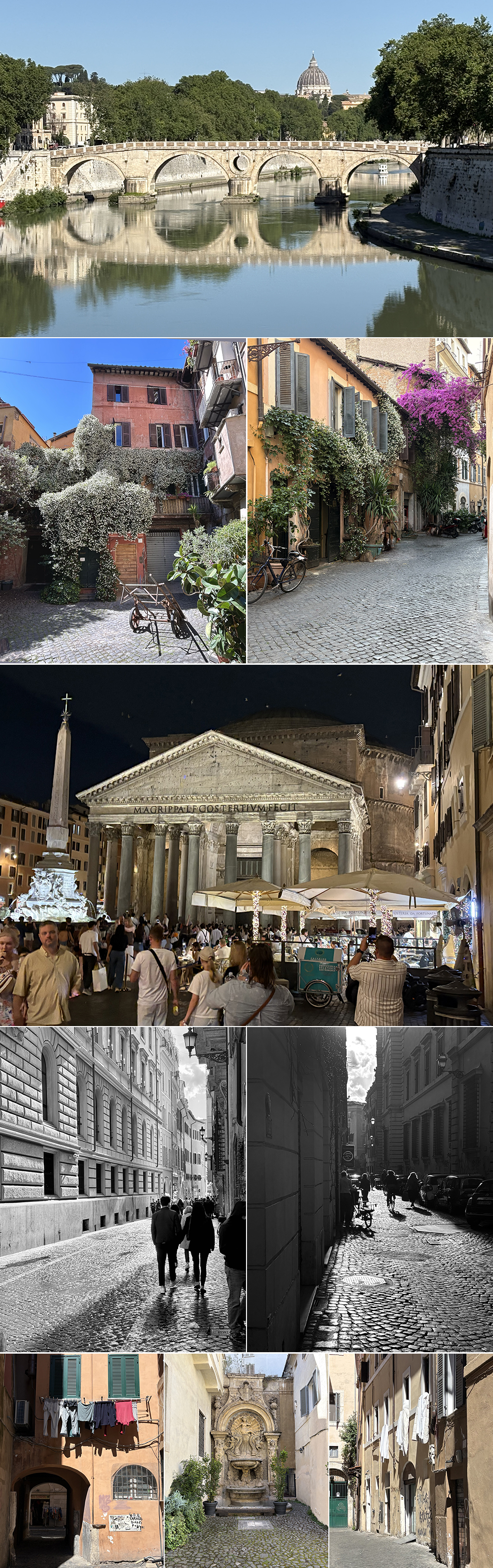
I never tire of the beauty I find in the streets of Rome, whether crossing the bridges or coming into a piazza at night. Yes, there’s occasionally some litter and – more and more – unattractive graffiti. However, there is still magic around every corner. I am especially fond of early morning or evening light that radiates down the narrow streets and creates beautiful shadows. Those photos, in my mind, are always in black-and-white. We were there at the optimal time this year for the blooming of the star jasmine and bougainvillea.
______________________________
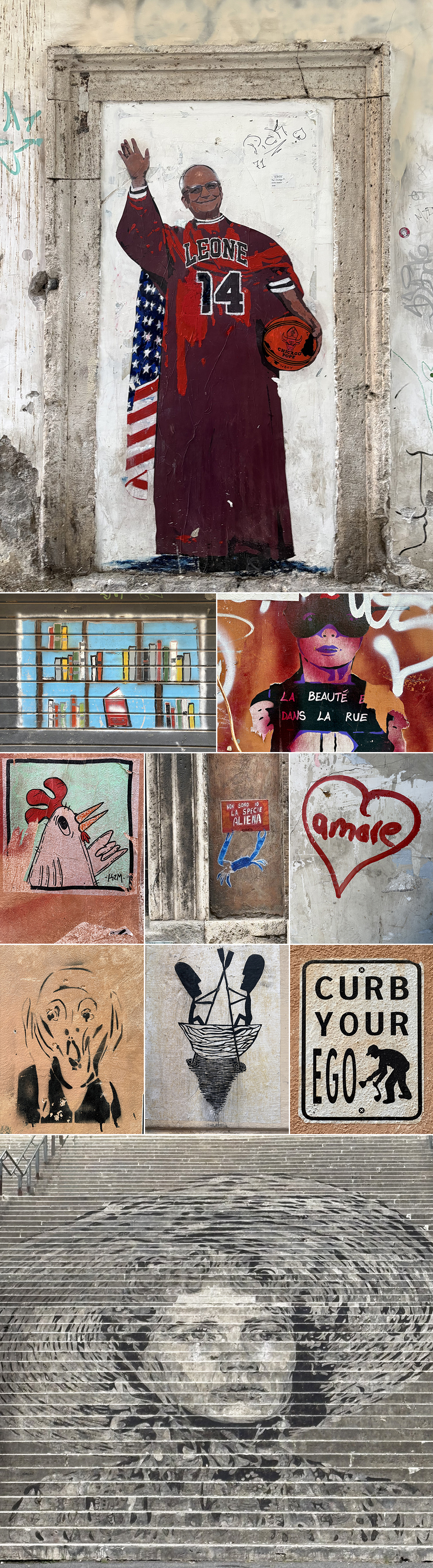
While the graffiti can be unattractive, there is some very clever street art in Vecchia Roma. My favorites are one of Pope Leo and another on a staircase in Trastevere.
______________________________
And finally, the restaurant and food recommendations:
Poldo e Gianna, Vicolo Rosini, 6, Roma
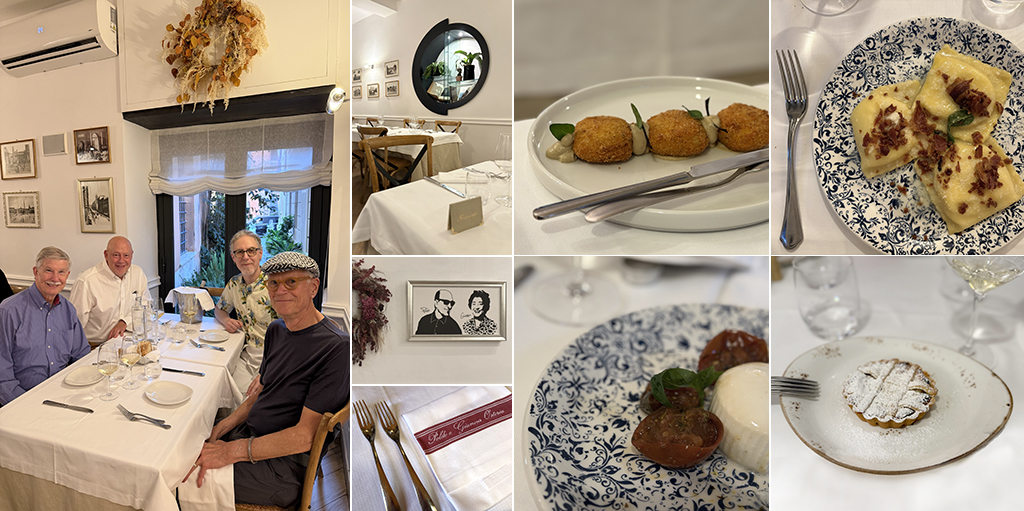
We met our Tucson friends Corbin and Paul at this wonderful restaurant on our last evening in Rome. We have enjoyed meals at this restaurant several times over the years. The food is well prepared and beautifully presented, the service is excellent, and the prices are very reasonable. Shown are the croquette di baccalà, ravioli di zucca, burrata e pomodoro, and the traditional Roman crostata di ricotta e visciole. (Thanks to Paul for the photos!)
______________________________
Clorofilla, Vicolo delle Grotte, 17, Roma
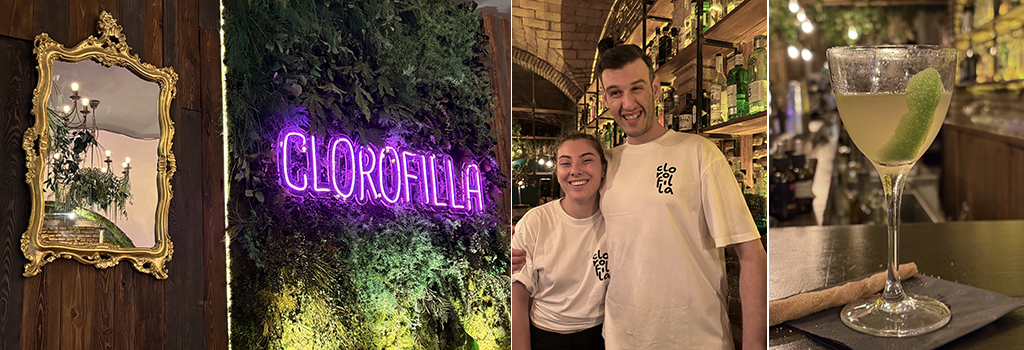
When on a post-pranzo stroll with Simonetta, we passed Clorofilla and she recommended it to us as a very nice place for creative cuisine. So we made a reservation for the evening we returned from Malta (more on that later). The menu is seasonal and creative (not just traditional Roman) under the direction of Chef Giorgio Tandoia. We had the artichoke stuffed with cheese and lemon for our antipasto, and the linguine with roasted peppers and the fettuccine with pork ragù for our primi. For our secondo, we shared a grilled skewer of lamb and zucchini ribbons with homemade pita bread, mixed greens and tzatziki. As we were ready to pay the bill, they brought us some house-made limoncello, which was delightful. Chef Tandoia and the staff are young, filled with good energy, are lots of fun, and very helpful. Aside from their reputation for good food, they are known for their creative and complex cocktails. We returned twice more — once for an aperitivo, once for a digestivo. Both nights, we enjoyed sitting at the bar and chatting with Sara and Nicolas; Nicolas is the creative mixologist behind their cocktails. Pictured below is “The Iceberg,” consisting of rum, lime, white vermouth, cucumber, venturo, and gentian, very refreshing on a simmering hot Roman night.
______________________________
Grappolo d’Oro, Piazza della Cancelleria, 80, Roma
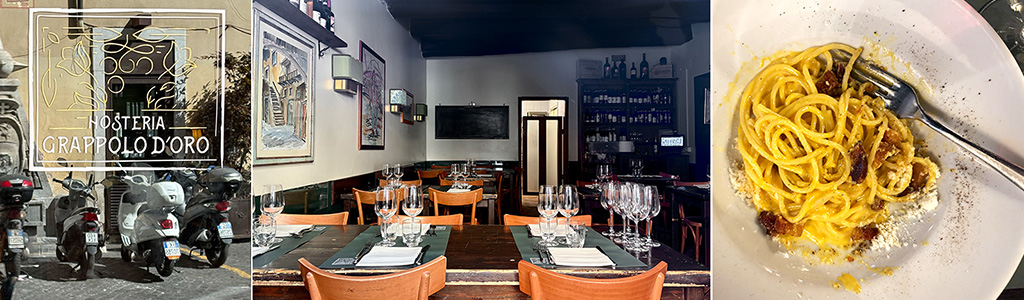
Simonetta’s daughter recommended this restaurant and told us their spaghetti alla carbonara was excellent (shown below), which I had for lunch and concur. Mark had lamb cooked in the style of porchetta (notably flavored with fennel and rosemary), which was also very good. We finished by sharing a zabaglione made with Marsala, orange zest and candied hazelnuts. That is definitely a dessert I need to recreate! Online reservations seemed to be booked well into the future, so I stopped by in person a few days beforehand, and had no problem getting the reservation we wanted.
______________________________
Osteria da Mario (Instagram only), Piazza delle Coppelle, 51, Roma
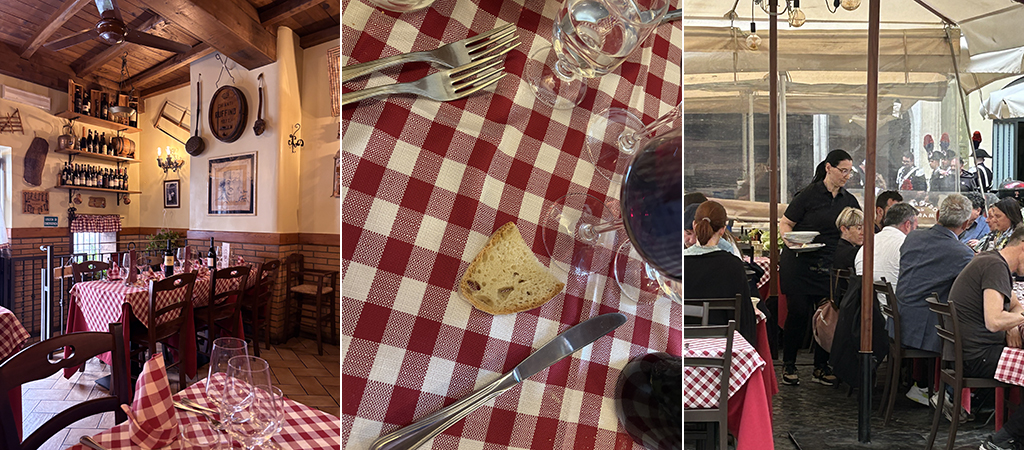
On our way back to the apartment from Piazza del Popolo, we had every intention of getting a simple sandwich to take home. But we came across a tiny piazza with two restaurants with covered outdoor seating and, from what we could tell, every person at both restaurants was Italian. This seemed a good sign, so we stopped for lunch, favoring indoors for the quiet and coolness. Osteria da Mario seemed frozen in time — red and white checked tablecloths, straw-covers Chianti bottles hanging from the beams, a framed photo of its founder Mario, and a menu of truly traditional Roman dishes. It was the real deal, and is run by Mario’s daughter and two sons. I had the mezze maniche alla gricia, and Mark had fettuccine con carciofi. The food was really solid and there was a real romance to it. We even went back another time during the start of the season’s first heat dome, and sat outdoors in the side street where there was shade and a nice breeze. (No online reservations.)
______________________________
Supplizio, Via dei Banchi Vecchi, 143, Roma
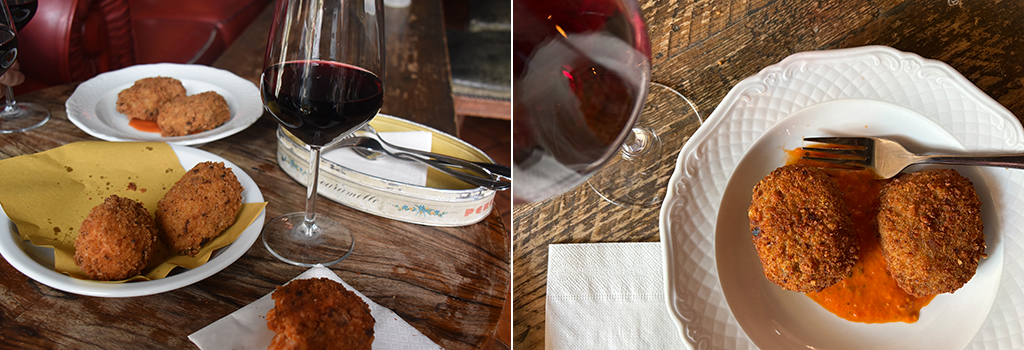
This has become a favorite of ours for a quick and filling snack or light lunch. A couple of supplì — stuffed rice croquettes about the size of an egg — and a glass of wine is all you need. Our supplì this visit were the classic (cheese) version and some wonderful eggplant croquettes. And now, just two doors down, Neve di Latte — our favorite gelateria — has opened. Isn’t that convenient? The gelato flavors we tried were: zabaglione, neve di latte (cream), stracciatella with strawberries, crema di uova, passionfruit, and strawberry sorbet.
______________________________
Supplì Roma, Via di S. Francesco a Ripa, 137, Roma (Trastevere)
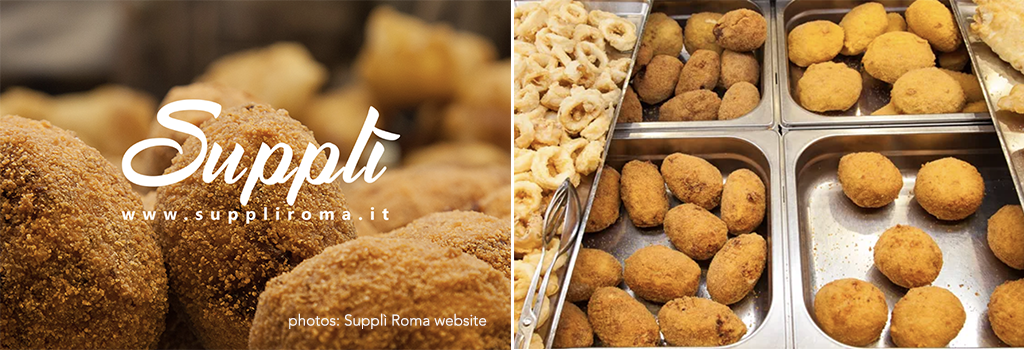
This is a nice little takeaway place Simonetta took us to one day. In addition to a variety of supplì, they also had mozzarella in carroza, zucchine fritte, calamari fritti, and pizza, and pastas. It’s very popular, especially with students. While we were in line, Mark had a nice visit with some students who are studying in Italy this summer. They were fascinated that he had done the same… fifty years ago.
______________________________
Il Forno, Campo de’Fiori, 22, Roma
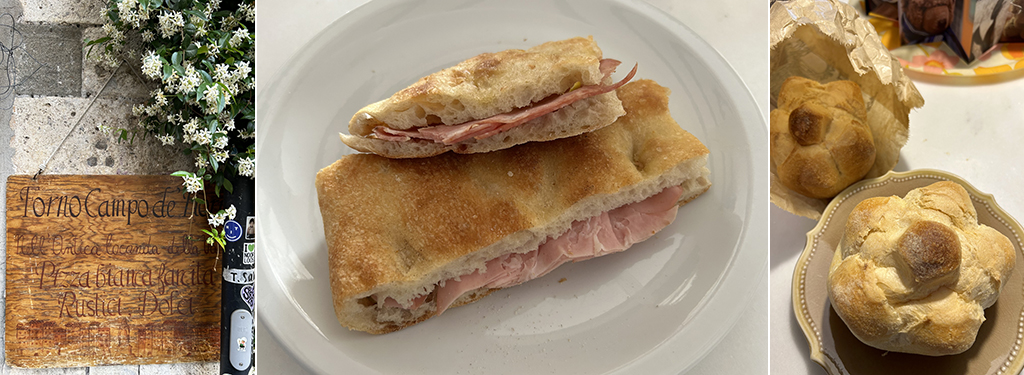
Mark has been going to Il Forno since 1974 and, as soon as he took me in 2011, I fell in love with it as well. It is the bakery I went to every morning to get our bread or distinctive hollow-lobed roll called rosette (as Mark discovered as a college student, the lobes hold a lot of apricot jam or Nutella). Around noon, across the side street from the bakery, their little “branch” shop opens with a large variety of sandwiches made from Roman pizza bianca, “white pizza” (like focaccia but thinner and crispier). If you arrive at the right time, there’s not much of a line. They are best known for their pizza bianca stuffed with mortadella. We had this classic several times while we were there. By the way, if you’re looking for the sandwich shop before it’s open, you will be greeted by a blank wall with no sign of life. You have to wait until opening time, then there’s the sign and the aforementioned line.
______________________________
Next week? Our last adventure of this summer – a couple of nights in Malta to visit family who live there.
Developed and maintained by Inspiratech LLC.
Design by Themeshift.
Eha Carr
July 15, 2026 at 5:08 amWhat wonderful, wonderful memories to stretch out until the next time . . . you had done your homework, you had more than one friend . . . methinks it was somewhat like being at home away from home . . . Loved your away-from-the-tourist scene restaurants and all the food photos . . . truly liked the street art very much including Pope Leo . . . would have liked to breathe the air in that wonderful library . . . again thank you for taking us along . . . I best remember the Piazza Navona – in my day spent many an hour at some of the wonderful restaurants there at the time . . .
David Scott Allen
July 15, 2026 at 7:22 amI dint think one could ever forget Piazza Navona, Eha — such a gorgeous urban space. Glad you enjoyed everything! Yes, we love getting together with friends around the world — it is one of life’s true pleasures.
Mimi Rippee
July 15, 2026 at 6:11 amI love that you seem to know people everywhere you go! What a great post. I really have no words. I don’t think I’m as good with my iPhone as others. But I do love it for panoramas.
David Scott Allen
July 15, 2026 at 7:23 amThanks, Mimi — I have had a good time learning things about the phone that have really helped. And for trips where we are running around all day (on the heat), not having a camera bag around my shoulder is really nice.
Barb
July 15, 2026 at 7:03 amSplendid! I always feel like I’ve been on a vacation after reading one of your travel posts. The Campo’de Fiori market looks amazing! You and Mark are certainly vacation experts! Thanks for sharing with us!
David Scott Allen
July 15, 2026 at 7:24 amThank you so much, Barb — I’m not sure if we are vacation experts but we sure like trying!
Yvonne
July 15, 2026 at 8:03 amSuch beauty and deliciousness! Looking at your pictures made me wonder what the impact of living permanently among layers of history does to the consciousness of a human being. Does it alter a person and in what way? Surely it must be positive, yet history itself tells us not necessarily so.
Thank you both for sharing your experiences and recipes!
David Scott Allen
July 16, 2026 at 8:34 pmThanks, Yvonne, for that incredibly provocative idea/question. Now you have me, wondering… I wonder what it would do?
angiesrecipes
July 15, 2026 at 10:43 amYou have me want to go pack and visit Rome immediately! That public library looks really impressive.
David Scott Allen
July 16, 2026 at 8:33 pmI do think you should go back, but wait until it gets a little cooler! You will definitely love visiting the library.
Carolyn Niethammer
July 15, 2026 at 2:27 pmWhat a culinary adventure. You must have had to do a lot of walking to work up an appetite for dinner after such sumptuous lunches.
David Scott Allen
July 16, 2026 at 8:32 pmI think we did a lot of walking to help counteract our daily calorie intake! We had so much fun!
Frank | Memorie di Angelina
July 15, 2026 at 2:36 pmNooo! Don’t stop now when you’re on a roll. Like you, I never tire of the beauty of Rome. And there’s always something wonderful to discover. “Non basta una vita” as they say in Italian… And thanks for the restaurant recs. I know the Forno well, of course, and I’ve been wanting to try Supplizio, but the others are new to me. They’re on the list for our trip this October!
And yes, the newer iPhones really do take marvelous photos. I’ve even used mine for the blog, believe it or not. I’ll let you guess which ones…
David Scott Allen
July 16, 2026 at 8:30 pm«Non basta una vita» doesn’t even begin to cover it. I hope you enjoy the restaurant recommendations. I think you will especially enjoy Poldo e Gianna.
I have also used my phone for the blog, but just a couple of times. I really think I get better shots with my camera though there have been times when the phone adapted to the lighting situation better.
Pauline McNee
July 15, 2026 at 3:20 pmWhat a wonderful tour of Rome you have given us David. I love visiting old libraries when I visit Europe, so much history, and a very special aroma, your public library looks amazing, I could stay there all day. I doubt we will get back to Rome now from Down Under, but I remember how fascinated we were when there, at how the streets opened up in the evening to restaurants which we had no idea were even there during the day. Your food experiences look absolutely delicious, and yes please, I know you will recreate a few of them. How lovely to keep in contact with Simonetta, and be treated to such authentic Italian food. What a precious lady. A wonderful post, and I know how much work was involved. I only take my iphone now when I travel, it does the job.
David Scott Allen
July 16, 2026 at 8:27 pmThank you so much, Pauline! Such a lovely and kind comment. Every time I visit someplace like Rome or Paris, I wonder if it will be my last visit. Traveling abroad gets harder and harder as we get older and older. Isn’t that library just amazing? It’s as if you dreamed the perfect library and then it appeared. You will definitely be seeing some recreated food soon. At least I hope before the end of the year!
Pauline
September 12, 2026 at 11:30 pmLooking forward to it David.
David Scott Allen
September 15, 2026 at 4:14 amLittle by little. There never seems to be enough time for recipe creation!
Mad Dog
July 16, 2026 at 4:19 amOnce again, those are some stunning pictures – from your iPhone!
The markets look beautiful, along with the fountains. The Romans have left an incredible legacy throughout Europe. They mixed a volcanic ash and lime into their concrete, which it lasts for millennia, whereas the modern version is only good for about 20 – 30 years!
The food looks amazing too, I couldn’t help noticing the delicious looking croquettes.
Thank you for taking us with you on your vacation.
David Scott Allen
July 16, 2026 at 8:25 pmIt is amazing what the ancient Romans accomplished, Mad Dog. Thanks for coming along!
Evening With A Sandwich
July 16, 2026 at 11:54 amOMG David, where do I start!!! Your iPhone captured it all very nicely. The history, the culture, food, art, you can never see or experience it all- so freakin beautiful. You did Rome well my friend, you did it well.
Always, thanks for sharing these amazing adventures with us.
Velva
David Scott Allen
July 16, 2026 at 8:23 pmThanks, Velva. I’m so glad you enjoyed the journey with us!
Sherry M
July 16, 2026 at 5:54 pmthe market and the square and the fountain bring back the memories of Rome – where we had the very best pizza and the very worst!! Love all the building photos David! since hubby is a building designer, i am always aware of architecture.
cheers
sherry
David Scott Allen
July 16, 2026 at 8:22 pmI am sure, Mr. P would love some of the architecture! Glad you have wonderful memories of the Campo de’Fiori and Piazza Navona, Sherry.
Patrick O’Donnell
July 17, 2026 at 8:03 pmDavid! I’ll be in Rome for a few days next week— just looking enough to try several of your restaurants! Thanks for all the excellent suggestions.
David Scott Allen
July 17, 2026 at 8:40 pmHave a great summer, Patrick — I hope you enjoy your time in Rome! I’ll look forward to online performances.
Inger
July 23, 2026 at 5:27 pmAgain so beautiful. I’ve been using my iphone more for travel photos and have been very happy with what it produces. I don’t do well with it on food, however, not sure why.
David Scott Allen
July 24, 2026 at 5:07 pmSince traveling, I have used my iPhone a couple of times for food and did the same shots with my camera — I really like the camera versions much better.
Marian Jensen
August 14, 2026 at 9:40 pmAnother fantastic post!
We also stay in the Campo de’ Fiori area. It’s busy, but never so busy that we think of staying elsewhere. We think it’s the best base in town.
I’m unfamiliar with the Bibliotheca Angelica–it’s now on “the list”. And (surprisingly) we’ve yet to visit the Ara Pacis, but we’ll make sure we do on our next visit.
We love Grappolo d’ Oro, Supplizio, and Il Forno. One of our favorite things to eat is Il Forno’s pizza bianca with mortadella. We often eat this while we sit in the Piazza Farnese and dream about moving to Rome. Sigh. Your other restaurant suggestions look fabulous and are now on “the list”, too. Consider trying La Tavernaccia de Bruno if you haven’t–their roasted suckling pig is delicious. Also, for a quick, late lunch bite in the Trastevere area, think about Trapizzino Trilussa–it’s gotten crowded, but it’s tasty and inexpensive.
I’ve enjoyed every minute of your trip, David. The effort you put into your posts is very appreciated, and your suggestions and comments are stellar. Thank you! And–for the record–what about that light in Rome?
David Scott Allen
August 15, 2026 at 1:14 pmYes, Marian, the light in room is exquisite! Glad you and Mark feel the same way about the neighborhood. I can’t imagine staying anywhere else! Thanks for the additional restaurant recommendations… I’m glad you have added the Biblioteca Angelica to your list — it’s a gem! I can’t even count the number of days we ate the pizza bianca with mortadella from Il Forno!