
When I tell you we visited quite a few palaces while in Rome, you’ll know these were not for personal dinner invitations. They are now museums. Rome is replete with such converted palaces and villas; they make beautiful backdrops for great works of art, sculpture, and antiquities. Today, I’ll give a brief overview, and include links if you want more information.
_____________________________
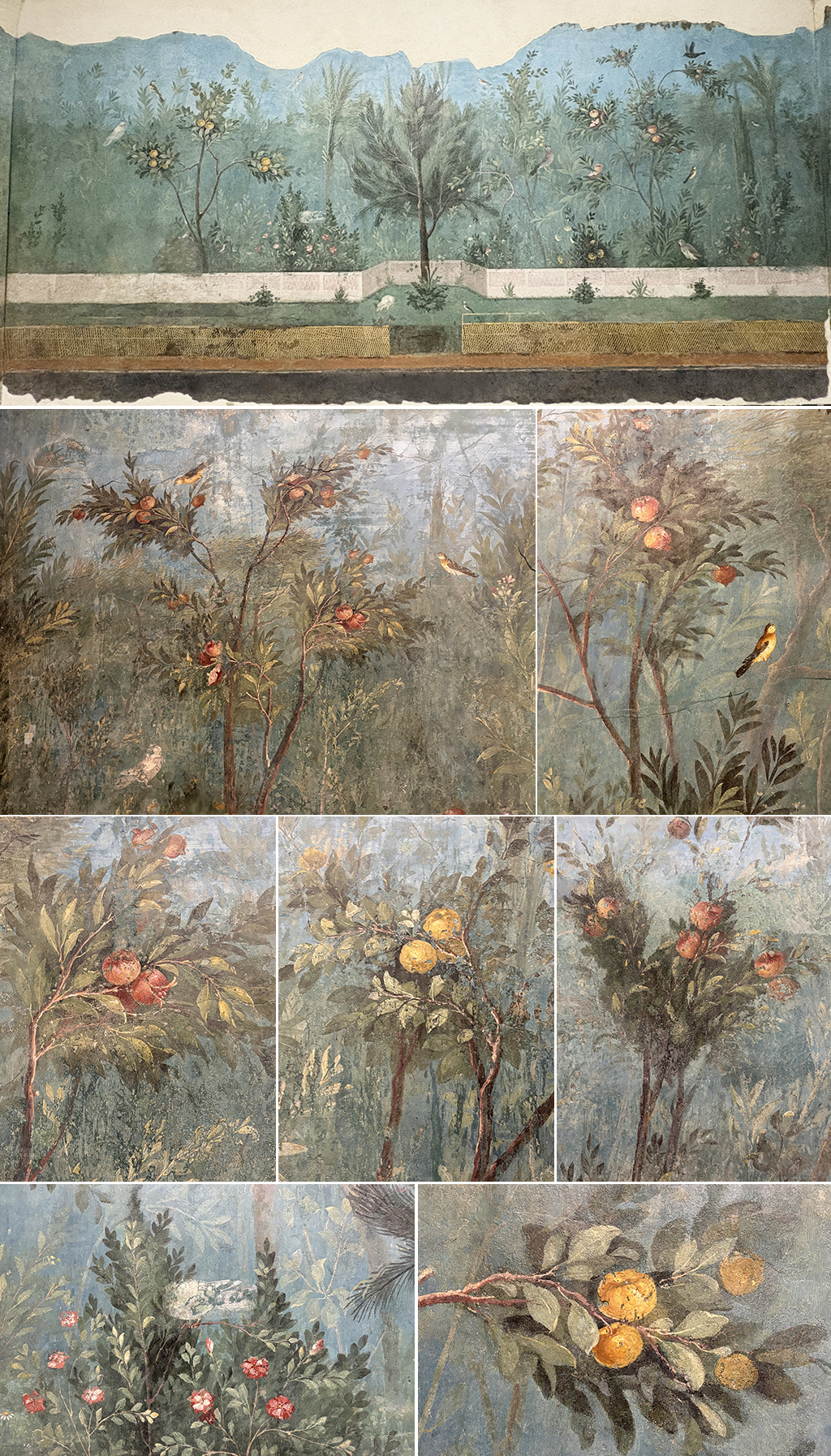
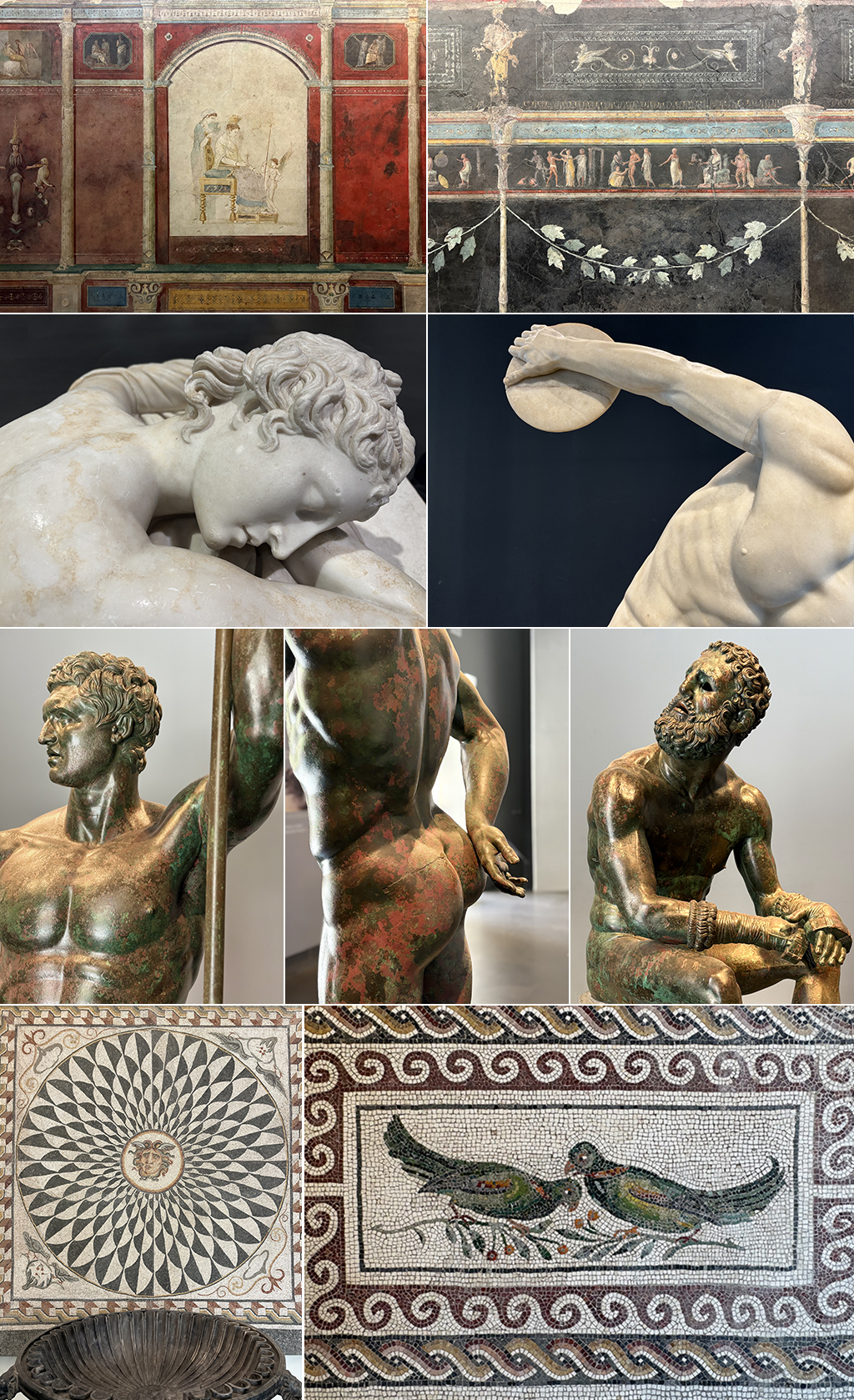
This visit to Rome, we returned to the Palazzo Massimo alle Terme, one of Rome’s several National Museums, each devoted to a different era’s art and artifacts. This 19th-century palace, very near the railroad terminus, houses masterpieces from the Roman Republic era through Late Antiquity, including bronzes, marbles, and beautiful mosaics. On its second floor, there are many frescoes transferred from ancient villas, notably a favorite of ours from the underground nymphaeum of Villa Livia. Livia was the Empress wife of Augustus. Her getaway villa was built between 39 and 25 BC about 7 miles north of Rome. This alone is worth the visit for us. We marvel at the painted room’s biologically recognizable flowers, birds, fruits, and trees. As usual for us, we spent hours enjoying the museum’s entire collection.
_____________________________
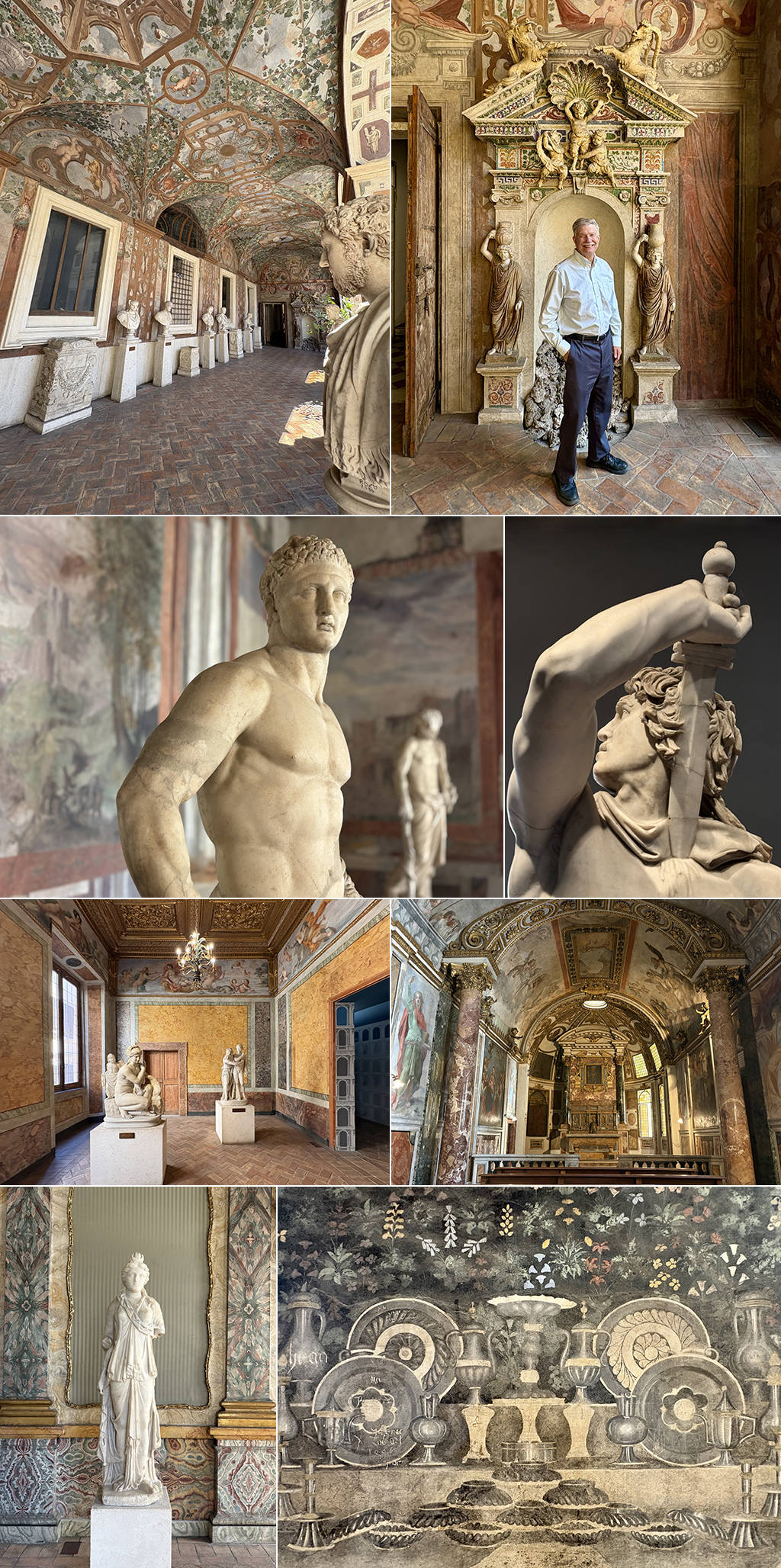
Since our visit to Palazzo Massimo included entrance to three other national museums, we decided to take advantage and we went to Palazzo Altemps, mostly so Mark could enjoy the architecture and its decoration. Built in the 15th century, it is now dedicated to the history of art collecting, and houses a wonderfully quirky collection of ancient Roman sculptures and fragments displayed in beautiful rooms that were lived in until the mid-19th century. It was the room decoration that took us there, but the sculptures and how they were displayed also caught our attention. My favorite parts were the lavish loggia, overlooking the internal courtyard, and the chapel.
_____________________________
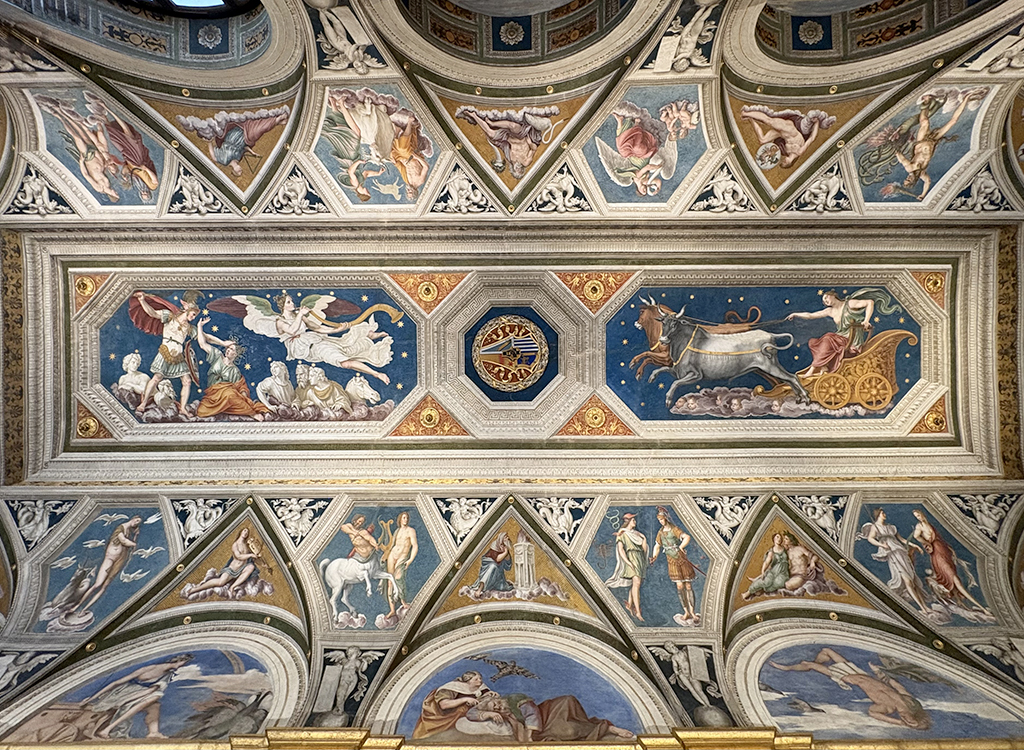
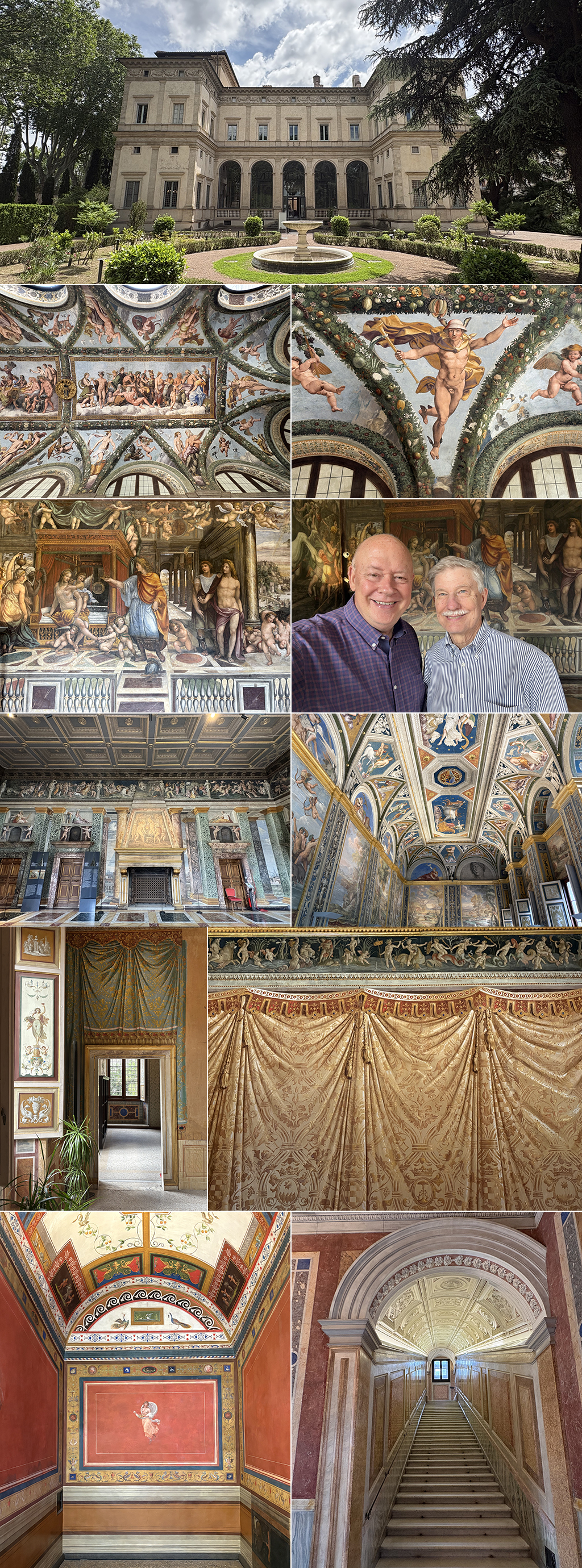
Once again, for a second visit, we went to the Villa Farnesina just across the Tiber in Trastevere. When we were there five years ago, much of its interior was in scaffolding so we hoped to see it fully this time, and we were not disappointed. It is a beautiful, early-16th-century Renaissance villa built by Agostino Chigi, a wealthy banker, and later acquired by the Farnese family as a get-away villa, conveniently located directly across the river from their massive city palace. It is filled with gorgeous frescoes throughout, some of which were painted by Raphael.
_____________________________
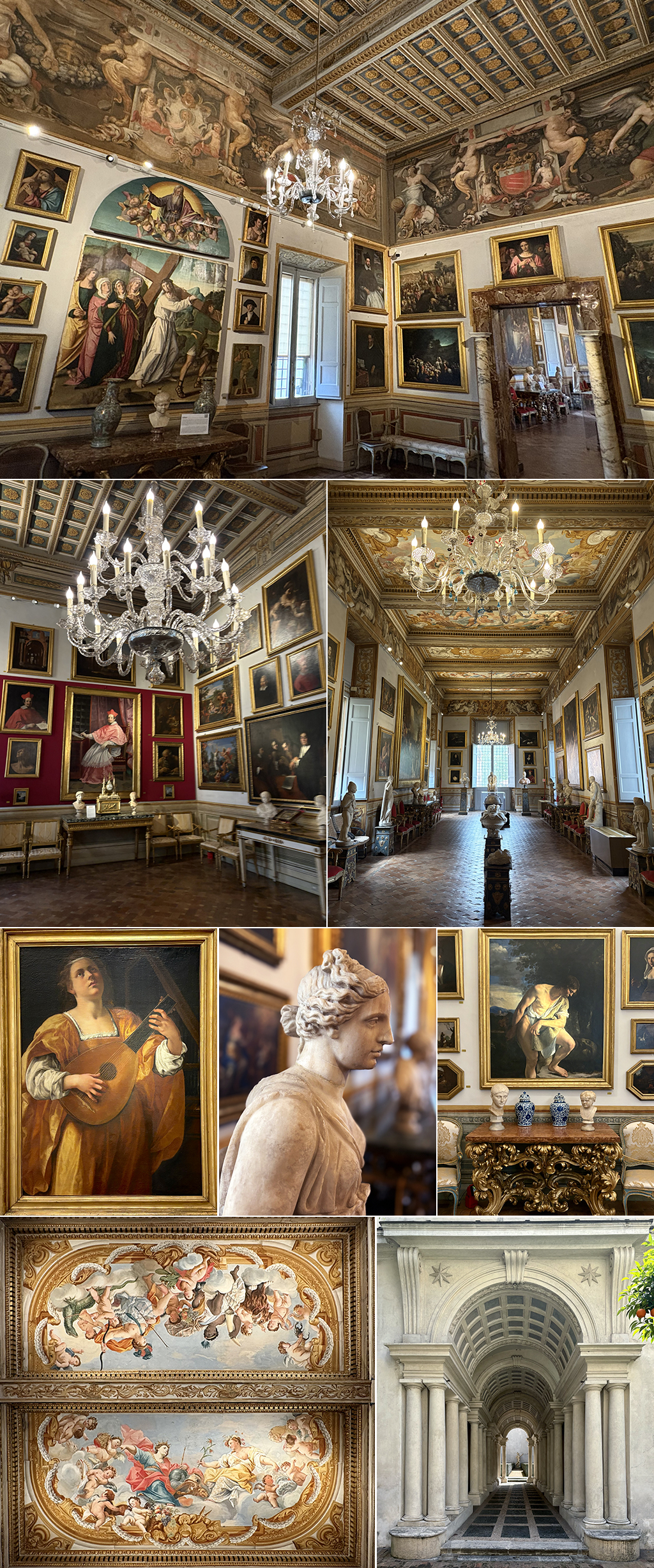
One day we decided to stay close to “our” neighborhood (Campo de’Fiori area), so we went to Palazzo Spada to visit the eponymous Galleria Spada, just two palazzi over from the Palazzo Farnese. The gallery consists of four rooms, and is the only section of the palazzo open to the public. But, oh, what rooms they are! It is in a back wing added in the 1600s by Cardinal Spada after he bought the 16th-century palazzo; he did this to accommodate his significant art collection. This includes a number of artists whose names remain prominent to this day – Titian, Rubens, Carravaggio for example – and some who are just being rediscovered, like Artemisia Gentileschi. Her paintings are so rich and sensitive that, regardless of their size, they drew our eyes immediately (the lute player below – the paining opposite is by her father, Orazio Gentileschi). Beside the palazzo is a giardino segreto. “Secret” meant private. In this private garden is a perspective colonnade designed by Borromini, an optical illusion of an arcade that appears to be 120 feet long, when, in reality, it is only 26 feet long. At the end of the view down the arcade, is a “life-size” sculpture of Mars, the Roman god of war, that is in fact only 24 inches tall.
_____________________________
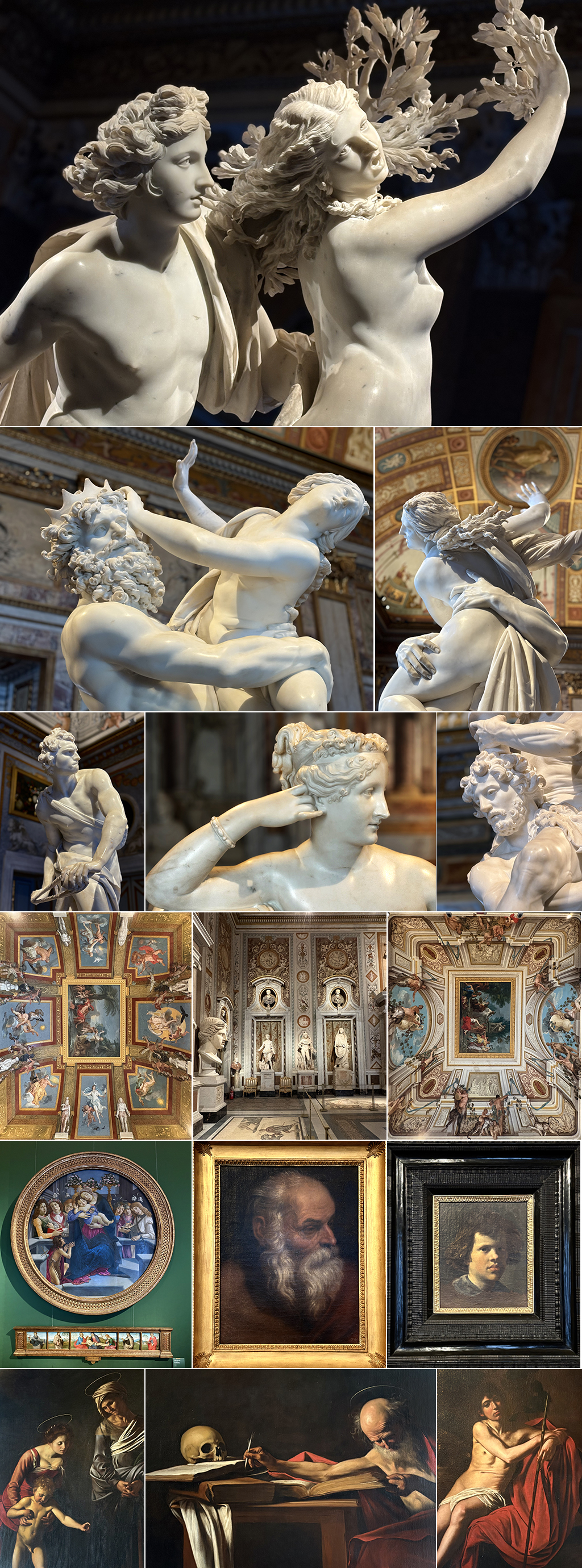
The Galleria Borghese, once referred to as the Villa Borghese Pinciana, is situated in the far eastern edge of the lush Borghese Villa park, above the Piazza del Popolo. The Galleria is best accessed from Via Pinciana. While a walk in the expansive gardens and park is a welcome respite from the noise and stunning glories of Rome, I highly recommend taking a taxi to preserve your energy for viewing the collection. The Galleria houses a dazzling collection founded by Cardinal Scipione Borghese in the early 1600s, one of the most prestigious art collections in the Western world, with masterpieces by artists such as Bottecelli, Rubens, Caravaggio, Raphael, Titian, and breathtaking sculptures by the young Bernini (below: Apollo and Daphne; the Rape of Proserpina; David, and Æneas, Anchises, and Ascanius).
_____________________________
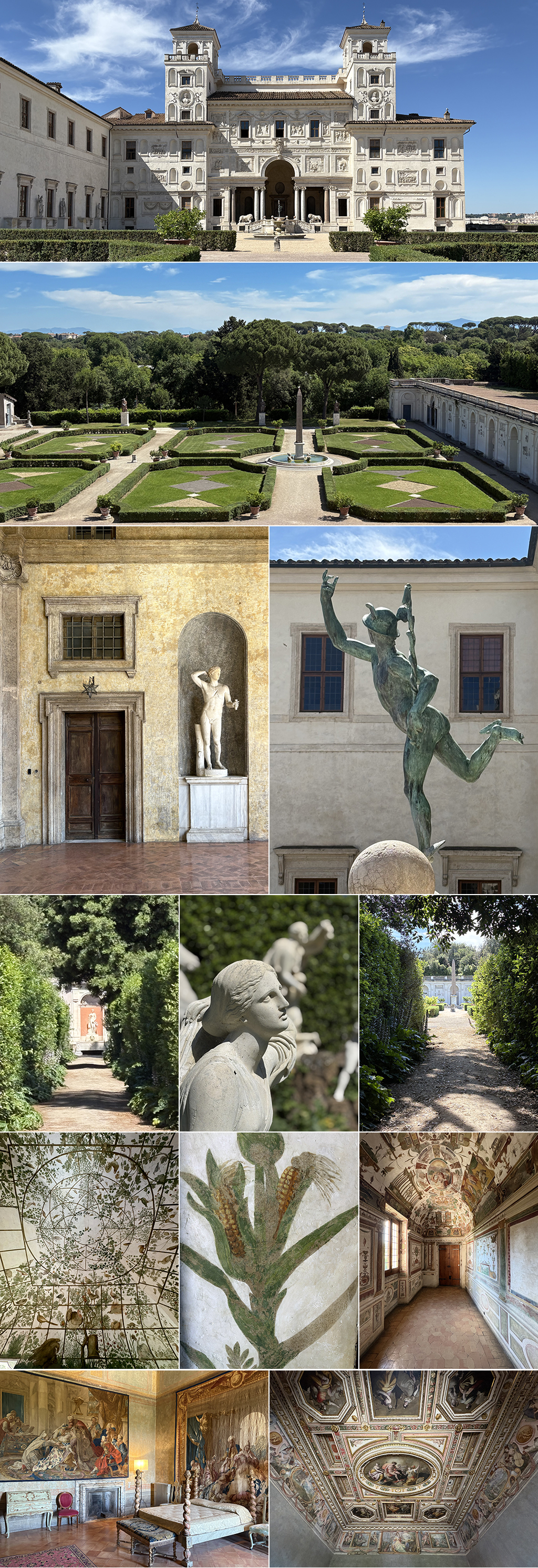
The Villa Medici, is a 16th-century Mannerist villa, built by Cardinal Ferdinand de’Medici. In 1803, when Napoleon occupied Rome, he moved the nearly 150-year-old French Academy of Rome into this villa, and it has been there ever since. Not surprisingly, we were greeted in French when we arrived. Though still functioning as a place of study, retreat, and practice for artists, in 2009 it was opened to the public for the first time. Tours are offered in French, Italian, English, and Spanish. The entrance façade is one of the most stark, fortified buildings in Rome, but viewed from the back garden, you experience its startling beauty. Because gardens are fragile and transitory if not maintained, we forget gardens were the culmination of a connoisseur’s collection, with rare plants, fine sculpture, and erudite references to antiquity assembled around symbolic themes among their clipped hedges and pavilions. No surprise then, that the regular tour spends much time in the gardens. Of special note was Cardinal Fernando’s study, or studiolo, nicknamed the “Bird Room.” The tour ends with a return to the immense loggia and a visit to the opulent suite of Cardinal de’Medici.
_____________________________
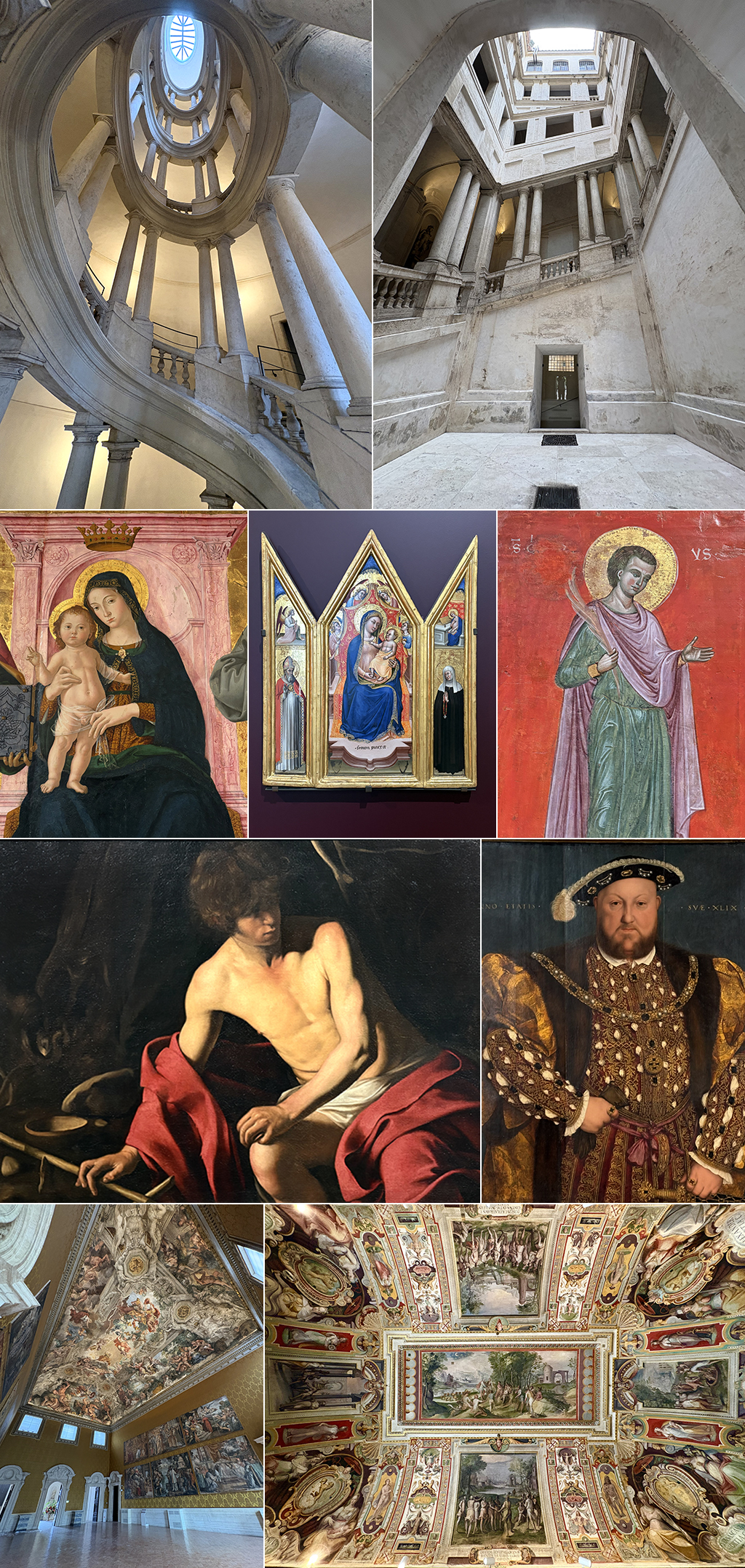
We got tickets online for visiting Palazzo Barberini, a 17th-century baroque palazzo designed by Moderna (of Vatican façade fame), Bernini, and Borromini for the Barberini family at a time when one of their members was Pope Urban VIII. Our intention was to see the special Bernini exhibit it was hosting in one wing. However, I made a delightful mistake when I booked tickets for the regular wing. This is one of the several national galleries, and we enjoyed its spectacular collection that included works by Raphael, Caravaggio, Holbein, and — always look up — some dazzling frescoed ceilings. My “oops” was easily remedied, and our day richly extended by purchasing a second set of tickets for the Bernini show.
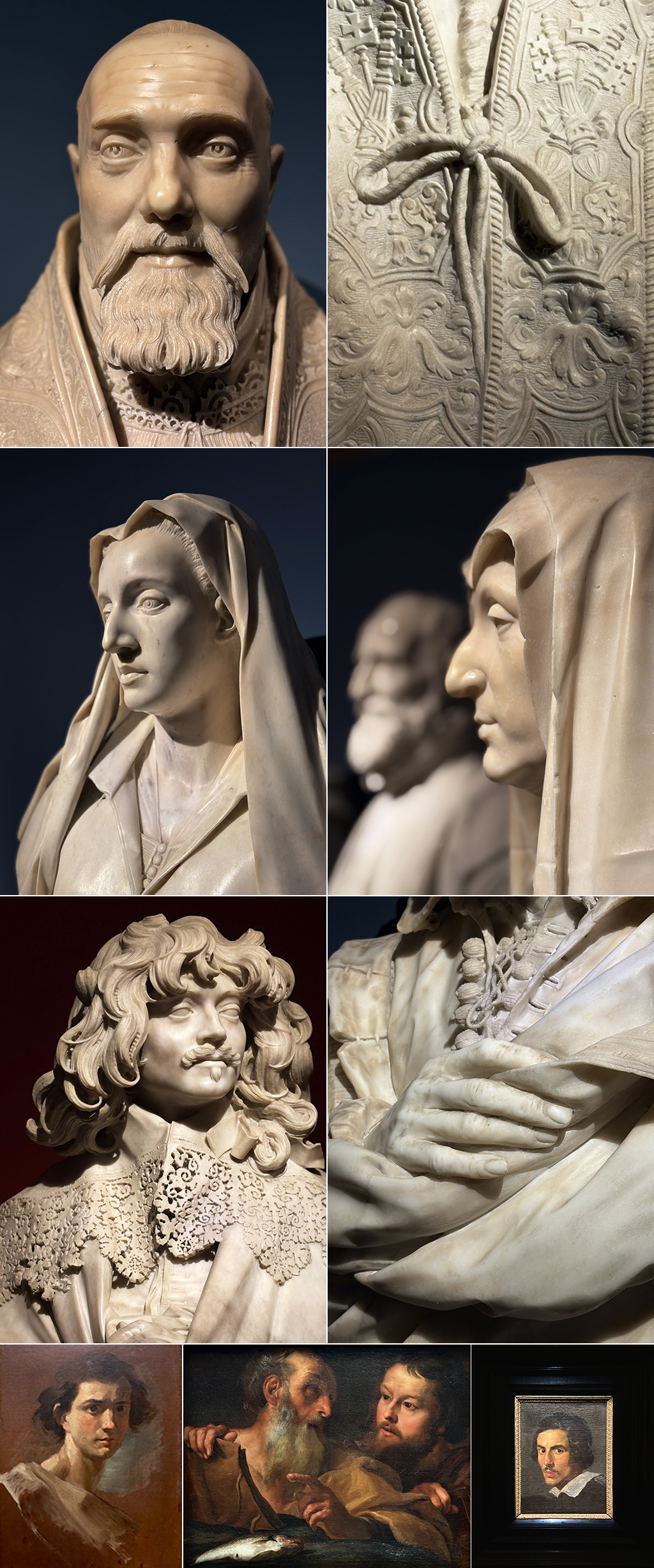
The Bernini Exhibit was small and spectacular; and there were few other visitors. The exhibit included works by Bernini’s father, by him, and contemporaries who were heavily influenced by his inventive new style. Bernini, though mostly remembered as a sculptor and architect, was also a fine painter, and here, as at the Borghese, we again encountered many of his paintings. The exhibit included some exquisite study drawings for the baldacchino in Saint Peter’s Basilica. They were small, but intricate, and it was fascinating to see how he considered design variations and its projected appearance from different angles. As one might expect, there were numerous busts of Pope Urban VIII, a major patron of Bernini.
_____________________________
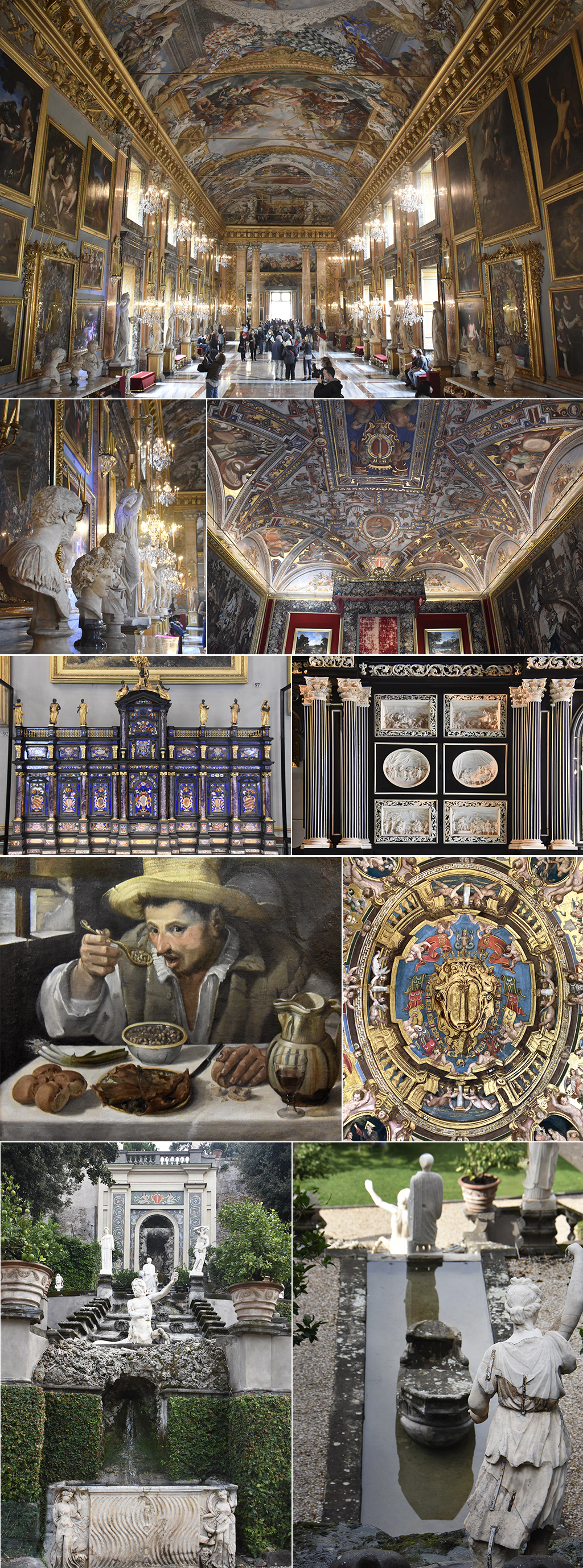
Do you have a free Saturday while in Rome? I would highly recommend securing advance tickets for the Galleria Colonna, which silver-screen buffs will recognize as the setting for the final scene of Roman Holiday. Among much that is remarkable about this palazzo, is that parts of it date to the 13th century, and it has been the home to the Colonna family for more than 20 generations; they still reside there. Its vast art collection includes works by Pinturicchio, Jan Brueghel the Elder, Tintoretto, Ghirlandaio, and Cortona, and behind the palace is one of the finest surviving baroque gardens in Rome, a steeply-terraced setting that affords nice views of the roofs and cupolas of Rome. As a food blogger, my favorite painting is one of its most famous — The Beaneater by Annibale Carracci. The painting dates to the mid-1580s and is noteworthy as it combines three aspects rarely seen in a single painting: still life, portraiture (of a peasant), and that peasant eating.
_____________________________
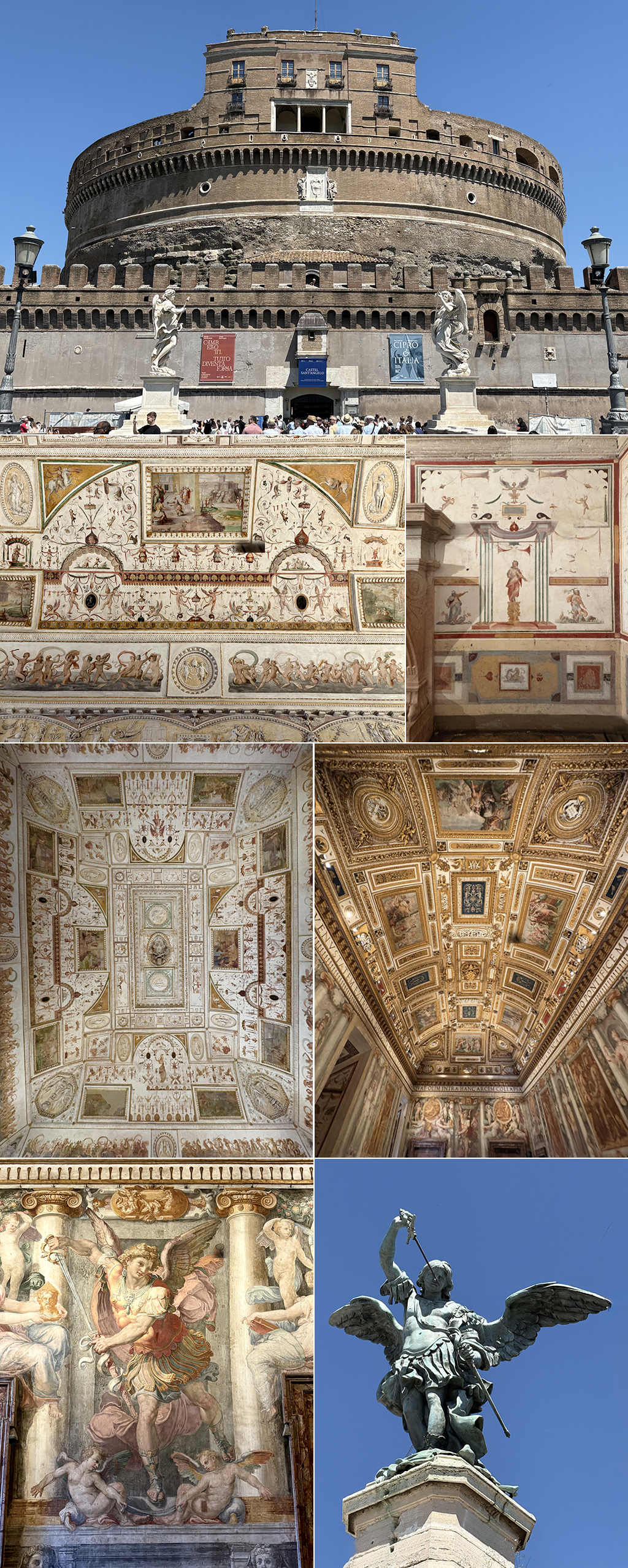
The Castel Sant’Angelo is perhaps the oldest of the palazzi we visited, and most would not even consider it a palace. It was built between the years AD 134 and 139 as a mausoleum for Emperor Hadrian, where his ashes were placed in an urn in AD 138. But it didn’t remain a tomb. It also served as castle and prison. In 1277, Pope Nicholas III built an emergency escape route — a covered bridge called the Passetto di Borgo — from the Vatican’s fortifications to the castello, where there were apartments for popes who might need them in emergencies. The passetto and apartments were used for such emergencies only twice — in 1494 by Pope Alexander VI to escape the invasion of King Charles VIII of France, and in 1527 by Pope Clement VII to escape the sacking of Rome by Holy Roman Emperor Charles V’s rampaging soldiers. The castle was also used for lavish banquets, and sometimes simply as a getaway. Now, it is a national museum. It includes a gallery of paintings, drawings, etchings, and architectural models of the structure’s history. Visitors can walk the upper parapets, visit several suites of papal apartments added or remodeled by several generations of early and late Renaissance popes, most spectacularly by Paul III (of the powerful Farnese clan), and also galleries with rotating exhibits. The visit culminates in the uppermost terrace just under the immense mid-18th century bronze statue of Saint Michael the Archangel that gives the castle its name. And, as promised, another Tosca reference for you: the final scene from Puccini’s tragic opera takes place there. Tosca, crushed by the news that her lover Mario had been duplicitously shot by a firing squad, flings herself off the battlements of the castello to her death to escape being arrested.
_____________________________
What’s up in the next installment? Everything else — historical sites, street art, visits with friends, and great places to eat. Stay tuned!
Developed and maintained by Inspiratech LLC.
Design by Themeshift.
Eha Carr
July 8, 2026 at 4:17 amMy computer mouse will need a replacement with the amount of up-and-down scrolling about to happen . . . some of this visual wealth I have not personally seen, much is remembered from days bygone . . . the world on this late evening seems a far more beautiful place than seen in earlier hours . . . thank you . . .
David Scott Allen
July 8, 2026 at 9:00 amThank you, Eha. I think that is the best part of blogging – bringing beauty to readers, whether it be art or food, is such a positive thing for me, even at the most difficult times.
angiesrecipes
July 8, 2026 at 4:45 amwow…I don’t even know what to say…you two for sure had a great time. I have never visited a palace..so I look forward to visiting them if I visit Rome.
David Scott Allen
July 8, 2026 at 8:58 amThanks, Angie – they really are spectacular.
Mimi Rippee
July 8, 2026 at 5:40 amGoodness. I’ll have to come back to all of these incredible photos and take another look. It’s almost too much for my brain!!!
David Scott Allen
July 8, 2026 at 8:58 amIt is a rather photo-packed post, isn’t it I hope you get back to enjoy them!
hayley
July 8, 2026 at 6:32 amWhat an exquisite account of all that you saw. I greatly enjoyed reading it and looking at all the fabulous photographs you took. Remarkable. Thank you.
David Scott Allen
July 8, 2026 at 8:57 amThanks, Hayley – I am glad you enjoyed it. The hardest part was choosing just a few photographs for each palazzo. There are so many more of each!
Kim Murphey
July 8, 2026 at 6:57 amYour photographs are stunning. I haven’t been to Rome in decades and this display has reawakened me. Thank you.
David Scott Allen
July 8, 2026 at 8:56 amThanks, Kim – I am so glad you enjoyed the post and hope it helps get you back to Rome soon.
Frank | Memorie di Angelina
July 8, 2026 at 7:14 amWow, a veritable hit parade of all my favorite palazzi in Rome! (And not just mine, obviously, lol!) And the best part is that, apart from Castel Sant’Angelo and the Galleria Farnese, they aren’t generally overrun with tourists. You have to wonder why since as your photos so beautifully show, they are all spectacular.
I got to see the gardens behind the Palazzo Colonna for the first time a couple of years ago. It wasn’t open to the public in my day. And Isn’t funny to see The Bean Eater there? It seems so out of place among such splendor.
And PS I’m so jealous that you got to see the Bernini exhibit!
David Scott Allen
July 8, 2026 at 8:55 amCastel Sant’Angelo was packed, as you say, but there were very few people in the Farnesina, which amazes me. The Borghese and the Barberini were quite crowded but not in such a way that was annoying.
The gardens at Palazzo Colonna had just reopened five years ago when we were there. I think it was Mark’s favorite part of the visit!
I wish you could have seen the Bernini exhibit — I am glad we got the extra set of tickets to do so.
Barb
July 8, 2026 at 7:25 amSTUNNING!!!
David Scott Allen
July 8, 2026 at 8:52 amThanks, Barb!
Fran @ G'day Souffle'
July 8, 2026 at 7:51 amAmazing amount of work you’ve done here! It amazes me how realistic the sculptures are and you’ve got to be quite talented to sculpt someone with a beard!
David Scott Allen
July 8, 2026 at 8:52 amThe sculpting of the beards, hair, and fabrics has always amazed me, Fran. Glad oyu liked the post!
Janet Foster
July 8, 2026 at 8:10 amThank you, David, for this spectacular revisit to a city so rich in history, art, architecture, beauty and life. You hit all my favorites, too numerous to include. Your post has energized my lazy summer indoors here in Tucson while waiting for the rains. Bravo!
David Scott Allen
July 8, 2026 at 8:51 amThanks, Janet. It is fun to share these memories that bring back memories for my friends. Yes, please bring on the rains!
Vance Morgan
July 8, 2026 at 12:38 pmI just completed your trip to Rome. I don’t have the right words to express my pleasure, except to say that I had some of the same emotion as when Anne and I traveled – it is one of being homesick. Not that we were not happy to return to the US, but because we realized how much we miss what we saw and experienced.
Vance
David Scott Allen
July 8, 2026 at 8:29 pmVance, that is the sweetest comment and it perfectly sums up the way we feel when we leave Rome. It’s so nice that it reminded you of your visits with Anne.
Mad Dog
July 8, 2026 at 5:46 pmI think you’ve outdone yourself this time! …and there’s a portrait of Henry VIII.
David Scott Allen
July 8, 2026 at 8:30 pmThanks, Mad Dog. I have to say that we were shocked when we saw the portrait of Henry VIII! Especially that it was painted by Holbein.
CC
July 10, 2026 at 1:27 pmOne word: incredible. The paintings are absolutely awei-inspring, but for me, it’s the sculptures that do my head in! I can’t even do a fondant Winnie the Pooh to save my life! haha! We had a mini of the discus thrower in our house when I was growing up, and my parents had it until 4 years ago. Now I need to add these places to my google map! Thanks, David, so glad you were able to see so much!
David Scott Allen
July 11, 2026 at 2:04 pmThe Bernini sculptures truly blew my mind — I’m so glad we saw so many!
Raymund
July 14, 2026 at 3:01 pmThis I Palazzi post is such a vibe, like taking a slow, luxurious wander through Rome without having to deal with the crowds or the heat. All those palazzi, frescoes, sculptures, gardens… it’s basically architectural dessert. I love how you describe each place with that mix of genuine awe and “yep, we spent hours here and would do it again,” because honestly that’s exactly how Rome gets you.
And the photos? Unreal. It’s the kind of post that makes me want to book a flight, grab a gelato, and pretend I’m the sort of person who casually spends afternoons staring at Bernini sculptures. Totally loved this one.
Inger
July 23, 2026 at 5:19 pmThese photos are so stunning (as always) David! You were so smart to do the long trip!
David Scott Allen
July 24, 2026 at 5:08 pmIt is almost the opposite of what we should do as we age — but the more I travel the more I want to stay places longer and really dig in!
Sherry M
July 29, 2026 at 8:28 pmso many amazing sculptures! We went to the then Villa Borghesi after a crazy train (?) ride i think, then walking all across the huge park. We had a Fodor’s travel guide which had many many insane directions to various places in Rome. I think they had done it on purpose! so we ended up going to all sorts of crazy places and walking for miles when there were just regular buses around the place!! Very deliberate i think!
sherry
David Scott Allen
July 31, 2026 at 8:35 amThat is crazy. Mark remembers something similar when he was there in 1974!
Marian Jensen
August 14, 2026 at 8:57 pmWhat a post, David! Your photography and comments are wonderfully detailed, and you’ve visited many of my favorite sites.
I have a small photo of Borromini’s Perspective in a powder room (!) to remind me that things aren’t always as they seem. Also, we have a photo of Bernini’s Rape of Proserpina in our living room. My Mark moved his camera to intentionally blur Hades’ fingers pressing into Proserpina’s thigh. The violence and sadness still can’t be softened.
Have you and Mark visited the Galleria Doria Pamphilj? The collection is fantastic and the audio-guide excellent. There’s a Caravaggio there (Rest on the Flight Into Egypt) that Mark should add to his list if he hasn’t already seen it.
Thanks for all your efforts with these posts. I’m loving them!
David Scott Allen
August 15, 2026 at 1:15 pmThanks, Marian. Sometimes the burning sculptures are rather violent in nature. But they do match the stories… Yes, we have been to the Galleria Doria Pamphilj. Not this time, though. I wish they had allowed us to take photographs inside, but I’m pretty sure we did see the Caravaggio! We will make sure it’s on our list for next time so that Mark can add it to his list.
Marian Jensen
August 16, 2026 at 2:35 pmWe were able to take photos on our 2020 visit, but I can’t remember about our prior visits. The Galleria Doria Pamphilj has such an outstanding collection. I’m surprised it’s not busier. That said, many of Rome’s most exquisite sites are uncrowded once you get away from the Vatican Museums and the Colosseum
David Scott Allen
August 16, 2026 at 4:13 pmI double checked back on my photos (2011) and no photos of the Pamphilj or the Corsini — both we “no photo” zones. Next time! Yes, once you get away from the Vaticano and the Colosseum, the crowds are pretty minimal!