Wild Thing.
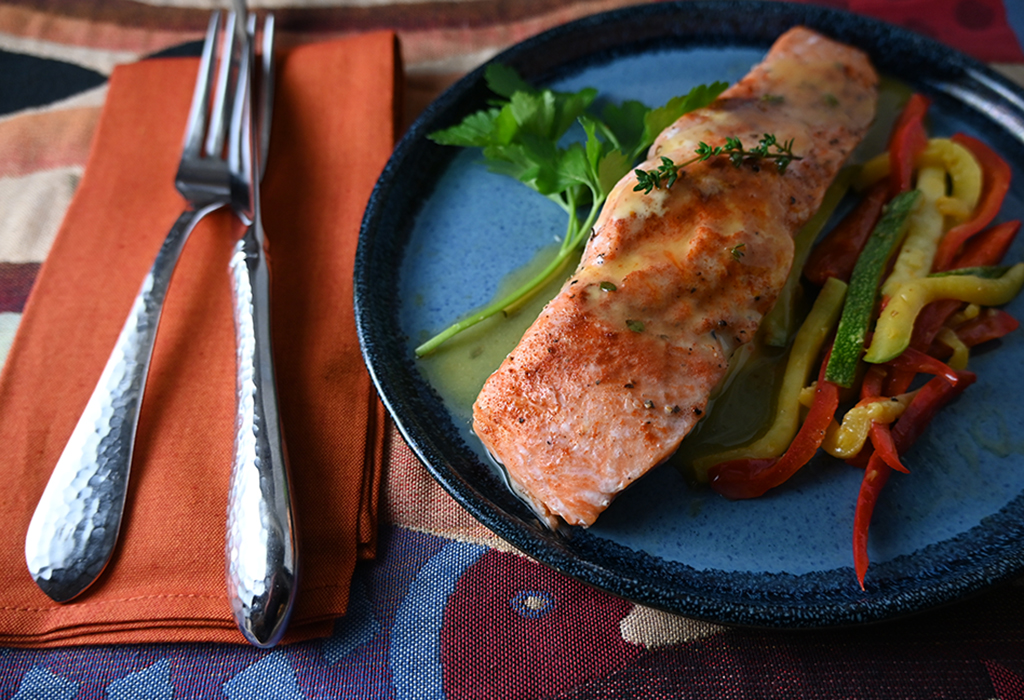
I have to be honest. I have never (until very recently) been a fan of wild salmon. Of course, I know all the downsides of farmed salmon, and I try to make the best choices by buying Norwegian or Scottish salmon. However, I know all the health benefits of wild salmon, as well, and really wanted to find a way that would make me like it. My biggest issues have been that it feels mealy in my mouth and it doesn’t have the rich, fatty qualities of farmed salmon.
Then, thanks to Ali Slagle at The New York Times, I discovered that I had been cooking it all wrong. Brining it briefly then roasting it “low and slow” is the way to go. I headed to White Cane Salmon at the farmers market and picked up several portions of wild Alaskan king salmon to serve with a beautiful Provence white wine; read more on theProvence WineZine. I chose to finish my salmon with a Meyer Lemon-Thyme Beurre Blanc. I hope you enjoy it.
~ David
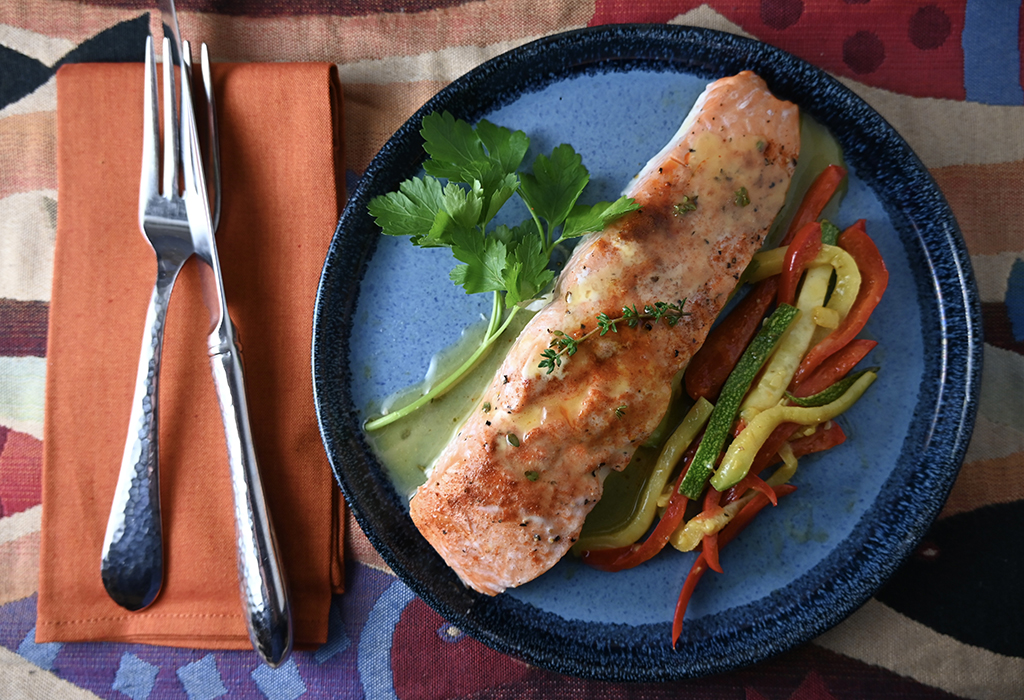
Roasted Salmon, Meyer Lemon-Thyme Beurre Blanc
David Scott Allen, Cocoa & Lavender
- 2 tablespoons kosher salt I use Morton’s, plus extra
- 4 8- ounce portions wild king salmon
- 1/4 cup white wine
- 1/2 cup strained Meyer lemon juice
- 1 shallot peeled and quartered lengthwise, root end intact
- 6 tablespoons plus 4 teaspoons cold unsalted butter divided
- 1 tablespoon fresh thyme leaves plus sprigs for garnish
- freshly ground black pepper
- sweet paprika
Stir together 2 tablespoons of the salt and 4 cups water in an 8-inch square baking dish until the salt has dissolved. Remove the skin from the salmon, and add the portions skinned side up. Let sit at room temperature for 15 minutes while you prepare the beurre blanc.
Place wine, lemon juice, and shallot quarters in a small sauce pan. Season with salt. Bring to a boil, reduce heat, and simmer briskly for approximately 7-8 minutes, or until liquid has reduced to about 2 tablespoons; it will look syrupy. Scoop out and discard the shallot quarters. Set the reduction aside.
Heat the oven to 275°F.
Drain and pat the salmon dry. Line a baking sheet with parchment, then add the salmon skinned side down. Place two 1/2 teaspoon slices of butter on each portion. Season with black pepper and a sprinkling of paprika.
Roast for 18 minutes in the upper third of the oven, then turn on the broiler for a minute or two to give it some color.
Towards the end of the roasting time, reheat the wine-Meyer lemon reduction over medium and, when gently bubbling, add the 6 tablespoons cold butter, one at a time, whisking constantly to emulsify the sauce. After the final tablespoon of butter has been added and emulsified, toss in the thyme leaves and stir.
Place the salmon fillets on four separate plates with vegetables and spoon the beurre blanc over the salmon. Garnish with a thyme sprig, if desired.
Serves 4.
In this version, I remove the salmon skin before brining and cooking. While leaving the skin on has benefits, slow-roasting with the skin-on produces a visually unappealing plate, and the skin is very difficult to remove once cooked.


Eha Carr
March 7, 2026 at 3:38 amDavid – this is absolute perfection . . . said with green-eyed jealousy from my side of the Pond as we unfortunately farm most of ours under hugely adverse conditions in Tasmania. Love the salmon . . . pretend we are not aware of the damage the pens do to the environment and the wrongly fed fish to our health. Love your recipe with the tad of thyme and paprika to give extra flavour . . . served beautifully . . .
David Scott Allen
March 9, 2026 at 11:11 amThankls, Eha. I recently (today) read an article about salmon and it stated that not all farmed salmon is bad. Look for the Aquaculture Stewardship Council and Best Aquaculture Practices logos — their farming practices are good.
FEL!X
March 7, 2026 at 4:37 amBrining it briefly then roasting it “low and slow” is the way to go – that’s what I always do!
I prefer to do it in a pan (Wok), so I can really see when the skin becomes crispy, then it’s the time to flip it!
David Scott Allen
March 9, 2026 at 11:10 amThanks, Felix.
Mad Dog
March 7, 2026 at 4:58 amThat looks delicious! I’ve been poaching salmon in home made shrimp stock recently, which turns out very well.
David Scott Allen
March 9, 2026 at 11:10 amPoaching is always a good idea regardless of the type of salmon.
angiesrecipes
March 7, 2026 at 4:59 amHere are mostly just farm salmon…that’s why I don’t eat them as often as before. The white butter sauce sounds fantastic!
David Scott Allen
March 9, 2026 at 11:09 amThanks, Angie. I just read an article that shows that not all farmed salmon is bad Look for the Aquaculture Stewardship Council and Best Aquaculture Practices logos — the salmon is responsibly farmed.
Carolyne
March 7, 2026 at 7:49 amI am going to try this! Normally, I roast salmon at high heat for 10-12 minutes. The results vary…
David Scott Allen
March 9, 2026 at 11:08 amThanks, Carolne. That was my method for Atlantic salmon — but I love the results of low and slow for wild salmon.
Barb
March 7, 2026 at 8:27 amI always buy wild salmon and brine it. Alaskan King is definitely the best salmon! I cook it skin side down in an oven proof skillet using fairly high heat for two minutes to crisp the skin for easy removal. I then transfer it to the oven to finish cooking at a low temp. I make a similar Beurre Blanc except I don’t use thyme, but I will try adding it next time, as it sounds good and certainly adds some color. If I don’t have a Meyer lemon and have to use a regular Lisbon lemon I sub Marsala for the white wine. The Cuvée Hortense sounds perfect for this dish! If only I had some King salmon left in the freezer I would be cooking it tonight, but alas, I’ll have to wait a couple months for it to come back in season. As always, you plated it beautifully!
David Scott Allen
March 9, 2026 at 11:08 amThanks, Barb — I really want to try your method of searing it then finishing in a low oven. If I don’t jave Meyers, I use half Lisbon and half orange juice, and it makes a perfect semblance of Meyer. I wish we could get the Cuvée Hortense in this country. It was a lovely pairing.
Mimi Rippee
March 7, 2026 at 9:04 amI have never thought to brine salmon! This is brilliant! Can’t wait to try it.
David Scott Allen
March 9, 2026 at 11:04 amThanks, Mimi – it really is worth trying!
Colette
March 7, 2026 at 9:37 amWow.
Just
W
O
W
David Scott Allen
March 9, 2026 at 11:06 amThanks, Colette — I really appreciate you!
Gerlinde de Broekert
March 7, 2026 at 11:56 amI have been making a recipe from Cook’s Illustrated where you brine the salmon and then cook it with the skin on without any fat. It comes out quite nicely. I like eating the salmon skin. Have a great weekend, David. I love your sauce.
David Scott Allen
March 9, 2026 at 11:04 amI like the skin when it is crispy, not soggy as is produced by this method. I am willing to forgo the skin for this perfectly cooked fillet!
Sherry M
March 7, 2026 at 7:16 pmnope never had wild salmon; i’ve never seen it in the shops, and doubt that we aussies can even get hold of it – but who knows? I do love farmed salmon, tho it is bad for the environment… sigh why is everything delicious bad for us and/or the environment? 🙁
David Scott Allen
March 9, 2026 at 11:03 amThanks, Sherry. I just today read an artole that not all farmed salmon is bad. There is some that meets ecological criteria for being responsibly farmed. The article said to look for the Aquaculture Stewardship Council and Best Aquaculture Practices logos. That was good news for me, as there are several places near me that have salmon that meets the criteria.
Carol
March 7, 2026 at 10:23 pmWild Salmon is something I can get here …All salmon is imported there is no salmon farmed in Thailand because of the heat…unfortunately it is difficult to get Meyer lemons here, a lovely recipe and beautifully presented, David.
David Scott Allen
March 9, 2026 at 10:59 amI am glad you can get wild salmon, Carol. As for the Meyer lemon, using half regular lemon and half orange juice will produce a similar effect.
Karen (Back Road Journal)
March 8, 2026 at 2:07 pmI’ll have to try the brining, it certainly does make a difference on pork and chicken. Thank you David.
David Scott Allen
March 9, 2026 at 10:58 amYes, indeed Karen — I love brining chicken breasts and pork chops/tenderloins. It makes such a difference.
Marcelle
March 9, 2026 at 8:02 pmWe have been on a salmon kick here in the last few weeks, well, a seafood kick in general, really. It turns out Emery really likes fish so we’re leaning into that a little bit 🙂 I will have to check our grocer’s seafood department for fresh-caught salmon, they always have a few varieties on the ice. I’m anxious to experience the difference. This recipe will be on our list to try soon, it really looks so good, David!!
David Scott Allen
March 11, 2026 at 7:54 amThanks, Marcelle I am so glad to hear Emery likes fish and seafood — how fun for you, as the cook! (I hope everyone else likes it, too!) I hope you get to try this and that you like it!
valentina
March 9, 2026 at 8:30 pmI’m definitely trying this method for wild-caught salmon next time! Like you, I haven’t loved it as much as farmed in the past, so really look forward to this. And of course, even better with your luscious beurre blanc! 🙂 ~Valentina
David Scott Allen
March 11, 2026 at 7:55 amI ma glad I am not the only one, Valentina — I think I might still love Atlantic salmnon more and now, after reading an article, know how to choose responsibly farmed Atlantic salmon.
Valentina
March 31, 2026 at 7:18 pmDavid, I just tasted the wild salmon I pulled out of the oven using this technique, and it’s SO GOOD! I followed the instructions exactly. I can’t believe how just 15 minutes in the brine changes it completely. 🙂 ~Valentina
David Scott Allen
April 1, 2026 at 8:03 amThanks, Valentina — isn’t it amazing? I was so thrilled to learn this trick and will never do salmon differently again! (Well, maybe…)
Jeff the Chef
March 10, 2026 at 6:32 amThat is a beautiful piece of salmon!
David Scott Allen
March 11, 2026 at 7:55 amThanks, Jeff!
Pauline
March 11, 2026 at 1:15 amAS my Aussie friends above have said, it’s mainly farmed salmon for us, but I’ve noticed the frozen salmon which I now buy sometimes as a more economical option is from Norwegian waters, and quite acceptable to eat. I love your beurre blanc, perfection on a plate. I’m looking forward to making it.
David Scott Allen
March 11, 2026 at 7:56 amThis beurre blanc will work with any perfectly-cooked piece of salmon, regardless of its provenance. 🙂
Ben | Havocinthekitchen
March 14, 2026 at 4:31 pmThis roasted salmon with lemon and thyme sauce looks wonderful, David! such an elegant and flavourful combination.
David Scott Allen
March 15, 2026 at 12:50 pmThanks, Ben. I was really happy with the recipe.
Raymund
March 19, 2026 at 12:42 pmI love how honest you are about wild salmon, I’ve had the same struggle with the texture, so this brine + low-and-slow method is a revelation. BTW have you tried NZ Salmon, yes they are farmed but its like the wagyu of the salmon world, layers of healthy Omega 3 fats
David Scott Allen
March 19, 2026 at 1:24 pmI was relieved when someone sent me an article about the different types of wild and farmed salmon, and what to look for for both types. Raymund, I would love to try NZ farmed salmon. I wish it were available here. I will keep my eyes open for it!
Inger
April 1, 2026 at 5:03 pmAh, if you heard people complaining about the “salmon lice” in Norway, it might help your resolve. I think king salmon is the best (aka fattiest) of the wild so I’m sure that helps. Lately I have been beer batter frying wild keta salmon as a good way to use something less expensive and tell myself a fish fry can be healthy 😉
David Scott Allen
April 3, 2026 at 11:06 amPerhaps I will stick to Scottish fish, then! I do love King salmon – we are having it several times in the next week or so. I am trying one of my Indian recipes with it.